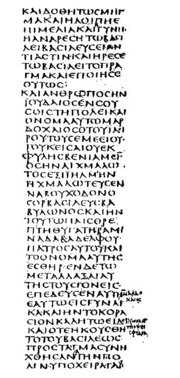
 146 year ago today, Aleph was found.
Aleph is the first letter of the Hebrew alphabet. It is also the symbol used to designate Codex Sinaiticus, which is the Aleph found in 1859.
Codes Sinaiticus is a fourth-century uncial manuscript of the entire Greek New Testament (as well as parts of the Old Testament and other works).
(An uncial manuscript is one written in all capital letters, which is basically what all manuscripts were before the invention of lower-case letters.)
Codex Sinaiticus is one of the two most important manuscripts in New Testament textual criticism (the study of which variants in New Testament manuscripts were most likely in the original–now lost–documents). The other most important manuscript is Codex Vaticanus.
Sinaiticus was found by Constantin von Tischendorf in a monastery (the Monastery of St. Catherine) at the ostensible site of Mt. Sinai (hence the name) in Egypt.
The text to the left is taken from Codex Sinaiticus.
(Incidentally, a codex is the modern form of a book that we use today, with pages attached to a spine, rather than the older form of book with pages dewn end-to-end, making a scroll. Christians popularized the codex or modern book.)
Codex Sinaiticus helped revolutionize the study of the textual history of the New Testament.

Jimmy,
Speaking of textual variants, has the Church issued any judgements on which versions are the definitive articles?
Jack
I’m not aware of the Church making any specific declarations on textual versions of the Bible, other than the endorsement of the Latin Vulgate back in the 1500s. But that wasn’t an endorsement of the Vulgate’s textual readings — rather, it was an affirmation that the Vulgate contains no errors in matters of faith and morals.
One can also make a case that, given the Church’s long history of liturgical use of the Greek Septuagint Old Testament and the koine Greek New Testament, that the Church has de facto blessed those versions. But again, that wouldn’t constitute an upholding of the specific textual readings of those Greek Bibles.
Jimmy –
For the last few weeks, I’ve been studying different Eastern ECF’s relationships to the Roman See, and this post on found documents made me wonder
if there have been any recently found patristic documents in the last quarter of a century? I wouldn’t even know what kind of scholarly journal would carry such a thing.
Wouldn’t it be great if some monastery in Bulgaria had a letter from the Apostle John that began, “To Clement, infallible bishop of the supreme juridical See of Rome, greetings in Our Lord Jesus Christ who has now seen fit to assume his immaculate Mother into heaven, body and soul, by the working of the Holy Spirit, who proceeds from the Father AND the Son”?
Of course I’m not Jimmy, but here are some of my own thoughts on this. I’m not “up” on the latest in the editing and publishing of newly-found patristic writings, but I’ve been told that most ancient Christian writings have never been translated or published in any language. But I do believe all of the very earliest patristic literature (the Apostolic Fathers) have been translated and published. As for a more “recent” discovery, it was in the 1930s that St. Melito of Sardis’ homily “On Pascha” was discovered. But I don’t of very many more recent discoveries.
As for your imaginary letter from St. John to St. Clement, if it did begin with those words, it would immediately be rejected as a forgery due to the anachronisms (such as the words “infallible” abd “juridical”) and the conspicuous grouping together of several Catholic distinctives. Christian doctrine and vocabulary has developed over time, and in the late first century the Church’s way of expressing her faith in Rome’s primacy and infallibility, in the Blessed Virgin’s assumption, and in the double procession of the Holy Spirit, were quite different from the way the Church expressed her faith in the 500s A.D. or the 1800s or 1900s. There are, however, enough indications from the earliest Christian writings to show that Roman primacy and infallibility has always been a part of the faith, even if not plainly stated in so many words as a formal doctrinal declaration (see St. Clement’s letter to the Corinthians and St. Ignatius’ letter to the Romans just for starters). And one can find something similar for the other doctrines you mentioned.
Greek English New Testament
At the moment, an English translation directly below each Greek Print the