A reader writes:
Do you know of a place I can go to get an authoritative definition of the Aramaic word Kepha (Or however you would transliterate Simon Peter’s Aramaic name meaning rock). I am in an online dialogue with some folks who say that Kepha in Aramaic means hollow rock and therefore would not be a suitable foundation for a Church. Therefore, Jesus could not have said, "You are Kepha and upon this Kepha I build my Church."
This website seems to agree with the "hollow rock" definition.
http://www.htmlbible.com/sacrednamebiblecom/kjvstrongs/FRMSTRHEB37.htm
Okay, two problems:
- The page you reference is an online version of Strong’s Hebrew Dictionary. Now the thing about Strong’s is, it’s not a scholarly dictionary. It gives brief glosses on words and is based, frankly, on outdated scholarship and has a lot of flaws. I really wish people would stop trying to appealing to it in apologetic controversies, because it’s simply too unreliable to try to get precise nuances out of. Unfortunately, it’s old enough (outdated scholarship, remember?) that it’s a public domain text and so it’s all over the Internet and people cite it constantly.
- You’ll note that the word in question (#3710) does not have "(Aramaic)" at the front of the definition (compare it, for example, to #3706). That tells you that the dictionary is attempting to offer a definition for the Hebrew word keph. Now the thing is: You can’t rely on a definition of a Hebrew word to tell you what an Aramaic word means. Hebrew and Aramaic may be cognate language, like English and German are, but you can’t use words in one language as a sure guide to the meaning of similar-sounding words in the other. The German word bitte sounds like the English word bitter (especially in a non-rhotic English accent that drops the final /r/), but they mean very different things. (Bitte means "please," not "acrid tasting.") In the same way, you can’t appeal to the definition of a Hebrew word as a reliable method of determining the meaning of an Aramaic term. So even assuming Strong’s is right on the meaning of the Hebrew keph, that can’t be used to settle arguments about the meaning of the Aramaic kepha.
The reader continues:
I have seen a translation of the bible into Aramaic where they used Kepha for Simon’s new name AND for the rock that Jesus builds His Church, but I was hoping to find some sort of Aramaic Dictionary that I can easily obtain that has a definition closer to "big rock".
I can help you here, but I have a caution: I’d drop the "big rock"/"small rock" thing. While this distinction existed in at least one dialect of classical Greek several centuries before the time of Christ, the distinction was gone by the first century. It is also exceedingly hard to recover something like size distinctions at this remote date in history since we can’t survey a swath of native speakers to ask them to clarify their usage. From what we can tell now, petros, petra, and kepha all just meant "rock" in the first century, and it isn’t productive to try to argue size differences one way or the other.
That being said, the most exhaustive Aramaic-English dictionary that is commonly in use today is A Compendious Syriac Dictionary (Syriac is a major Aramaic dialect) by R. Payne Smith, which was edited down from a longer work (Thesaurus Syriacus) by his daughter, J. Payne Smith.
So. . . . Here’s the definition for kepha in Smith:
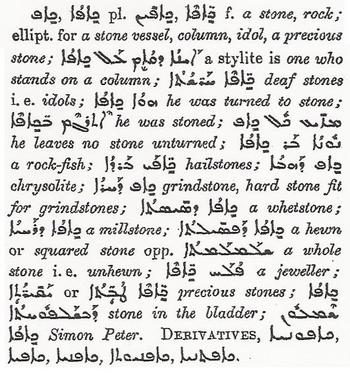 Now, you may not be familiar with the Aramaic script that the dictionary uses, but you should be able to see that the basic meanings of the term are "a stone, rock."
It is also used elliptically (i.e., as shorthand) for "a stone vessel, column, idol, a precious stone." This means, for example, that speakers might be referring to a stone cup (a kind of vessel) and say, "Hand me that stone."
From there the entry starts to give examples of the term used in phrases ("he was stoned") and compound constructions ("a millstone").
As you can see, though, in no case is a definition anywhere close to "hollow rock" given, either for the term itself or for anything else the entry covers.
The idea that kepha means "hollow rock" is simply bogus.

And even words derived from the same source in related languages can have diverged in meaning. For example the German word “Tier” and the English word “deer” are descended from the same earlier Germanic word, but “Tier” means “animal”, while “deer” is obviously a very specific type of animal. Similar pairs are “Hund” (meaning “dog”) and “hound”, and “sterben” (meaning “to die”) and “starve”. So even if Hebrew “keph” and Aramaic “kepha” are related, there may have been changes in shades of meaning between the two.
Best of all — English “black” and French “blanc” are derived from the same root word!
(English “blank” is also from it — so it might mean the mutations of “devoid of color”)
Jimmy,
I like the other definitions. Vessel and column both support the “foundation of church” interpretation. A column is obviously a support, and a vessel – wow. Something that is used to hold another thing…could it be perhaps… the Holy Spirit!? Especially looking at Peter’s model of servant leadership, the view of the papacy as a vicarage, and even the concept of ’emptying oneself’.
Anyway, that (vessel) may be where the ‘hollow rock’ idea comes from? Even so, I think that particular analogy supports, rather than detracts from the idea of Peter as a foundation.
I was looking at the Septuagint recently, and I noticed that in Isaiah 22 (which is the Old Testament reference of the event at Ceasarea Phillipi in Matt 16 of course) and I noticed that when God is expressing his anger at Shebna he says, “What have you to do here and whom have you here, that you have hewn here a tomb for yourself, you who hew a tomb on the height, and carve a habitation for yourself in the rock?” (Isaiah 22:16)
Shebna angered God for carving “a habitation for yourself in the rock.” The Greek word there in the septuagint was petra. Jesus desires to build his habitation on a petra, and he changes Simon bar Jonah’s name to Petra (well Petros since Simon ain’t no girl). Coincidence?
Brian
P.S. Thanks Jimmy!
hey jimmy,how about this one…kepha means to bind or forbid(asar) and peter means to loosen or permit (hitir).so here we have simon bar jonahs 3 names. first, theres simon son of john, the natural man. but we are all born into sin, so we are bound by it,kepha(unforgiven) and to be released or loosened by knowing the messiah, jesus,we are forgiven, peter.
Hi Jimmy , i have been searching for sometime to find my name Peter written in Aramaic and joined up if possible but to no avail ! could you please help ? kind regards Peter
Hi Jimmy , i have been searching for sometime to find my name Peter written in Aramaic and joined up if possible but to no avail ! could you please help ? kind regards Peter
My understanding of the name, Kepha, is that it translates as hallowed rock. It has also been indicated that this type of rock was useable as a vessel for water. With this in mind, it is an appropriate name for an Apostle of Christ, the Living Water, yet it is not in any manner proof that Peter is the foundation of Christ’s church. If any other knowledge is necessary about which church is The Church of Christ, simply use the example, “A tree is known by the fruit it yeilds.” It does not take much more to weed out any apostate church.
Jack Rook,
Where God builds a Church, the Devil puts up a tent. Where there is great good, as there is in the True Church, great evil is at its heels.
Jack Rook,
Where God builds a Church, the Devil puts up a tent. Where there is great good, as there is in the True Church, great evil is at its heels.
Assertions are not arguments. Jimmy spent some time debunking the very notion you put forth; if you want to argue the contrary you need to put forth arguments, not just assertions. In lieu of that, it is my understanding that “kepha” is the ordinary Aramaic word for “rock.”
No, the subsequent words of Matthew 16:18, “Upon this rock I will build my church,” are that — as the solid majority of Evangelical, Protestant and Eastern Orthodox biblical scholarship now admits.
And what is “fruit”? Good works. The Catholic Church, with its hospitals, missions, charities and schools, does more good works than all the fragments of Protestantism combined.
You seem not to know the meaning of the word “apostate.” Although many anti-Catholic rhetoricians use the term “apostate” to mean “really bad heresy,” in fact it refers not to false teaching about Christ, but to total repudiation of Christ. Julian was an apostate; Arius was only a heretic.
The Catholic Church confesses the Holy Trinity, the Deity and Humanity of Christ, the Crucifixion the sole meritorious cause of our justification, the Resurrection, the Ascension, the Second Coming. Whatever theological differences any anti-Catholic may have with the Church, the term “apostate” can never be more than overreaching false rhetoric.
False witness against your neighbor is a sin. Do not accuse your neighbor of denying Christ, who confesses Him and clings to Him for salvation.
The word P’shitta means Pashat or simple i.e. plain meaning , which distinguishes it from the more complex meaning of allegory such as in Origen’s Hexpala often marking addions to the Septuagiant with an oblisk. In Rabbinic Judaism we use a Hebrew word Pardes, meaning orchard. It is an acroynm for four levles of Torah interpatation. They are as follows Pashat(Plain, or literal meaning) Ramez(interpated meaning) Drash(Searched meaning like the Midrashic interpatations of the rabbis and last sod(secret meaning) often hidden as in Qabalistic interpatation. All four levels apply to the interpating of the Torah in rabbinic tradition. I however do not necessarly agree with the traditon being a believer in Jesus Chirst as Master and God Incarnate. Jesus usually agrees with the plain literal meaning based upon the context being used. This the P’shitta represent the best Syrian Aramaic traslation of the Hebrew, Chaldean and Greek texts of the Christian Bible of its time. However Jewish Aramaic has some differences from Syrian Aramaic and even from the Aramaic of Jesus in his day, None of the existing Aramaic languages fully represent the First Century Jewish Aramaic of Galliean Jews of Jesus day. Sam P’s; Pashat is Hebrew not Aramaic, but closly related I think to the word P’shitta. Sam