 Y’know those southwestern paperweights that have scorpions encased in clear acrylic?
I used to have one of those when I was a boy.
It was cool, but creepy, having that scorpion there under the plastic–looking like it was poised to strike.
I’ll probably buy one again next time I run across one–probably at a place that sells knick-knacks in the desert southwest.
But I’ll make sure not to break it open.
Why?
You may have a LIVE scorpion on your hands.
Y’see: There were these paleontologiests in Utah (a rich site of dinosaur fossils) who were encasing a dinosaur fossil in plaster, and apparently they also encased a live scorpion in the plaster.
Flash forward fifteen months and they’re taking the plaster off the dinosaur fossil (with jackhammers), and out of one of the cracks wriggled the trapped scorpion.
It had been in there for over a year without food (insects), water, or air. (Well, maybe a little air was trapped in or seeped through the plaster.)
Turns out that scorpions can do this kind of thing. EXCERPT:
Scorpions, which eat insects, are capable of surviving for months without feeding or moving in a sleep period known as diapause, said Richard Baumann, a Brigham Young University zoologist.
Interestingly, a form of diapause also occurs in mammals, though only at the embryonic stage.
In any event, the scorpion thing is creepy, okay?
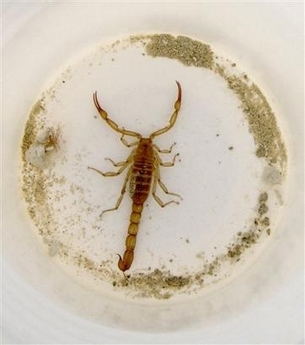
That’s a picture of the little guy who survived–at the bottom of a bucket after he was freed from the plaster.
He was later set free to go live out the remainder of his interrupted scorpion life in the wild.
Now, maybe the odds are low of getting and breaking an acrylic paperweight with a live scorpion in it.
But I’m not taking any chances.
Incidentally, this puts a WHOLE new light on those SCORPION SUCKERS. Imagine what could happen while you’re licking one of THOSE!

Gee, suddenly icy sidewalks don’t seem so bad…
ummm…. eeekkk.
The high molding temperatures required to melt the acrylic during molding and/or the acrylic monomer/polymer mix should kill the scropion if it was not dead already from the inerting insecticide.
Jimmy, I think we have those at the Cherokee Trading Post- a kind of a kitschy tourist spot in Oklahoma. They sell stuffed rattlesnakes and they make buffalo burgers, too. The next time I’m driving by, I stop in and get you a scorpion paperweight.
Um . . . is that a 5 gallon bucket? ‘Cos, if so, that’s no “little guy”!
Bet it scared the willies outta the folks who were knocking the plaster off the dino bones!
What are little boy’s made of…snips and snails and puppy dog’s tails, that’s what boy’s are made of…well, I guess males were created from dirt afterall, that must be why so many of you find creatures like this so fascinating 😉
I was watching that Australian guy on the TV the other week, y’know, the man who is a crocodile hunter or something, anyway, he went in search of the most dangerous snake on the face of the earth…when he found it he proceeded to lay down on the ground and let it fan his face with it’s tongue…how wierd is that?
God Bless.
I saw that yesterday, creeped me out too.
Chris
http://amateureconblog.blogspot.com/
Personally, I’d like a pair of moose nugget earrings to wear while I eat my scorpion sucker.
“Imagine what could happen while you’re licking one of THOSE!”
You might get hungry and want some more. In some parts of China they do eat live scorpions.
http://www.pulseplanet.com/archive/Apr99/1854.html
I’ve got a friend who’d vacation in Morocco and buy up tons of plastic-encased scorpion keychain souvenirs, and come home and sell them on eBay. Those things sold like crazy! *barf*
I have a scorpian in acyclic, it is over ten years old. You suppose I am safe, should it crack? After all the experts said it could live months like that, not years?
Scorpions are not all that bad.
My elementary school mascot was the Scorpion. During recess, some of us would hunt them down near the far edge of the playground and catch them barehanded (they were being ousted from their homes by some construction). No one ever got stung (not that I recommend the activity). We were allowed to keep them in a jar until the end of recess when the monitor would throw them as far as possible past the fence.
Apparently some scorpians have a better shot at surviving its stay in plaster than a pre born does its stay in the wrong womb.
Apparently some scorpions have a better shot at surviving its stay in plaster than a pre born human does its stay in the wrong womb.
My boss had one of these. I kind of wish I’d knocked it over now.
That’s creepy. A co-worker goes to Arizona on vacation often, and she always reminds me that while they’re there they check their shoes before putting them on…each and every time.
And they turn on the beside lamp in the condo they use because scorpions can show up in houses.
I don’t like bugs or stingy things…
Contemporary office furniture.
Contemporary office furniture suite. Contemporary office furniture.