Okay, I don’t really have a #2 planned for this series, but you never know.
Here’s what happened:
On my roadtrip to Texas last week, I took along some low-carb food in case I had trouble finding it on the road (in the sense of restaurants; I’m not talking about roadkill!). Among the things I took was a carton of low carb milk that I had opened and didn’t want to go to waste. I could take this because the carton in question had a screw top cap and so wouldn’t leak all over the place.
So, over the next day, I finished the container of low carb milk and tossed it to one side, figuring I’d throw it away the next time I stopped at a motel.
But before I did so, I noticed that something had happened to the milk carton: It had swelled up and now looked like this: What had caused it to swell up? I wondered.
It couldn’t be the few remaining drops of milk in the carton releasing gasses, I thought. There weren’t enough of them to produce this kind of dramatic swelling.
Then I realized: I’m in an area where the elevations are above 4,000 feet. I bet that’s the reason why the carton bulked up so much.
The air in it from when I finished drinking the milk was put in at a lower altitude and then trapped in there when I sealed the carton.
But the air at that lower elevation was denser and there was more pressure on the outside of the carton from the air surrounding it. Now that I was at a higher elevation, the surrounding air pressure was lower and the carton was expanding due to the pressure of the denser air inside of it.
Or that was my hypothesis.
So I decided to do a little science experiment.
Instead of throwing the carton away, I kept it for another night and looked at it again in Dallas, which has an altitude of less than 500 feet. If my thesis was right then the drop of 3500 feet should cause the carton to de-inflate.
The next night the carton looked like this:
As you can see, it’s un-swelled itself considerably!
In fact, its sides are a bit sucked in now, and this was without opening it or doing anything to release the pressure in it.
In case it’s easier to see the difference, here’s a side-by-side comparison of the two: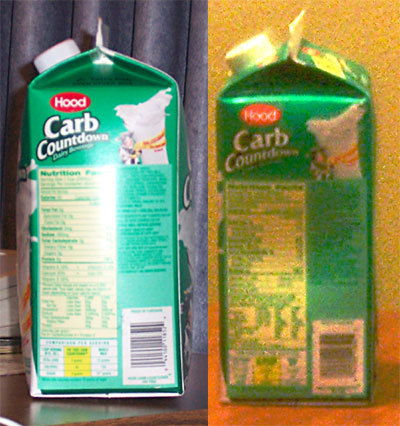
So there you have it! Science is all around us–even when you don’t expect it!
There’s also a bit of relevance here to humans: It ain’t just milk cartons that expand or contract based on the air pressures found at different altitudes. Humans do, too. Our respiratory system is largely open since we’re breathing in and out all the time. Unless we’re holding our breath, our lungs won’t swell up or swell down this way based on rapid changes in air pressure, but other systems in our body aren’t so open: Our circulatory system, for example contains a certain volume of blood that is relatively constant and is used to operating at a particular level of pressure, and the fluids in our tissues don’t go in and out of us as quickly as air does when we breathe in and out. So the blood and other fluids in our bodies will be subject to at least some expansion and contraction the way the air in this milk carton was.
I assume that’s at least part of what’s going on when folks experience

As I sit here with my about-ready-to-deliver pregnant belly — I shudder to think what would happen if I were to suddenly go up a mountain right now!
I guess that’s why they don’t like preggos on planes . . .
It’s a fine line between genius and insanity, that’s all I have to contribute…I’m perplexed trying to figure out which one of these you are Jimmy 🙂
Thanks to your experiment I can, however, deduce an excellent way of appearing slimmer without even trying…just what I like to hear.
I’ll see your theory and raise you a hypothesis.
“It couldn’t be the few remaining drops of milk in the carton releasing gasses, I thought.”
Or COULD it?
A surprisingly small amount of milk could produce a significant amount of gas in this way. As a home brewer, it is fascinating to see how much gas can be produced by natural fermentation.
So, the natural processes of putrefaction on the remaining organic material (milk) in the carton caused the release of gases.
I will try a similar experiment and log the results.
The shrinkage could have been caused by the imperfection of the screw-top seal, which slowly released the pressure.
When I finish milk jugs at home I routinely leave them on the counter until I throw them away later on in the day, and they always experience this swelling – sometimes so much that I’m surprised by the sound of the cap popping off and flying through the air like a popped cork. Obviously no change in elevation here.
My theory is that the cold air in the jug has warmed and therefore expanded, pushing out the sides of the jug.
Could another possible factor be the temperature? Was the temperature the same in Dallas? I tend to agree that it was the altitude though. I’ve noticed the same effect on water bottles that I’ve opened in the mountains. When I get back home to a lower elevation the sides are sucked in.
I have a more extreme example. I usually take bottled water with me when I travel, including on those occasions when I brave seats that are too small and cramped to fly. Well, same thing happens. When I drink the water up at high altitude (20,000ft or more usually) the bottle looks normal. After landing it’s noticeably crunched together, just like the milk bottle.
Looks like altitude to me. I work in astronomy, and when I go “up”, I have to shake my toiletries down in their bottles, or likely experience overspill when I first use them. There’s enough extra pressure to force lotion or shampoo out. Recap at the end of an observing run, go back down, and the plastic bottles are sucked in.
You can also see this after a plane flight (the cabin pressure is noticeably below sea level air pressure, so an imperfect seal yields sucked-in bottles after a flight.)
Same thing with the bends. When a diver ascends too rapidly, little bubbles come out of solution in the tissues which cause pain and decreased function. That’s why deep divers need to ascend slowly and pause periodically.
STP: Standard Temperature and Pressure.
Jimmy’s experiment was on pressure (altitude). The one thing he did not mention were the temperatures involved. More than likely, the altitude changes caused the (bulk) change in the carton condition. Changes in temperaure may have also contributed by a very small amount, but without knowing the temperatures involved, you cannot assume the contribution is zero.
This happens when er fly from Dallas to Mexico City (with a much higher altitude). Before leaving we open all bottles of shampoo and let out sime air. When we arrive they’re perfectly fine since the air has expanded. If we don’t do this, the bottles expand to the point where they pop open and we get shampoo all over our clothes.
One the way back we get the exact opposite effect with bottles.
Very interesting, Jimmy.
I’ve always wondered: is low-carb milk just as good as traditional milk? I’ve always hesitated because milk is my beverage of choice. Fancy restaurant? Milk. Breakfast? Milk. Snack? Milk.
You’ll have to continue this roadside experiment series. Science is fun. Do you happen to be a fan of Mythbusters?
If anyone would like to run some numbers, the ideal gas law is a good place to start:
pV = nRT
where p is the pressure of the gas, V is the volume of the container, n is the number of moles (mol) of gas (those folks who’ve had some general chemistry are cringing right now), R is called the “gas constant” and T is the temperature. If you measure the pressure in atmospheres (atm), the volume in liters (L), and the temperature in Kelvin (K), then R has a value of 0.08206 L atm /(mol K). There’s lots of unit coversion websites out there that can help turn inches of mercury (which is what atmospheric pressure is usually reported in weather reports) into atmospheres.
Now, the ideal gas law is only exact for imaginary (“ideal”) gases where the gas particles don’t attract or repel one another, and the volume the gas molecules take up is vanishingly small compared to the size of the container, but it’s a very good first approximation.
However, since we seem to be mostly just interested in the change, and if we assume that the seal on the container was absolutely tight, then we can write
p_i * V_i / T_i = p_f * V_f / T_f
where p_i is the initial pressure (at the beginning of the trip), V_i is the initial volume, and T_i is the initial temperature. p_f, V_f, and T_f are the final pressure, volume and temperature. If you use this, you don’t have to worry about unit conversions for pressure and volume (use whatever you like), but you still have to enter the temperature in Kelvins.
Using this would help you decide if there was any escape of gases from the milk; the above equation assumes that the amount of gas was constant during the change. If your calculated V_f is much smaller than the measured V_f, then you might start to think that some evaporation was taking place.
I love MYTHBUSTERS!
As far as low carb snacks on the way home, stock up on some good beef jerky. A nice thick piece that still has the drying rope attached should last you from Dallas to El Paso
Your last paragraph about this phenomenon occurring in humans is the very reason athletes, like Lance Armstrong for example, tend to train at high altitudes. They end up with more blood in their system which can make them more effective performers, especially for endurance-related sports.
It’s definitely altitude. I see this routinely as I live above 4000 feet and travel over 10,000 foot mountains to visit family living at a few hundred feet. You see this kind of stuff with balls, bottles, balloons, etc. It’s the air pressure inside.
Gene,
Yes, that helps athletes, but also the air is thinner in high altitudes and getting used to exertion in those altitudes can greatly improve your performance. Especially if the competition is at sea level with very rich, dense air.
and remember zip-loc type bags so that you DON’T get shampoo, etc. all over your clothes.
: )
C.M.W.,
Eww.
I use to scuba dive. When coming up from depth you had to make sure there was a small stream of bubbles coming out of your mouth or you could very easily pop a lung. Never hold your breath coming up!
Actually Gene the reason athletes train at high altitude is that if you live and train in a place at high altitude then the body thends to compensate for the low amount of oxygen by increasing the red cell count so that more oxygen can be transported. When you go back down to a lower altitude that extra amount of red cells remains for a while giving you a boost since your body is able to bring more oxygen to your organs and muscles. So though it’s related to the atmospheric pressure it technically doesn’t involve an increase of blood volume per se.
Now if you were a REALLY intrepid scientist, Jimmy, you would have reported what the smell was like after the pressure experiment was over!
You have to be particularly careful taking a 6-pack of beer up a mountain, I’ve found.
I presume they must bottle some of these drinks at high altitude just for that reason??
Jimmy, haven’t you had a tube of lotion or shampoo just totally spit all over you when you go to a higher elevation? This happens to us when we drive from the Texas plains to Colorado. One has to open toiletries CAREFULLY that first night.