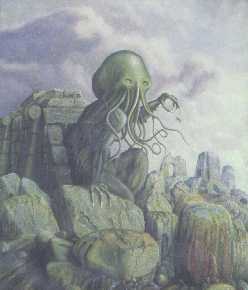
 Y’know that Erich von Daniken book Chariots of the Gods that was such a phenomenon back in the 1970s, what with its claim that ancient astronauts visited the earth and left behind various ancient mysteries along with legends turning them into ancient deities?
Boy, that book is annoying.
I mean, I’m sorry, but Ezekiel just did not see a flying saucer.
And the Nazca lines are just not alien landing strips (though NASCAR race tracks might be).
Well, as annoying as his book are (and they’ve inspired even more annoying imitators, like Zecharia Sitchin–as well as cool things, like Stargate SG-1), von Daniken wasn’t the first person to have the idea of deities "really" being aliens.
Others had that before him.
H.P. Lovecraft, for example.
And, it turns out,
THERE’S A DIRECT CHAIN LINKING LOVECRAFT’S WORKS WITH VON DANIKEN’S.
(CHT to the reader who e-mailed!)

Very interesting. Colavito references a longer article “From Cthulhu to Cloning” http://jcolavito.tripod.com/lostcivilizations/id1.html, which connects Lovecraft to many of the new age/occult groups currently holding sway. Jimmy, perhaps some of your readers’ misgivings about Lovecraft were not so misplaced?
We’ve been through this before.
Lovecraft’s popularity with new age/occult groups is no more a black mark against him than is the popularity of St. Francis among eco-wackos and New Agers, or of Tolkien among the sex-drugs-and-rock-n-roll hippie generation, or of Wagner among the Nazis, or of Vatican II among modernist dissenters.
If there is a causal connection, it discredits von Daniken’s theories — not Lovecraft’s fantasies.
A couple of interesting notes:
Wes Craven the horror writer went to Wheaton Bible College–the dark subconscious repressed imaginations of those Evangelicals.
Marvel Comics had a cast of characters called the Celestials that did genetic experiments to create humans, Eternals, and Deviants. Although supposedly the Kree (in the Skrull v. Kree wars did too)
Christianity (orthodox/traditional) has the strongest prohibitions on extra-terrestial life but it is not infallible teaching ex cathedra nor is it deposit of the faith.
In the Talmud it actually teaches there is extra terrestial life but different from us just like sea life. Check it out at
http://www.chabad.org
Jimmy, there is evidence, don’t be so dismissive:
Evidence
Many authors use ancient mythologies to support their theories, most notably the basic tenet of nearly all ancient creation myths of a god or gods having come from the “heavens” to earth and creating man, with the extraordinary adventures of these various gods interpreted as being modern technologies as seen from the perspective of a simple-minded earthman.
For example, flying machines often show up in ancient texts. One classical example is the Vimanas, flying machines that can be found in the literature of India in which stories range from fantastic aerial battles employing various weaponry including bombs, to the mundane relating simple technical information, flight procedure, and flights of fancy.[3]
In the Biblical Old Testament, God is described as having various attributes that could be interpreted as primitive descriptions of advanced rockets or other flying machines. He is described as having an upper body of metal[4], appearing on a column of smoke and/or fire[5] and making the sound of a trumpet[6]. These descriptions portray the God of the ancient Hebrews as not only having the characteristics of a flying machine, but also quite clearly describe God as a physical presence[7], not an abstraction. This God follows the Hebrews around and rains lighting[8] and stones[9] down upon their enemies from His position in the sky. Additionally, the characteristics of the Ark of the Covenant[10] and the Urim and Thummim[11] are identified as suggesting high technology, perhaps from alien origins.
Other examples include the very detailed descriptions in the Biblical Book of Ezekiel, the apocryphal Book of Enoch, and countless ancient stories from China to Peru.
Physical evidence includes the discovery of ancient “model airplanes” in Egypt and South America, which bear a passing resemblance to modern planes and gliders.[12] Probably the most famous piece of circumstantial evidence are the Nazca lines of Peru; countless enormous ground drawings which can only be seen from high in the air.[13]
[edit]
Earlier ideas
Earlier sources — while generally not referencing ancient astronauts per se — suggest the creation of some monuments was beyond human means, such as Saxo Grammaticus’ suggestion that giants had created Denmark’s massive dolmens, or in tales that Merlin had assembled Stonehenge via magic.
Evidence for ancient astronauts often consists of allegations that ancient monuments, such as the pyramids of Egypt, or Machu Picchu in Peru, or other ancient megalithic ruins, such as Baalbek in Lebanon,[14] could not have been built without technical abilities beyond those of people at that time. Such allegations are not unique in history. Similar reasoning lay behind the wonder of the Cyclopean masonry walling at Mycenaean cities in the eyes of Greeks of the following “Dark Age,” who believed that the giant Cyclopes had built the walls. Typical candidates for the lost civilizations that taught or provided these skills are the lost continents of Atlantis, Lemuria and Mu.
Another frequent theme that can be encountered in many mythologies is a person who comes from far away as a god, or as the archetype of a “civilizing hero” who brings knowledge to mankind. Prometheus is the best-known Western example. In Native American lore there are numerous examples, including Quetzalcoatl of the Aztecs and Viracocha of the Incas.
In Theosophical writings of the 19th and early 20th centuries, many precursors to the ancient astronaut theories can be found. Theosophy influenced authors such as H. P. Lovecraft and Charles Fort, and even later authors such as Erich von Däniken.
[edit]
Ancient astronauts in fiction
The ancient astronaut theory has been addressed frequently in science fiction and horror fiction. Early occurrences in the genres include H. P. Lovecraft’s The Call of Cthulhu (1926) and At the Mountains of Madness (1931), and John W. Campbell’s Who Goes There? (1938) (the last two stories both incidentally set in Antarctica). Arthur C. Clarke has written several stories utilizing the theme, most famously in 2001: A Space Odyssey. So too did Walter Ernsting (The Day the Gods Died). Douglas Adams used a satirical version of the theory in his Hitchhiker’s Guide to the Galaxy series. The Doctor Who serial Pyramids of Mars featured the Egyptian gods being aliens. Even the Tintin adventure Flight 714 references ancient astronaut theories.
The TV show The X-Files has borrowed the theory, and both the original Battlestar Galactica and the 2003 remake explored the idea that Earth was colonized by man millennia ago. The movie Stargate and its spin-off television series Stargate SG-1 and Stargate Atlantis feature aliens posing as gods to influence early earth cultures, and later on in the SG-1 series, aliens are found to have traveled to earth millions of years ago to influence human evolution. The Stargate: Ultimate Edition: Director’s Cut DVD includes a featurette interview with Erich von Däniken entitled “Is there a Stargate?”.
The computer game Rise of Legends features the Cuotl, a Pre-Columbian mesoamerican civilisation manipulated by a group of aliens whose spaceship crashed.
The manga Bio-Booster Armor Guyver features numerous ancient astronaut trappings in its explanation of the Creators and the origin of the Guyver.
There is interesting comparisons in the ancient Hindu texts between modern weaponry, aircraft, spaceships, missles and weapons of mass destruction. Just read the Vedas. Fascinating.
It is hard to dismiss.
SDG
the Page, Plant Bonham, Jones
affection for Tolkien is real and good
for Golem and the evil one
came up and swept away with her
in the darkest depths of morder I met a girl so fair
Erich, your article was interesting but long. You could just post the link:
http://en.wikipedia.org/wiki/Ancient_astronaut_theory
Wes Craven the horror writer went to Wheaton Bible College–the dark subconscious repressed imaginations of those Evangelicals.
;-0!!!!!
EXTRATERRESTRIAL LIFE
Giuseppe Tanzella-Nitti
I. The Question of Extraterrestrial life: An Interdisciplinary Approach. 1. A Brief Glance at History . 2. Interdisciplinary Aspects of the Debate . – II. The Research on Extraterrestrial Life in the Scientific Context. 1. Life in the Framework of Cosmic Evolution . 2. Scientific Projects on the Research of Life. 3. The Search for Extraterrestrial Intelligence (SETI) . – III. The Religious and Theological Debate. 1. Historical Aspects of the Relationship with Christian Thought. 2. Some Theological Positions . – IV. Christian Theology and Extraterrestrial Intelligence: Some Approaches . 1. The Absence of Prejudicial Arguments against the “Pluralistic” Hypothesis and the Reasonableness of the “Classical” Position . 2. The Universality of the Image of the One and Triune God in a Cosmic Context . 3. The Cosmic, and therefore Creaturely, Headship of Christ .
1. The Question of Extraterrestrial Life: An Interdisciplinary Approach
The observation of the starry sky has always provoked many questions. Perhaps one of the most common concerns the possibility of the existence of life on other planets similar to our own. From a historical perspective, however, the question about life in the cosmos appears to arise within a context different from that of the great questions regarding its origin and all that characterizes the “cosmological problem” ( GOD, I.1). If it is true that the ancient theogonies predisposed human beings to recognize the presence of anthropomorphic divinities in regions other than the Earth ( SKY, I), the issue of a plurality of worlds and whether they are habitable acquires force only when new speculative visions and discoveries radically change mankind’s understanding of his place in the universe. Generally speaking, this theme has not central to philosophical thought, but its development in the natural sciences and, more recently, in space technology has influenced various cultural sectors (literature, customs, and cinema) besides having a significant impact on religious and theological spheres. The hypothesis that life exists on worlds other than our own is found in human culture from the classical age until our day. From an objective point of view, to find forms of life on other planets and, above all, to communicate with extraterrestrial intelligence would represent without doubt one of the most extraordinary experiences in human history.
1. A Brief Glance at History. The historical debate about a possible plurality of inhabited worlds has been widely documented (cf. Crowe, 1988; Dick, 1982 and 1996; review articles by Crowe, 1997, and Dick, 1993). The atomists were probably the first to hypothesize the existence of extraterrestrial life. Their mechanistic philosophy assigned to the infinite number of atoms in the cosmos the capacity to give rise to an infinite number of bodies in a multitude of possible combinations, hence also beyond the Earth. Epicurus (341-270 B.C.), and then more importantly Lucretius (99-55 B.C.), affirmed a kind of “Principle of Plenitude,” according to which all the potentialities of matter were destined to be realized sooner or later, in this way giving rise to a world the perfection of which would be proportional to the richness of the existence it contained. The question regarding possible inhabitants of the moon – a question intuitive and spontaneous given the proximity and apparent size of our satellite – appears in the works of various classical authors, including Plutarch (45-125). Within his De facie quae in orbe l unae apparet , a small treatise of philosophical cosmology on the difference between the properties of the Earth and the moon, the Latin writer presents a debate about the origin of the shadowy spots apparent on the lunar surface. Philosophical thought descending from Aristotle (384-322 B.C.) will find greater difficulty in speculating about the presence of inhabitants of other worlds as the heavenly sphere progressively becomes marked by the characteristics of eternity, immutability, and incorruptibility. That sphere is radically distinct from our terrestrial environment (the so called “sub-lunar” world), to which belongs instead change and contingency. The lunar sphere, in which some mutations were also observed, will thus remain halfway between the two.
In the Middle Ages, Christianity was not opposed to the idea that God could have created other worlds, even ones more perfect than our own ( MANY-WORLDS MODELS , I), but the theme did not directly concern the possibility of their being inhabited. In the cosmology of De docta ig norantia , Nicholas of Cusa (1401-1464) alludes to possible inhabitants of other worlds (which he naively placed on the stars). He also tried to systematize from a philosophical point of view the relations such worlds would have with the Earth and its perfections, as well as that between the nature of their inhabitants and our intellectual nature. In a reflection shared by many of our contemporaries, the Cardinal-philosopher concluded that we simply cannot know anything about such comparisons : «The inhabitants of other stars, wherever they are, do not have any proportion with the inhabitants of our world, also if their whole region is in a concealed proportion with our own, for the finality of the universe […]. But, since this region remains unknown to us, also its inhabitants remain completely unknown to us» (Book. II, ch. 12). Giordano Bruno (1548-1600), the renaissance interpreter of the “Principle of Plenitude,” hypothesized the presence of life diffused throughout the whole universe, not only in the form of inhabited stars and planets, but also as a vital principle able to provide a soul to the stars, planets, comets, and indeed to the whole universe. Galileo (1564-1642) and Kepler (1571-1630) never addressed the theme directly, but understood that the heliocentric system placed the Earth in a condition of greater similarity with other solar planets. As had Plutarch and not without irony, both of them asked themselves whether the visible and regular spots on the surface of the moon could have been the work of intelligent inhabitants (cf. C. Sinigaglia, Lo “scherzo” di Plutarco e il “sogno” di Keplero , in Colombo et al., 1999, pp. 155-168).
Starting in the middle of the 17th century, thanks to the widespread use of the optical telescope as a scientific instrument for astronomical observation, one able to reveal an immense number of stars invisible to the naked eye, interest in the theme of life in the universe experienced a rebirth. The rapid diffusion of works in favor of a plurality of inhabited worlds stands as proof. For example, the work of Bernard le Bovier de Fontenelle (1657-1757), Entretiens sur la pluralité des mondes (1686), appeared in dozens of editions and translations, and the posthumous work of Christian Huygens (1629-1695), Kosmotheoros, sive de terris coelestibus earumque ornatu conjecturae (1698), was quickly translated into five languages.
With the passage of time, due to their greater contact with the progressive widening of horizons stimulated by the observation of the cosmos, astronomers were the ones to publish works concerning the possibility of forms of life beyond the confines of the Earth. First William Herschel (1738-1822), well-known for having initiated the first systematic studies on the spatial distribution of the stars and on the formation of the Milky Way, then Richard Proctor ( Other Worlds Than Ours: The Plurality of Worlds Studied under the Light of Recent Scientific Researches , New York, 1871), and above all Camille Flammarion ( La pluralité des mondes habités , Paris, 1862), contributed to the debate within the scientific world throughout the 19th Century. The work of the latter knew an extraordinary diffusion, with over 30 editions in fewer than twenty years and in print without interruption until 1921. It was again an astronomer, the Italian Giovanni Schiaparelli (1835-1910), who provoked interest in the possibility of intelligent life on the planet Mars with his famous observations of its “channels” (1877), regular structures on the surface of the planet to which attention had earlier been drawn by Father Angelo Secchi (1818-1878), a Jesuit astronomer. The writings of Schiaparelli on the planet Mars (recently re-edited in Italian with the title La vita sul pianeta Marte: tre scritti su Marte e i marziani , Milano, 1998), together with those of Proctor and Flammarion, brought about a cultural phenomenon and custom that ended up generically identifying inhabitants of other worlds with the term “Martian.” The position of a non-astronomer, Alfred R. Wallace (1823-1913), a naturalist and an original supporter with Darwin of the theory of evolution by natural selection, must also be recalled as part of the debate between the 19th and 20th centuries. Wallace prepared a vigorous defense of an anthropocentric universe in his work, Man’s Place in the Universe: A Study of the Results of Scientific Research in Relation to the Unity or Plurality of Worlds (1903). In open disagreement with the pluralist position, this essay provided a number of arguments in defense of the uniqueness of human life within the cosmos. This book also enjoyed wide diffusion due to the scientific ambience of its origin.
In the contemporary era, the progress of radio-astronomy and the initiation of space research, together with physical images of a universe of unsuspected dimensions of space and time, offered a vision of man’s place in the cosmos that logically raised the question of the possibility of extraterrestrial intelligence. In this line, works by some scientists have exercised great influence, for example, the texts of H. Shapley, Of Stars and Men (Boston, 1958), and of Shklovskii and Sagan, Intelligent Life in the Universe (San Francisco, 1966). General interest in the theme, however, has been sustained above all through other phenomena, such as science-fiction literature and the cinema.
In the more narrowly scientific realm, the 19th century’s enthusiasm for a possible “close encounter” with other inhabitants of the solar system has been replaced by the methodical research for elementary life forms or pre-biotic material in environments similar to our solar system, not to mention the initiation of long-term programs in radio-astronomic exploration of more remote environments (see below, II, nn. 2 and 3). At the same time, the opportunity was not lost to send “messages in a bottle,” such as the plate with an image of a human couple and some coded scientific data placed on the automatic probes Pioneer 10 and 11 (launched in 1971), the first to venture outside the solar system; digitalized images and sounds of planet Earth on the similar Voyager probes (1977); and a radio transmission in binary code sent towards the galactic globular cluster M13 by the Arecibo radiotelescope (1974).
2. Interdisciplinary Aspects of the D ebate. The theme of cosmic life is brought to today’s culture by science, not philosophy. It reaches the public mostly through the mass media, literature of different genres, and certain other artistic expressions (on the interdisciplinary aspect of the debate, see, e.g., the papers contained in the collective work edited by R. Colombo et al., L’intelligenza dell’universo , 1999). It suffices to think of the science-fiction novels of H.G. Wells, author of War of the Worlds (1898), which continue to inspire, even after a century, films like Star Wars (1938-1945) by George Lucas. Consider also the diffusion of novels by Isaac Asimov, some of which have also been reproduced on the screen. Other forms of inspiration also exist, like the novels of C.S. Lewis in his Ransom’s Space Trilogy (1938-1945) , also known as Perelandra , where the visit to worlds other than our own involves the themes of virtue and sin, of liberty and redemption, of the diversity of creatures and their dependency on a common Creator. The great question regarding the significance of human life in the universe and its relationship with transcendence is one of the central themes of 2001: A Space Odyssey (1968), written by Arthur C. Clarke and directed by Stanley Kubrick ( CINEMA, I).
The peculiarity of the subject of life beyond the Earth’s confines entails an inevitable meeting point in which the great themes of anthropology, philosophy and religion are expressed sometimes unconsciously, sometimes more explicitly. The implications of possible contact with other intelligent forms of life can easily be grasped: One might desire to gain insight and information regarding the future and destiny of the human species; the laws that govern the physical universe, some of which could be unknown to us; and the origin and diffusion of life, and the possibility of its survival in a technological era. But ‘the man on the street’ would certainly want to question civilizations different from our own about the meaning of conscious life, about the knowledge they have of a Creator, and about the existence of God.
The humanistic significance of the theme is noticeable when one observes that in many works of literature, art, and cinema, the “space” context (or “heavenly” context, if one prefers) provides implicit references to the great cosmic myths about the fight between light and dark, between good and evil. It re-proposes the intervention of mediators from faraway worlds, the delivery of moral messages that awaken in human beings the existential questions that ordinary terrestrial life has made dormant. At other times, the idea of a possible relationship with civilizations different from our own offers an interesting conceptual place in which the human family returns to self-understanding. As shown by some movies, it is not rare that humankind rediscovers its unity of origin and its common aims when prompted by the search for defenses against possible cosmic perils or by the necessity to achieve some efficacious and coordinated behavior on a planetary scale.
As Paul Davies has intelligently pointed out, an implicit religious dimension is concealed within research for extraterrestrial life. This dimension expresses itself in a precise literary fashion and aims to explore human spirituality in relationship to meeting “the other.” To quote from the conclusions of his book, Are We Alone? : “The powerful theme of alien beings acting as a conduit to the Ultimate—whether it appears in fiction or as a seriously intended cosmological theory—touches a deep chord in the human psyche. The attraction seems to be that by contacting superior beings in the sky, humans will be given access to privileged knowledge, and that the resulting broadening of our horizons will in some sense bring us a step closer to God. The search for alien beings can thus be seen as part of a long-standing religious quest as well as a scientific project. This should not surprise us. Science began as an outgrowth of theology, and all scientists, whether atheists or theists, and whether or not they believe in the existence of alien beings, accept an essentially theological world view” (Davies, 1995, pp. 137-138).
Thus the religious resonance just highlighted reveals a last important interdisciplinary dimension of the debate: that of the relationship with theology. Christian theology would particularly be involved in light of its “register of uniqueness.” This “register” seems to regulate the relationship between God and man, with its apex reached in the mystery of the Incarnation of the Son of God. For theology, to widen the horizon and consider intelligent beings other than humankind could mean the last possible consequence of a sort of “Copernican Principle” that first deprived human beings of the geometric center of the known universe, then of the uniqueness of their biological history on the Earth, and finally of the centrality of their consciousness within the cosmic panorama. Although theology has not dedicated special reflection to this point, it possesses the resources to confront this issue thematically. The general idea shared by the public and the mass media, however, is that a “close encounter of the third kind” would drastically call into question some important principles of the religious establishment . If theology is not obliged to give an account for all that is merely possible, its discourse on God and human beings —if developed within a contemporary scientific context— nonetheless cannot ignore at least some of the questions that the presence of extraterrestrial life would provoke ( NATURAL SCIENCES, IN THE WORK OF THEOLOGIANS).
II. The Research on Extraterrestrial Life in the Scientific Context
The analysis of our theme within a scientific context must begin with an important clarification. The debate concerning the actuality of unidentified flying objects (UFO) and their possible extraterrestrial origin does not pertain to the object to which science intends to refer when speaking of extraterrestrial life (ETL) and extraterrestrial intelligence (ETI). That debate is outside the boundaries of the scientific and interdisciplinary perspective here assumed. Moreover, the impossibility of having public, scientifically-ascertained knowledge of the data prevents our being able to consider the subject with adequate rigor.
1. Life in the Framework of Cosmic Evolution. We do not know if life is a unique event within cosmic history, one which happened only on this remote planet of one of 10 11 stars in one of the 10 11 or 10 12 galaxies that likely populate our universe; or, on the contrary, if it is a rather diffuse phenomenon. We certainly know that its appearance requires an incredible series of delicate stages and conditions within space and time, the consideration of which cannot be avoided when we desire to evaluate the possible diffusion of life on a cosmic scale.
Neither are we able to comprehend if the whole of these delicate conditions must be considered as a highly improbable event or as a sort of cosmic imperative, linked to the action of a process or of a law that inevitably guides the various steps of the history of the universe (cf. de Duve, 1995). In other words, we do not know if life is a universal and quasi-inevitable phenomena, reproducing itself everywhere that the conditions permit it to do so, as has been suggested by Christian de Duve or Manfred Eigen; or if life is equivalent to a mere probabilistic number, the result of chance at the roulette wheel of cosmic evolution and a phenomenon that does not have any significance, as laconically sanctioned by Jacques Monod and Steven Weinberg. But the philosophical perspective intuits that the richness of life’s complex phenomenology, the teleology of its processes, and its absolute singularity in comparison to inorganic matter all tend to imbue the incidence and the possible significance of life with categories that transcend the false dichotomy of chance and necessity ( BIOLOGY, V).
Setting aside for the moment the physiochemical conditions connecting the necessary conditions for the formation of environments adequate for life with the numerical values of the constants of nature that regulate and determine the intrinsic structure of the universe —conditions that are usually discussed as related to the anthropic principle— I will briefly summarize here some of the main steps that precede any possible appearance of life in the cosmos.
First of all, the elements necessary for life (e.g., oxygen, carbon, potassium) are present only after at least one or maybe two generations of massive giant stars. At the end of the thermodynamic and thermonuclear evolution of such stars, the products of their explosions as supernovae make available an adequate abundance of these elements in cosmic space. Within this environment enriched by heavy chemical elements —the universe begins its evolution composed almost essentially of the lightest element, hydrogen, with a small fraction of helium — other types of star s (main sequence dwarfs) such as our sun must then form, which are more stable and have a longer evolution. Only these stars have an average life long enough (at least several billion years) to give orbiting planets a dependable source of energy for a time sufficient to permit the slow development from very simple to more complex forms of life.
Candidate planets to host a biosphere must then be of a mass sufficiently large to retain a gaseous atmosphere gravitationally, but also sufficiently small to grow cool in a reasonably short time. Planets with a mass such as those of Jupiter or Saturn, for example, have not yet concluded their cooling and therefore have not yet formed a solid surface, even though their birth was contemporary with the Earth’s (around 4.6 billion years ago). In addition, the planet’s distance from the central star must be optimal, so that the planet receives from its star a necessary but not excessive quantity of heat. Hence the star cannot belong to a binary or multi-stellar system (the incidence of which is statistically quite high), because these systems cannot guarantee sufficient stability for the planetary orbit.
Moreover, evolution of life on a planet fit to host it also has its own growth times. Not to mention the time necessary for the formation of life’s indispensable chemical compounds, such as water, numerous compounds of carbon and oxygen, and, as far as possible, those of an atmosphere, it is also necessary to wait for the patient diffusion of the more simple life forms. With the products of their biochemical processes, these help supply the biosphere with necessary substances for superior life forms, which are organically more complex. We know that the time elapsed on Earth from the formation of the first micro-organisms to the appearance of mammals was not less than three billion years. If we consider that the time separating the universe today from its earliest phases of very high density and temperature is certainly not less than 10 billion years, we must conclude that a cosmic time significantly less than this would very probably have been insufficient in any place of the cosmos to allow for the development of forms of life similar to those known today on Earth.
In 1961, Francis Drake attempted to formalize at least some of the preceding conditions in order to estimate what chance there might be to enter into communication (plausibly by radio) with other forms of intelligent life, at least within our galaxy. The use of what will later be called “Drake’s equation” concerns the computation of a series of restrictive probabilities, which are multiplied with each other in order to estimate the number, N, of civilizations in the Milky Way Galaxy possibly able to communicate with us. In the formula proposed by Drake, N = R * f p n e f l f i f c L, R * indicates the rate of formation of the central stars with adequate energetic properties; f p the fraction of them that could have associated planets; n e the number of them with conditions similar to those of the Earth; and f l , f i , and f c the fractions that could develop, respectively, life, intelligent life, and intelligent life at a level of technological civilization. The last factor, L , regulates the “average life” of a technological civilization on a planet. The estimates for N are, as one might expect, very diverse. To Drake’s original calculation that resulted in an approximate value for N = 100,000, other scientists oppose a value around N = 100, but still other experts have very different opinions, according to some of whom there would be only one active and technologically developed civilization for every 300 galaxies , i.e., ours would be the only such civilization in the Milky Way and in the nearest 299 galaxies surrounding i t (cf. F. Drake, Nuove prospettive per la Galassia , in R. Colombo et al, 1999, pp. 118-127; J. Oró, Vincoli per lo sviluppo della vita intelligente, in ibidem , pp. 83-107; the more critical estimations are by Rood and Trefil, Are We Alone? , New York 1981).
As some authors have opportunely pointed out (cf. McMullin, 1980, pp. 83-84), the principal limit of this type of equation is the lack of a realistic model that satisfactorily describes the processes whose fractions of probability of occurrence are to be calculated. For example, to know the fraction of stars that could have planets similar to the Earth, we must have a precise model for planet formation from star clouds. This model should also have parameters describing the various characteristics of the formed planets, in order to select how many planets would be suitable. Unfortunately, however, we do not possess such a model today. Things get even more complicated when we consider that we know very little of the “why” of the origins of life on a planet and even less with respect to intelligent life. Therefore we do not have a realistic model to evaluate whether or not this must happen a certain number of times or never at all. The logic of a statistical theory (for example, the kinetic theory of gas) is to deduce an average behavior for a larger scale on the basis of one’s knowledge of known smaller-scale processes (for example, the principles that regulate the motion of a particle). A statistical theory for the formation of planets with a biosphere, but above all a statistical theory for the formation of life, is not rigorously possible, because we do not know the modality of these processes with a sufficient level of accuracy. Moreover, in nature we have a unique known event, namely us terrestrials, and we cannot securely distinguish what is necessary for our appearance and what might not be necessary. In short, we have insufficient information.
Inevitably, the scientific disciplines that tackle the theme of life in the universe try to use deduction as far as seems reasonable, attempting to link our inferences with what knowledge we have of the cosmos and its environments. At the same time, I believe that in a theme such as ours the attitude better methodically grounded will always be induction, together with the patience to wait and discover.
2. Scientific Projects on the Research of Life. Contemporary science confronts the theme of life in the cosmos in various thematic contexts (for a general overview, see the proceedings of some recent conferences edited by Papagiannis, 1985; Shostak, 1995; Batalli Cosmovici et al., 1997; and the collection of Italian essays in Colombo et al., 1999). These contexts include the research and the study of organic compounds and of biological structures possibly present in interstellar space or on the surface of heavenly bodies (comets, asteroids, satellites or planets) adequate hospitable to them; the research for at least some elementary form of life in particular places within our solar system; the detection and the study of planetary systems formed around other stars in a manner similar to our solar system; the theoretical and experimental reconstruction of the processes that might have given origin to life on Earth in order to better understand such mechanisms on a cosmic scale; and finally, the research for possible radio signals of intelligent origin by means of radio-telescopes partially or totally dedicated to the sounding-out of the sky in centimetric and decimetric wavelengths. All this activity has entered the panorama of scientific research as a new discipline called “bioastronomy” or also “exobiology.” Since 1982, the international scientific community has granted such research activity official status within its international bodies (i.e., Commission 51 of the International Astronomical Union ).
From a historical perspective, the first official entry within a strictly scientific environment of the theme of extraterrestrial life dates back to the second half of the 19th century, namely, the observation of the channels on Mars by Schiaparelli. Beginning in August, 1877, their possible intelligent origin was the object of dispute throughout the world for about thirty years. The mysterious images were then recognized to be natural structures thanks to the use of observational instruments with a high power of resolution. The “red” planet, on which Herschel had indicated two polar caps thought to be formed from frozen water (but which today we know to be formed from solid state anhydrous carbon), remained almost until today a potential candidate for the presence of some elementary life forms. Mars became the object for space missions immediately upon the birth of astronautics, first with the passing flight of a number of probes ( Mariner , 1964-1971), then with soft landings on its surface ( Viking in 1976), and finally with reconnaissance missions starting with self-propelled automatic probes ( Pathfinder in 1997). Both the Viking probe and the Pathfinder mission conducted experiments to verify the existence of possible forms of life, reporting negative results. The first decade of the third millennium will again be a theater for more perfected space missions. Both the European ( Mars Express , launched in 2003) projects and those of the United States (several missions since 2003-2004 returning to Earth with material to analyze) will act as a preludes to a probable manned mission in the future .
The observations completed during the last decades of the 20th century tend to exclude the possibility of life forms, especially more complex ones, on planets within our solar system due to the prohibitive chemical and physical conditions present within their atmospheric envelopes or on their surfaces. However, scholarly interest has shifted to some of the massive satellites. Images obtained in the 1970s and 1980s from the Pioneer and Voyager probes, and more recently from the Galileo probe, have attracted researchers’ attention to some of the satellites of Jupiter and Saturn. Particular attention has been paid to the Jupiter satellite Europa due to the discovery of the presence of water there, and to Enceladus and Titan in orbit around Saturn, which also exhibit very interesting morphological characteristics. The Cassini-Huygens probe, launched in 1997, is at this moment actually journeying towards Saturn and is expected to arrive at the surrounding environs of Titan during 2004.
Thanks to the development of Earth’s observational technology and above all to the use of orbital instruments such as the space telescope Hubble ( COSMOS, OBSERVATION OF THE, II-III), approximately forty star systems have been identified in the last few years which show a star encircled by one or more planets. So far, the planets discovered have had masses comparable or greater than that of Jupiter, the majority of these being too close to the central star and therefore ill-suited for life (cf. Doyle et al., 2000). It must be taken into account that present observations tend to pick out only the more massive planets, due to instrumental constraints. Thanks to a new generation of technology, such as that of the Next Generation Space Telescope , which will be operative in orbit in 2010, we will probably be able to identify planets with a small or intermediate mass, and make more accurate measurements to acquire information on the possibility that such bodies host a chemistry suitable for life. From a theoretical point of view, it appears the formation of planets orbiting around a star is a relatively frequent phenomenon, although the physical characteristics that would make them hospitable for life are rather restrictive, as we have already seen.
Objects of interest for contemporary bioastronomy are not only planets and satellites, but also very small bodies, such as asteroids and comets, and, in general, the vast regions of interstellar space. With radio frequency observations and infrared spectroscopy, it has become possible to discover the presence of over one hundred different types of molecules in interstellar space, including water, carbon monoxide and dioxide, ammonia, methanol, formaldehyde, and various carbon, silicon and nitrogen compounds, as also a certain number of amino acids. Many of these molecules, some of which have been found directly on meteoric residues or observed on comets, are identical to those that characterize the chemistry for living organisms and therefore raise questions about their possible role in pre-biotic processes and about their possible origins from biological processes already in existence. Presently, however, no nucleic acids or other biochemical structures of a cellular origin have been observed—not even within the vast environment of interstellar space—that lead us to think micro-organisms are present beyond Earth.
Notwithstanding the absence of results that might have demonstrated traces of life, past or present, in environments other than those of our own planet, we must recognize that scientific activity confronts us with a new way of considering life, a way that for the first time fixes coordinates on the cosmic dimensions and no longer solely on the terrestrial.
3. The Search for Extraterrestrial Intelligence. Within the context of the relationship between scientific activity and the research of extraterrestrial life, the SETI program ( Search for Extraterrestrial Intelligence ) deserves special mention . The idea of dedicating radio-telescopes to listen for possible intelligible signals coming from places beyond our solar system derives from the suggestion of Cocconi and Morrison (1959). At the dawn of radio-astronomy, this suggestion demonstrated the theoretical possibility of terrestrial instruments receiving from space, even at enormous distances, electromagnetic flux densities comparable to those that we emit here on Earth when transmitting ordinary radio programs. The authors’ advice was to begin listening to frequencies adjacent to the neutral hydrogen emission line at 21 cm (1420 MHz), which could easily be chosen as a reference point for other technological civilizations, given its intensity and diffusion throughout the cosmos. In 1967, an echo of a possible radio contact with extraterrestrial civilizations sounded in public opinion when Burnell and Hewish discovered the first pulsar . Until Goldreich and Julian definitively demonstrated in 1969 that such regular and intermittent signals were produced by neutron stars in rapid rotation, some believed it was possible these signals were of an intelligent origin, jokingly calling them little green men.
But beginning in 1961, a progressive involvement on the part of researchers and the employment of new instruments gradually brought about the formation of the SETI Institute. Today the Institute has its own projects and researchers, but works in collaboration with NASA, as also with other major radio-astronomy research institutes on the planet (documentation and information at the address http://www.seti-inst.edu/). In the context of an interdisciplinary discussion, the Seti Academy Committee is also worth mentioning. In collaboration with other scientific institutions, this committee of the International Academy of Astronautics (IAA) dedicates part of its activity to the study of the social and cultural consequences of a possible contact with other civilizations and to preparation of possible protocols for communication. Some international procedures have already been established; in case an event of this type were to be verified, they foresee independent confirmations of the discovery, international bodies to be informed, and priorities to follow.
In addition to the philosophical aspects previously indicated, an optimistic interpretation of Drake’s equation provides motivation to sustain such research, but there is also another important factor. As time goes on, the volume of space in which the terrestrial radio signals are journeying increases proportionally to the cube of the distance covered by the speed of light (the velocity of radio signals) during that same time. Thus, the probability for receiving a possible extraterrestrial response likewise increases as time progresses. At this time, terrestrially produced radio waves have reached the stars (and possible planetary systems associated with them) inside a sphere with a radius of approximately 70-80 light years, making us for the moment conclude that extraterrestrial civilizations do not exist within a distance of around 30-40 light years from the sun (computing the time a possible radio answer needs to travel back) , or, if they do exist, they are not capable of responding or perhaps do not have the intention to reply to our signals. In this context, one may refer also to the fact that the great radio-telescope of Arecibo ( Puerto Rico ) was deliberately used in 1974 to send toward the globular cluster M13 a radio message of 1679 bits in binary code, decodable in a black and white image containing information on Earth and human biology. The research projects for the first decades of the 21th century involve interferometric radio-telescopes in orbit around the Earth or on the concealed face of the moon (i.e., in the shadow of signals coming from the Earth) in order to increase the power of resolution and the sensitivity for reception of possible intelligent extraterrestrial signals.
For the more optimistic, such as the radio astronomer Ron Bracewell, the many technological civilizations that might populate the universe would already have a communicative network in place, a kind of Galactic Club (Bracewell, 1979), which humans must enter sooner or later. But the hypothesis that advanced civilizations may have very diffuse presence has often been contested, because there has not yet been contact with any of them, neither in the present nor in the historical past. If there were a million such civilizations in our galaxy, they would be separated by a distance of approximately 100 light years from each other. Historically known as the “Fermi Paradox” for the Italian physicist who, almost as a joke, made this type of calculation for the first time in 1950 during a lunch at Los Alamos , this problem is often posed in a colloquial fashion with the question where are they? The proposed responses have varied, ranging from the suggestion that such contacts may have already happened in epochs when humans were not in a position to appreciate them, to the fact that there would be a certain resistance to the establishment of such relationships given the enormous technological or even cultural differences, differences that could also account for a sort of “ invisibility ” of their presence in our midst. The variables of the problem, many of which certainly come from outside the scientific sphere, are such that the Fermi Paradox serves as a useful admonition, albeit it is not an apodictic argument. Considerations similar to Fermi’s and equipped with opportune solutions were made around 1930 by Kostantin Tsiolkovsky (1857-1935) within a philosophical climate known as “Russian Pancosmism” (cf. V Lytkin et al., Tsiolkovsky, Russian Cosmism and Extraterrestrial Intelligence , “Quarterly Journal of the Royal Astronomical Society” 36 (1995), pp. 369-376).
III. The Religious and Theological Debate
The theme of the presence of life, particularly of other intelligent creatures, in environments different from our own terrestrial one has never constituted a special topic of theological speculation, nor are there official teachings of the Church regarding it. Holy Scripture, even when it presents the action of God or his relationships with humanity in a cosmic context, does not mention it. A verse from the Gospel of John that some writers love to cite as a possible exception is Jn 10:16: “I have other sheep that do not belong to this fold. These also I must lead, and they will hear my voice, and there will be one flock, one shepherd,” which certainly remains suggestive, but does not in reality offer any serious ground for exegesis in such a sense. References to some historical precedents of the theological debate are very few and fragmented. Summaries of the principal positions can be found in Grasso (1952), Dick (1996), Crowe (1997), and in the essays of Coyne and Dick collected in the volume edited by Steven Dick (2000).
1. Historical aspects of the relationship with Christian thought. Of the relevant texts extant, one of the earliest is a letter by Pope Zachary (741-752), in which he mentions that the priest Virgil taught a doctrine on the plurality of inhabited worlds. Zachary reproved the idea that there were inhabitants at the poles , on the moon, or on the sun ( quod alius mundus et alii homines sub terra sint, seu sol et luna: cf. Epistola XI ad Bonifacium , PL: 89, 946-947). The doctrinal motive for such a call to order is simply to prevent the introduction of elements of novelty that, by calling into question the unity of the human family, would make it more difficult to understand the relationship to God and to original sin of men who were not descendants of Adam ( CREATION, II). In 1277, with the intention of protecting the freedom and omnipotence of the Creator, the bishop of Paris, E. Tempier, condemned a proposition of the Aristotelian tradition according to which the First Cause could not have created many worlds, though the censure did not mention anything about their possible inhabitants. Some years before, Thomas Aquinas (1224-1274) had responded in his Summa Theologiae to the question of whether other worlds existed, affirming that only one world existed (cf. pars I, q. 47, a . 3). But we cannot make direct use of the medieval debate on the multiplicity of worlds to know the position of Christian theology on extraterrestrial life. The medieval concept of “many worlds” was not equivalent to ours today when we refer to different planets that could be inhabited. By the “oneness of the world,” they were referring rather to the unity of the universe. Within the thought of Thomas and other medieval philosophers the unity of the world derived from the unity of its Creator and from the unity of his final causality for all that exists. In the question of the Summa cited above, Aquinas in fact associated the idea of a plurality of worlds with the supporters of chance who, like Democritus, denied an ordering wisdom ( MANY-WORLD MODELSs , I). The warning of Tempier, in which the concept of mundus (world) did not totally coincide with the usage of Thomas Aquinas, was intended only as a corrective of an academic nature rather than as an ecclesiastical intervention in the strict sense. It was aimed at maintaining unaltered the characteristics of the Creator, and this not so much within the sphere of the real but rather within the sphere of the possible.
The debate about the heliocentric system did not have official repercussions for our theme. Some ecclesiastics expressed their private opinion that to lower the Earth to the level of other planets could lead some innovatory spirits to go still further, even to the point of supposing the existence of inhabitants on those planets, with the consequences foreseen by Pope Zachary in the 8th century . Just so, the idea was manifested in a letter by the abbot Giovanni Ciampoli to Galileo sent on February 28, 1615 (cf. Galileo, Opere , edited by A. Favaro, Florence 1968, vol. XII, p. 146) and in a letter sent to Pierre Gassendi (1592-1655) by the abbot Le Cazre (cf. P. Gassendi, Oeuvres , Lyon 1658, vol. VI, p. 451). The 17th century was characterized by a general attitude of prudence, as also indicated by the fact that Fontenelle’s essay, Entretiens sur la pluralité des monds , was placed on the Index of Prohibited Books in 1687 .
In the 18th century, the theological climate seemed to change. No specific solutions were offered to frame or solve the dogmatic problems that extraterrestrial life could pose for Christianity, but the entire theme was regarded with greater openness and without any particular fear. In the first place, theologians seemed to underline more the greatness of the Creator and the incomprehensibility of his plans for the universe. Anglican apologetics offered a connecting point by inserting the possibility of extraterrestrial life into its natural theology (W. Derham, Astro-theology , London 1714). Of greater significance, however, was the reaction of many Christian authors against the work of Thomas Paine (1737-1809), The Age of Reason (1793), a text that for the first time directly proposed a radical incompatibility between the Christian religion and the existence of intelligent extraterrestrial life. According to Paine, the discovery of non-terrestrial life would inevitably lead to a repudiation of religion: “Are we to suppose that every world in the boundless creation had an Eve, an apple, a serpent and a redeemer? In this case, the person who is irreverently called the Son of God, and sometimes God himself, would have nothing else to do than to travel from world to world, in an endless succession of death, with scarcely a momentary interval of life” ( The Age of Reason , New York 1961, p. 283). Paine’s criticism will not be shared by sincerely believing astronomers who were also favorable to a pluralist hypothesis, as were T. Wright, J. Lambert and the same William Herschel, but it also gave rise to theological works aimed at refuting Paine’s thesis, e.g., T. Chalmers ( Astronomical Discourses , 1817) and T. Dick ( The Christian Philosopher , 1823) in Scotland, and T. Dwight in the United States ( Theology Explained and Defended in a S eries of Sermons , 1818).
The 19th century theological work of Joseph Pohle, Stellar W orlds and their I nhabitants ( Die Sternenwelten und ihre Bewohner , Köln 1884), re-edited many times for approximately twenty years, plainly favors the hypothesis of a plurality of inhabited worlds. Given that the physical universe is so vast and that the reason for creation is to give glory to God, Pohle deduces that such glory must be bestowed by many intelligent beings dispersed throughout the cosmos and that have a direct relationship with the material universe, unlike the multiplicity of angels, whose nature is purely spiritual. An echo of this conclusion can be found in one of the most widely diffused European theological textbooks of the 20th century (cf. M. Schmaus, Katolische Dogmatik , Munich 1957, vol. II, n. 109). Pohle’s position will be shared by various scientists of his era, among them the Italian priest-astronomers Angelo Secchi and Francesco Denza ( SECCHI, III).
2. Some Theological Positions. As has already been observed, today’s theological literature does not give special attention to our theme. Theological textbooks present only fleeting glimpses of it, usually following a line of prudent openness to a possible occurrence that, in the end, must be a factual event and not a theoretical deduction. In the second part of the 20th century, in addition to the cited articles by Grasso (1952) and Perego (1958), contributions to the theme were made by Davis (1960) and Zubek (1961). Special attention was dedicated to this subject in the works of E. Milne ( Modern Cosmology and the Christian Idea of God , Oxford 1952), E. Mascall ( Christian Theology and Natural Science , London 1956) and above all K. Delano ( Many Worlds, One God , New York 1977). Paul Tillich will complain of the absence of such reflection within the theological field (cf. Systematic Theology , vol. II, Chicago 1957, pp. 95-96). Teilhard de Chardin dedicates only a brief essay to our topic ( La multiplicité des mondes habités , 1953), to which he added an even shorter, but interesting, footnote. Especially within intellectual circles interested in the relationship between science and religion, the theological implications of life in the cosmos is the theme of contemporary conferences and debates, which are not without a certain effect on public opinion, but which also have yet to give rise to works of particular scientific maturity.
The point of departure for most theological reflections basically remains Pohle’s thesis: the Creator’s greatness and glory are compatible with the gift of life and of intelligent life in the cosmos, also in numerous environments other than the Earth, although we do not know what God’s plans are for these creatures. Thereupon, theology immediately offers a clarification already present in all the works of the writers who replied critically to Paine: redemption from original sin regards the human family and cannot be transposed into the life of other creatures. The same consideration was made centuries earlier by the Franciscan William Vorilong (1390-1463), but it constitutes only a first approach to the problem (cf. G. McColley, W. Miller, St. Bonaventure, Francis Mayron, William Vorilong and the Doctrine of a Plurality of Worlds , “Speculum” 12 (1937), pp. 368-389).
Some writers have gone still further. According to Mascall, it would not be difficult to acknowledge the possibility of various hypostatic unions of the Incarnate Word if this were judged opportune by the universal salvific will of God. Milne suggests that the uniqueness of the Incarnation could be compatible with the fact that radio communication between civilizations would become the vehicle of informing other intelligent creatures about the history of salvation God realized on behalf of terrestrials and extending to other creatures a sort of “redemptive information” capable of moving them to give thanks to God or to believe in Him. The position of Kenneth Delano, who approaches the question with a Catholic perspective, distinguished itself for a notable flexibility. After recalling the fittingness of associating the greatness of God with a creation much richer than one could imagine, he indicates the necessity for genuine humility with respect to the transcendence of divine plans, a humility that should lead one to avoid geocentric or anthropocentric attitudes, thus respecting the silence of Scripture on the topic. Without placing limitations on any possible history of revelation or salvation, Delano holds that any of the three divine Persons could become incarnate on any planet. According to Delano , such positions are preferable to a sort of “Cosmic Adam,” in which the single redemptive act of Christ on the Earth would apply to the whole universe. In any case, also according to Delano , a redemptive pluralism does not impede humans from spreading to other intelligent beings the evangelical message and the love God shows us. In my opinion, the positions of Mascall and Delano regarding possible multiple incarnations of the Son or of other divine Persons end up moving away from a true Christian understanding of Revelation, as we will see.
If the preceding considerations underline the flexibility necessary for a theme such as this, the position of Charles Davis (1960) seems much better defined. Starting from the biblical data of the cosmic centrality of Christ with respect to the whole material universal and of his headship over all creatures, including the angels, Davis concludes that the more correct theological position should be to maintain the uniqueness of the hypostatic union (the assumption of human nature by the divine Person of the Son), which happened only once and only within the context of the earthly economy of salvation ( JESUS CHRIST, INCARNATION AND DOCTRINE OF LOGOS). The consequent privilege for human nature would not be an expression of anthropocentrism, but the consequence of a coherent Christocentrism. If the centrality of Christ, the Son of God made man, in the cosmos and in history was merely the effect of a geocentric horizon present in the modes of expression used in Scripture, the greater part of our theological understanding of creation and of our relationship with God in Christ would inevitably be twisted. To leave unaltered the understanding of the headship of Christ, the God-man, in a “strong sense” means to continue to believe that the incarnation of the Word constitutes the greatest self-communication of God to creation, also against the background of all other possible creatures, and it means, for us humans, to assume the corresponding responsibility. A universe where, on the contrary, many possible incarnations of the Word were possible, would no longer be a Christocentric universe. If this were to happen as a factual event, we would have to conclude that our understanding of Revelation had been until then largely imprecise and ambiguous. Teilhard de Chardin holds the centrality of Christ in a strong sense, but at the same time he stresses the action of a third “cosmic” nature of Christ (a nature other than the divine and the human natures) and ascribes to it, and not to the human nature of the Word, the work of recapitulating in Him all creation and all the beings which participate in it (cf. La multiplicité des mondes habités , in “Oeuvres,” Paris 1969, vol. X, p. 282). De Chardin can thus overcome the obstacle of anthropocentrism, but introduces an element extraneous to the Christological dogma, which teaches instead the presence of only two natures, human and divine, in the divine Person of the Word (cf. DH 300-303).
IV. Christian Theology and Extraterrestrial Intelligence: Some Approaches
I believe that the theme of possible intelligent life of extraterrestrial origin, i.e., intelligent life outside the experience of unity of the human family common to the entire biblical message, represents one of the major speculative efforts facing Christian theology. It would therefore be no surprise if many questions are perhaps destined to remain unanswered. The only available analogy for our topic is the study of the relationship between Christianity and the other religions of the Earth, a relatively young discipline, one of growing importance in an age of globalization ( INFORMATION, VII). Without doubt, the study of this relationship provides useful guideposts for our problem, including the salvific universality of the Incarnation of the Word, the singularity of the hypostatic union, the necessity not to separate the richness (and in some way the unpredictability) of the creative and salvific action of the Holy Spirit from the mission and the role of the Son, which the Spirit must necessarily guide. The relationships among the religions then becomes generally framed, not without noticeable effort, in what theology calls “inclusive Christocentrism,” the attempt to re-read the other religions implicitly in the light of the mystery of Christ (on this, see the document issued by the International Theological Commission, Christianity and Religions , 1997). But such an analogy only serves as a first approach to the problem, since the theme of life in the cosmos would supplant the unity of the human family, created and redeemed in Christ, posing a problem with a wholly new aspect, as did, for example, the discovery of the American Indians, about whom Pope Paul III (1534-1549) did not have difficulty to recognize their belonging to the descendants of Adam (cf. DH 1495). Therefore nothing else remains for us to do but to approach the problem in steps.
1. The Absence of Prejudicial Arguments against the “Pluralist” Hypothesis and the Reasonableness of the “Classical” Position. A first fixed point is that there are not prejudicial arguments hindering the admission of the “pluralist” position, neither on the part of the magisterial teaching of the Church nor on the part of theological reflection. The omnipotent will and unfathomable freedom of God the Creator continues to imply a valid relevant argument, as does the recognition of the intrinsic value of life, and in a special way the dignity of intelligent life, everywhere it is manifested. All life is in some way a participation in and a reflection of that Life, with a capital letter, that believers know subsists in God himself. To these may be added what the Judeo-Christian tradition professes about the existence of angels. This tradition shows that the meaning of creation is not completely based on the relationship between man and God, “but remains open to other creatures,” which, although likewise dependent on God, have a history and an economy of salvation distinct from that of humankind. Thomas Aquinas, for example, gave arguments of fittingness to support that the number of angels would be very high, surpassing any multiplicity of material entities whatever (cf. Summa Theologiae , I, q. 50, a . 3).
Nonetheless, to think that humankind is the only form of intelligent life in the cosmos would for theology represent a “classical” position (or a classical solution , as we would say in the language of physics) and one that would not require the re-interpretation of many aspects of Revelation . Such a solution is reasonable, and cannot be qualified as a priori or anti-scientific. Today we know that the very large size of the physical universe does not respond to a sort of “redundancy,” but is linked to a necessity of anthropic origin: a very large space inevitably corresponds to the long time necessary for the stellar production of chemical elements indispensable for life ( ASTRONOMY, III; ANTHROPIC PRINCIPLE). As a consequence, both the probabilistic argument based upon the greatness of the cosmos and the theological argument regarding the fittingness that manifold intelligent beings are created to give glory to God in regions where man could not do so are weakened. In an expanding universe—the only one that could lead to the formation of structures and environments that are adequate for life—the long time required for biological evolution necessarily means a large space and a large amount of matter already formed or in the process of formation. In this universe it is as reasonable to hold the simultaneous appearance of many civilizations as it is to hold the existence of only one. The teleology highlighted by the anthropic principle does not indicate conclusions about the multiplicity or the singularity of intelligent life, but only about the time necessary for its appearance and about the necessary relationships between life and the structures of the universe in its entirety. Not knowing the “ultimate reasons” for the origin of life, science cannot know if life is the result of a categorical imperative or of a highly improbable event: therefore, equations such as those offered by Drake are of their nature also destined to calculate “necessary” conditions, but not “necessary and sufficient” conditions for the presence of intelligent life. In the absence of data that require new solutions within a wider interpretative framework, a theology that wants to conserve its “classical” solution cannot be charged with unreasonableness on this account.
2. The Universality of the Image of the One and Triune God within a Cosmic Context. A second fixed point is that the image of God entrusted to the Judeo-Christian tradition is not geocentric, nor anthropocentric: it reveals itself to be universal and transcendental, subject of a creative omnipotence whose range is without doubt of cosmic order and certainly not only local. But within the context of free and conscious life, the Trinitarian image also presents itself with characters of universality: the existence of a paternity and of a filial relationship, whose intelligibility is linked to the generative process common to every living being, and the existence of a Love-Gift, the Holy Spirit, the understanding of which refers to the idea of communion, altruism, and donation that is certainly not extraneous to the dynamic of conscious life. This suffices to reject the opinion that Christian theology, in order to open itself to the possibility of intelligent life in the cosmos, must inevitably set aside the image of God proper to it, i.e., as one and triune, accepting a sort of new “Copernican revolution” that would induce all civilizations of the universe to cease to recognize their own God, and to begin together to recognize a common but unknown God, analogously to what John Hick would like the different religions of the Earth to do today ( The Rainbow of Faiths: Critical Dialogues on Religious Pluralism , 1995 ) .
Every believer in God would certainly see any eventual meeting with a non-terrestrial civilization as an extraordinary experience. A believer would be fundamentally inclined to manifest a sense of respect in such an encounter, to recognize our common origin and the new possibility to understand better the relationship between God and the entire creation. A similar meeting, and perhaps the ensuing dialogue, would have a “religious” dimension in the more natural sense of the term. At the same time, it seems important to note that a believer who is respectful of the requirements of scientific reasoning would not be obliged to renounce his own faith in God just on the basis of the reception of new information of a religious character from extraterrestrial civilizations. In the first place, human reason itself would suggest the need to submit this new “religious content” coming from outside the Earth to an analysis of reasonableness (analogous to what we are accustomed to do with religious content proposed to us on Earth); once the trustworthiness of the information has been verified, the believer should try to reconcile such new information with the truth that he or she already knows and believes on the basis of the revelation of the one and triune God, conducting a re-reading inclusive of the new data similar to that which would be applied in an ordinary inter-religious dialogue.
Generally speaking, such contact could not be considered a sort of verification of the religious conscience of humanity. For their part, despite the great majority of terrestrials who believe in the existence of a Creator of Heaven and Earth, humans have not supplied any information of a religious type within the “messages in a bottle” that have been sent out beyond the solar system (see above, I, n. 1). From a materialist perspective, the idea that a new entrance into the Galactic Club will free man from an infantile religious phase and definitely give us back the awareness of our true place in the universe could be suggestive, yet in reality is very naïve. The majority of the great existential, and hence religious, themes pertaining to human life on our Earth would not be resolved by the friends of this Club.
3. The Cosmic, and therefore Creaturely, Headship, of the Mystery of Christ. If the mystery of the Incarnation refers to a Christocentric headship and not a geocentric one, then it can be explored and expressed with cosmic and universal categories, categories not anthropological. The third fixed point for our attention should therefore be the universal, and not only local, revealed and salvific value of the Incarnation. The headship of Christ, the God-man, over the angelic creatures (cf. Heb 1,3-14 and 2,5-18) would be interpreted as revealing his headship over all possible creatures (cf. Eph 1,10; Col 1,20). The grandeur of the hypostatic union, which is infinite in a sense, also gives the vicarious sacrifice of Christ an infinite meritorious value. The way in which this would apply to the whole universe remains a mystery to Christian theology, but it is not that the efficacy of this sacrifice increases through multiplication. The celebration of the Holy Mass, for example, applies the fruit of the same historical event to different times and places without multiplying it. Contrary to what is suggested by other authors, I believe that a like participation and efficacy of salvation on a cosmic plane —where this might be necessary for other intelligent and free beings— cannot depend on an interplanetary missionary impetus nor upon indirect communication (although these factors can, and perhaps must, be involved ). It could only depend upon an economy guided by the Holy Spirit, also if accomplished in a way mostly unknown to us, but certainly the only one able to secure the universality and interiorization of salvation. As in the terrestrial salvific economy, the Spirit would still lead to the Son and would in some way render him present. This entire perspective reflects the logical conviction that the Creator everywhere has his own ways to make himself recognized, and perhaps also to make himself present within his creatures.
On the personal history of other possible intelligent beings, responsible for their freedom before God, Father and Creator of everything (cf. Eph 4,6), we humans cannot say anything. We can affirm, however, that, as creatures, the mystery of Christ, the Word incarnate, is not extraneous to them. God has assumed in Christ a created nature, a finite will and freedom, making his own the experience of limits and of creaturehood, an experience that has a value that certainly extends beyond that of the “human” creature as such. But Christ has taken onto himself also the reality of death and he has revealed its transitory character, prefiguring in his risen body a destiny that belongs to the whole universe and not only to man. But what resonance would this have for other creatures whose original and originating relationships with God we don
Missionaries to Mars? The religious implications of the search for life in the Universe
David Wilkinson, The Plain Truth, Apr-May 2004
original source | fair use notice
Summary: Will Christians have to hold a closing-down sale if extraterrestrial intelligence (ETI) is found elsewhere in the Universe? Or has there already been the passion of the Christ on different worlds?
——————————————————————————–
Mars has become big news. Beagle may be out there somewhere on the surface trying to ‘phone home’; meanwhile, the US has landed Spirit and Opportunity and sent back stunning pictures of the Martian surface. Mars Express orbits the planet confirming the existence of water, and George Bush prepares to go boldly where his father was unable to go by planning to land humans on the surface of Mars.
In amongst all of this is the age-old question, ‘are we alone in the Universe’? While the exploration of Mars may not give us good evidence for another decade, this question drives our thinking both in a scientific sense and indeed in a religious sense.
Will Christians have to hold a closing-down sale if extraterrestrial intelligence (ETI) is found elsewhere in the Universe? Or has there already been the passion of the Christ on different worlds?
A Christian search for extraterrestrial intelligence?
It will come as a surprise to some that the Search for Extraterrestrial Intelligence (SETI) can in part be traced back to a Christian motivation. Kepler (1571-1630) argued from Galileo’s observation that since Jupiter had moons it too must be inhabited. He reasoned that as God had made the Moon for our benefit, then the moons of Jupiter were made for the benefit of the inhabitants of Jupiter. So then there must be inhabitants! A similar type of argument was used by the astronomers Richard Bentley (1662-1742) in England and Christian Huygens (1629-95) in Holland. Following the discovery of the vast number of other stars apart from our sun in the Universe, they reasoned that if there were stars which were unable to be seen from Earth, then they must have been created for the benefit of those who could see them. There must be other beings elsewhere in the Universe.
The historian of science Colin Russell has suggested that common to the many speculations about other worlds in the seventeenth century was an insistence on God’s ability to create life anywhere he wished and that the universe existed not just for the sole benefit of human beings, but to exhibit his glory to all.1 E.A. Milne, the distinguished Oxford cosmologist and Christian went even further: ‘Is it irreverent to suggest that an infinite God could scarcely find the opportunities to enjoy himself, to exercise his godhead, if a single planet were the seat of his activities?’2
Christians have long understood that God’s creation contains other life apart from humans. From worms to wasps, God’s creativity is expressed in a wide diversity and indeed extravagance of non-human life. The relics of primitive life on Mars at one level would not cause any difficulty at all for Christians; it would simply be yet more of the tapestry of creation.
Intelligent life, but not as we know it?
Of course, if we found that the Universe was full of bacteria that would not be very interesting.
Star Trek would not work if the on-going mission was to boldly go to seek out yet more bacteria! The key question for many is whether there is other intelligent, self-conscious life within the Universe. The scientific jury is still out on this question. On the one hand we know that the Universe is a very big place containing more than 100 billion stars in each of 100 billion galaxies. On the other hand biologists clearly point out that the evolution of self-conscious life depends in a very delicate way on many aspects of the laws of physics and the circumstances of the earth. Finding evidence of primitive life on the surface of Mars (and if it could be shown that this was not contamination from the Earth) might tell us that life itself may be emerging in many places in the Universe, but that does not necessarily mean that all amoebas will inevitably turn into accountants! Indeed the lifeless surface of Mars today is a reminder that the building blocks for life may be there in abundance, but things have to
be just right for intelligent life to develop.
While the SETI programme continues looking for signals of other civilisations, the continued silence of the heavens is not encouraging. The physicist, Fermi, in the 1950s suggested that if the Universe was giving birth to many civilisations then ‘if they existed they would be here’. While some will argue for UFOs and alien abductions to be good evidence, the vast majority of the scientific community is unconvinced. The fact that as yet we have not seen or heard ‘ET phoning home’ has been significant.
But just supposing we were to encounter little green men and women, what would that mean for religion and Christian faith in particular?
A watchmaker of alien watches?
Paul Davies has written widely in recent years on the link between God and his work as a cosmologist. He is especially struck by the anthropic balances that make life possible. These are the amazing balances in the law and circumstance of the Universe that allow the development of carbon-based life. These, coupled with the intelligibility of the Universe, lead him towards a cosmic designer.
He believes that there are as yet undiscovered principles of complexity, organisation and information flow consistent with the laws of physics, but not reducible to them, and these principles lead to intelligent life.3 If this turns out to be the case, Davies feels that atheism would seem less compelling and something like design more plausible.
William Paley became famous in the nineteenth century for likening this design in the biological world to finding a watch as you walk across the heath. The intricacy of the design suggests a designer. Would such a watch on the surface of Mars give any proof of the existence of God?
Such an argument may dent atheism, but it does not prove the Christian God. Even if you identify ‘design’ you then have little idea as to what the designer is really like?
Contact problems for religion?
If you cannot prove God then can aliens become a means of disproving God? Jill Cornell Tarter is one of the leading SETI researchers in the world. She argues that if ETI is detected then ‘long-lived extraterrestrials either never had, or have outgrown, organised religion’.4 She thinks that religion causes war and the destabilisation of societies, and therefore a stable, technological civilisation would mean either one universal religion or no god at all. Indeed, if it is one universal religion, then we will all convert to it and junk the divisive religions of Islam, Christianity and Judaism on the cosmic scrap-heap.
Of course, this is a long way from finding evidence of life on the surface of Mars. Whilst wildly simplistic in its understanding of religion, technology and society, it is however interesting to see SETI researchers seeing their work in dialogue with the big questions. Cornell Tarter does not recognise the positive contribution of religion to society, not least in the growth of science itself. The situation is far too complex to predict that any ETI will have one God or no religion at all. Her argument is weak, but she is not alone in using alien life to attack God.
Is God an alien?
Famous for his iconic 2001: A Space Odyssey, Stanley Kubrick once suggested that ‘all the standard attributes assigned to God in our history could equally well be the characteristics of biological entities who, billions of years ago, were at a stage of development similar to man’s own and developed into something as remote from man as man is remote from the primordial ooze from which he first
emerged.’5 Is ‘God’ in fact a super intelligent alien?
Again, this is not new. A former NASA engineer, J.F. Blumrich in a book The Spaceships of Ezekiel, published in 1974, suggested – quite unconvincingly – that Ezekiel’s vision of God was in fact an encounter with a flying saucer.
Erich Von Daniken and others went further in arguing that many of the accounts of Jesus were simply telling the story of a super- technological alien. Thus, angels in ‘shining garments’ are actually aliens in space suits and the ascension was simply ‘beam me up Scotty’! Such suggestions are highly-entertaining but do little justice to basic questions such as the historicity of the life and teaching of Jesus, and the significance of his death and resurrection.
There are even reputable scientists who have suggested similar things. The cosmologist Edward Harrison was struck by the anthropic balances in the Universe.
He suggested that there could be only three explanations: First, God designed the Universe, but Harrison hastily argues that answer precludes further rational inquiry. Second, the anthropic principle of this Universe as one universe in many universes, but he finds this unsatisfactory. His preferred third option is that this Universe is created by life of superior intelligence existing in another physical universe.
How does he get to this extraordinary conclusion? First, he picks up on the suggestion that black holes could be the birthplaces of new universes. Second, he argues, that due to the rapid evolution of intelligence there is every reason to expect that a time will come in the future when we will be able to design and create our own universes. Thus, the fine-tuning of this Universe is to be explained as an engineering project of superior beings. They have created this Universe out of a black hole. He calls it a ‘natural creation theory’ and claims that it also explains why the Universe is intelligible to us. It is created by minds similar to our own who designed it to be that way.
One wonders whether this is an elaborate wind-up, even though it appeared in a scientific journal. Harrison criticises belief in God for stopping any further rational inquiry, but then falls into the same trap. What can we possibly know about these ‘superior’ beings in another universe? If he is to be drawn to the conclusion that this Universe is designed, is it not simpler to see the ‘superior being’ as God? Indeed, in contrast to the unknown aliens in another universe, Christians claim that this God, far from being in another universe, has revealed himself in this Universe and forms a personal relationship with those who open their lives to him.
The evidence for the existence of God is much stronger than that for superior beings in another universe.
Big Brother on Mars?
Whilst Paul Davies is open to God, he does think that the discovery of extraterrestrial intelligence would somehow undermine what he sees as Christianity’s claim that men and women have a special and exclusive relationship with the Creator.
If we are not alone then we are not special.
Whilst Davies might be right in seeing this in some expressions of Christianity, it is not true to the traditional Christian position. Russell points out that the popularity of the speculation about other worlds in the seventeenth century was a significant indicator of the ascendancy of biblical values over those of Aristotle. The reason being that in the Aristotelian Universe, position and status were closely associated. The Earth was at the centre of all things, separated from the rest of the Universe by the orbit of Moon. We were special because we were placed at the centre.
In contrast, the Bible does not associate status and place. The dignity and worth of human beings comes from the gift of relationship with God. This is clearly spelt out in the Genesis narratives. The core of being made in the image of God, being given stewardship over the world and having the capacity for intimate communication with God are all held together in the gift of relationship. Such a relationship can be special without being exclusive. I have a special relationship with my daughter, but that is not devalued by the fact that she has a brother with whom I also have a special relationship.
Extraterrestrial intelligence does not pose a problem to Christian belief that men and women are special in the eyes of God. It may even increase the sense of awe at how great this God is who creates with such diversity and extravagance.
God in little green flesh?
Yet how would the existence of ETI affect the central Christian claim that God has become a human being in Jesus to communicate with us and to save us from our sin? This has bothered some theologians. Arthur Peacocke, who has done so much to hold science and religion together, worries, ‘Does not the mere possibility of extraterrestrial life render nonsensical all the superlative claims made by the Christian church about the significance (of Jesus)’6
Here is what theologians call the issue of particularity: Christian faith is based on a particular revelation at a particular time to a particular people, which is, at the same time universal for all. Christians have thought about this in terms of other cultures and faith communities and a few have tried to extend this to ETI. The speculations have followed two separate paths.
Some have said that the revelation of God in Jesus is once for all for the whole Universe. Milne observed:
‘God’s most notable intervention in the actual historical process, according to the Christian outlook, was the Incarnation. Was this a unique event, or has it been re-enacted on each of a countless number of planets? The Christian would recoil in horror from such a conclusion. We cannot imagine the Son of God suffering vicariously on each of a myriad of planets… We are in deep waters here in a sea of great mysteries.’ 7
Milne eventually solves his great mystery and overcomes particularity by suggesting the sending of the good news by radio waves!
Others have taken a different view. Milne’s view was severely criticised by the theologian E.L. Mascall in his Bampton lectures in 1956. He argued that if salvation was what God was all about, then he would make sure his creatures knew about it. Mascall stresses that salvation has to be achieved through incarnation.8 That Jesus became a human being means that it is doubtful that his saving work would be for different types of beings.
Such a view was also represented by the hymn writer Sydney Carter who wondered:
‘Who can tell what other cradle,
High above the Milky Way,
Still may rock the King of Heaven
On another Christmas Day?’ 9
In deciding between these two views we need to proceed carefully. Christian faith understands God in human flesh for two purposes – one is about showing us what God is like, and the other is to save us from our sin which alienates us from God. In thinking about incarnation on another world, we need to ask the question posed by C.S. Lewis – that if aliens do exist, and if they are intelligent, will they have sinned like human beings?
Milne is right that we find ourselves in a sea of great mysteries! However, the physicist and theologian Sir John Polkinghorne, when asked about whether God would become incarnate on different worlds, replied that the God he saw in Jesus ‘will do what is necessary.’ 10 It seems to me that’s not a bad answer!
Why search Mars at all?
If the science from Mars and indeed from other considerations is not clear, and some of the theological questions need more thinking, we can ask the question why is there so much fascination with this question? The search for life on the surface of Mars is part of a wider human quest that is also expressed in the fascination of The X-Files phenomenon of alien visitation and in much of the science fiction industry. We can highlight five themes common to this fascination.
1. Lost in space
First, a feeling that can only be described as cosmic loneliness.
The astronomer David Hughes writes:
‘The confirmation of the existence of extraterrestrial life is billed as the greatest possible scientific discovery of all time. Today, however, we are still experiencing the pangs of cosmic loneliness. Never mind not coming to visit, no extraterrestrial being has even left a calling card or shouted at us from a distance.’
If there is no evidence of life on Mars, and indeed we do find that we seem to be alone in the Universe, what does that mean for how we understand the significance of human beings?
2. Why are we here?
Stephen Hawking might be trying to figure out how the Universe emerges from a quantum fluctuation, but that still does not solve the question ‘why?’ At the same time recent discoveries confirm that the Universe will continue to expand forever, eventually dying in what, for many, seems a pretty pointless heat death. Yet the anthropic balances of this Universe seem to indicate that the development of carbon-based intelligent life seems to be an important part of the structure of the Universe. 12 Would the discovery of other life help us in thinking about ‘cosmic purpose’?
Paul Davies sums it up: ‘For those who hope for a deeper purpose beneath physical existence, the presence of extraterrestrial life forms would provide a spectacular boost, implying that we live in a universe that is in some sense getting better and better rather than worse and worse.’ 13
3. Who are we?
The science fiction author Ray Bradbury commented on claimed evidence of life on Mars:
‘This latest fragment of data… is only worth our hyperventilation if we allow it to lead us to the larger metaphor: Mankind sliding across the blind retina of the Cosmos, hoping to be seen, hoping to be counted, hoping to be worth the counting.’ 14
The search for ETI also shows an interest in our ‘cosmic identity’,
that is, we want to find out about ourselves. Humans do that fundamentally in relationship. Science fiction has used this device on many occasions. Star Trek reflected the American culture of the 1960s, exploring themes such as racism through encounters with ‘aliens’. We want to find out about aliens because we want to find out about ourselves.
4. The War of the Worlds?
Fourth, we all seem to have some sense of ‘cosmic fear’. H.G. Wells novel of 1898, The War of the Worlds, was a story with a specific purpose.
It was written in response to the outrage he felt at the colonialist eradication of the people of Tasmania. His aim was to show what it was like to be a victim of a war of extermination.
However, in 1938, the radio version of Orson Wells had quite a different effect on the American public.
It produced widespread fear and panic in many Americans who were in the grip of pre-war paranoia. Science fiction works on such fear and paranoia, from the Alien movies to the vast flying saucers of Independence Day. Even the discovery of small Martian ‘bugs’ would remind us of our own vulnerability on this fragile planet Earth.
5. There must be a better world somewhere
Finally, we want ‘cosmic salvation’. Some believe that aliens would help us through new medical techniques, help us to resolve our environmental problems, and allow us to discover deeper truths about the Universe.
As far back as 1949, Sir Fred Hoyle pointed out this motivation for believing in extraterrestrial intelligence: ‘the expectation that we are going to be saved from ourselves by some miraculous interstellar intervention’. 15
The hope for many is that something outside of ourselves will come and save us from the reality of life that we know. We look beyond our present knowledge for hope.
Searching Mars helps you work, rest and play?
This fascination with questions of cosmic loneliness, purpose, identity, fear and salvation is of course not confined to SETI. They are the age-old questions of religion and philosophy. Paul Davies rightly sees that the interest in extraterrestrial intelligence ‘stems in part… from the need to find a wider context for our lives than this earthly existence provides. In an era when conventional religion is in sharp decline, the belief in super-advanced aliens out there somewhere in the universe can provide some measure of comfort and inspiration for people whose lives may otherwise appear to be boring and futile.’ 16
The search for life on Mars is part of natural human curiosity that Christians see as a gift from God.
This scientific quest is, in the words of Kepler, ‘thinking God’s thoughts after him’ and is to be welcomed. Christians have nothing to fear from this quest, although as we have seen there will be some challenging questions along the way. In fact, as Christians see some of the deeper motivations for SETI they can find a common ground for exploring the big questions of the Universe. It is interesting that even in so-called post-modern culture we want to invest so much in finding out the answer to the question of life on Mars. However, even the answer to the question will not deliver friendship in the face of loneliness or help in our need of salvation.
The Apollo astronaut James Irwin once said, ‘It is more significant that God walked on earth than that man walked on the moon.’ While I would love to walk on the surface of Mars, my own life is given purpose and perspective through God who walks on this earth in Jesus. In that sense we are a visited planet!
David Wilkinson is Fellow in Christian Apologetics and Associate Director of the Centre for Christian Communication at St Johns College, University of Durham.
He is author of Alone in the Universe? The X-Files, Aliens and God (Crowborough, Monarch, 1997).
1 C. Russell, Cross-currents, Interactions Between Science and Faith, (Leicester, IVP, 1985) p. 52.
2 Quoted in P. Davies, Are We Alone? (London, Penguin,1996) p. 30.
3 P. Davies Are We Alone? (London, Penguin, 1996); P. Davies, The Fifth Miracle: The Search for the Origin of Life (London, Allen Lane, 1998).
4 J. Cornell Tarter, In Many Worlds: The New Universe, Extraterrestrial Life and the Theological Implications, ed. S. J. Dick, (Radnor, Templeton Foundation Press, 2000) p. 145.
5 J. Angel, ed., The Making of Kubrick’s 2001 (New York, New American Library, 1970) p. 331-2.
6 A. Peacocke, In Many Worlds: The New Universe, Extraterrestrial Life and the Theological Implications, ed. S. J. Dick, (Radnor, Templeton Foundation Press, 2000) p. 103
7 E.A. Milne, Modern Cosmology and the Christian Idea of God, (London, Oxford University Press, 1952) p. 153.
8 E.L. Mascall, Christian Theology and Modern Science, (London, Longmans, 1956) p.36.
9 S. Carter. Every Star Shall Sing A Carol, (Copyright 1961 Stainer and Bell Ltd) Used by permission.
10 Quoted in The Observer, (11th August 1996).
11 D.W. Hughes, The Observatory, 116, 183, (1996).
12 D. Wilkinson, God, Time and Stephen Hawking, (Crowborough, Monarch, 2001).
13 P. Davies, Are We Alone? (London, Penguin, 1996) p. 52.
14 R. Bradbury, The Wall Street Journal, (21st August, 1996).
15 F. Hoyle, Monthly Notices of the Royal Astronomical Society, 109, 365, (1949).
16 P. Davies, Are We Alone? (London, Penguin, 1996) p. 89
HOW ABOUT A JEWISH PERSPECTIVE?:
In a message dated 96-08-16 16:43:35 EDT Jason Goldstein writes:
>What do our sages say about life elsewhere? Is it possible? Could it be
>intelligent? And do they have to have knowledge of Hebrew (the language
>of creation) for Judaism to hold water?
There is an interesting 50-page essay, “The Religious Implications of
Extraterresrial Life,” by Rabbi Norman Lamm, in his book, “Faith and Doubt”
(Ktav paperback, 1986). Lamm, president of Yeshiva University, writes,
“Already there has been established a new science, ‘exobiology,’ the study of
forms of extraterrestrial life.” He also references Walter Sullivan’s
volume, “We Are Not Alone.” (McGraw Hill, 1964) Somr hold that man will be
found to be relatively inconsequential compared to other forms; a conclusion
that Rabbi Lamm challenges in his essay on “extheology,” a religious
conception of a universe in which man is not the only inhabitant. He also
reviews and analyzes the conflicting evidence on the possibility of other
inhabitants.
Rabbi Lamm writes, “Objectivity is obtained in science by recognizing that
phenomena are without purpose. Modern thought, from scientism to
existentialism, has banished teleology and reduced man to a purposeless and
insignificant blob of protoplasm. But whether all that is modern is
necessarily true is, of course, an entirely different question. — More than
once in the past have the wisest men of a generation been caught up in ardor
and passion for certain ideas which seemed most plausible and which later,
upon further reflection and examination, turned out to be follies. In our
present situation, similarly, we must beware of over-familiarity with the
fantastic and an overzealous stretching of the limits of possibility.”
Lamm, along with many scientists, considers the possibilities of significant
extraterrestial life remote, and reviews the evidence for his conclusion.
Nevertheless, he discusses the religious challenges that would ensue should
the speculations prove correct. He discusses the subject from the
standpoints of the uniqueness of man, the uniqueness of the Creator, and the
relation between Gd and man.
If you are interested in the reconcilliation of science and religion, you
would also enjoy the 1990 Bantam paperback, “Genesis and the Big Bang,” by
Gerald L. Schroeder, an MIT PhD in nuclear physics. It is subtitled, “The
Discovery of Harmony Between Modern Science and the Bible.”
Leonard Mansky (Len613@aol.com)
Religious Implications from the
Possibility of Ancient Martian Life
Christopher J. Corbally, S.J.
Vatican Observatory, University of Arizona, Tucson, AZ 85721
ABSTRACT
Reactions to the announcement by Dr. McKay and his collaborators that they had found
evidence for primitive life in a meteorite from Mars have been intense. Some concerned
the scientific evidence, some the implications of extraterrestrial life, especially if
intelligent. Underlying these reactions are assumptions, or beliefs, which often have a
religious grounding. The two divergent beliefs, for and against the plurality of life in the
universe, are examined historically and through religious traditions, particularly the
Judeo-Christian. This examination guides the formulation of the right relation between
science and religion as one that respects the autonomy of each discipline, yet allows for
each to be open to the discoveries of the other. Based on this relationship, perspectives
from scientific exploration are developed that can help individuals to respect and cope
with the new phenomena that science brings, whether these imply that we might be alone
in the universe or co-creatures of God with the ancient Martians.
I. Introduction
Thanks to Dr. Chris Romanek and the rest of Dr. David McKay’s team, last August and
September were exciting months for “exo-scientists”. People’s reactions to the
announcement of evidence for primitive life in a meteorite from Mars were intense, and
the media rightly played to this public interest. Some reactions concerned the science;
others concerned the implications, such as in this selection:
No doubt there are moral and religious implications in this.
(Rep. Jerry Lewis, chairman of the House Appropriations Committee for the NASA
budget on National Public Radio)
There is no proof yet, but if there were, then it would cause some sort of rethink.
(Spokesman for the Roman Catholic Church in Ireland in The Boston Sunday Globe by
Chet Raymo)
Every time science reveals one of these little mysteries, it says to me there is a
universal cosmic intelligence absolutely beyond my ken.
(Rabbi David Goldstein in The Times-Picayune by Bruce Nolan)
The news is fatally suspect because it rises out of a scientific view of physical
processes contradicted by the Bible.
(Rev. Rusty Tardo in The Times-Picayune by Bruce Nolan)
These reactions are rather like surface features indicating a deeper question. For
underlying them is the prime implication that I find coming from the announcement: the
reactions point to our need for the right relationship, or dialogue, between science and
religion. Six months after the announcement we have some increased perspective from
which to understand this relationship and so of approaching the possibility of Martian
and any other extraterrestrial life fruitfully. Frequently, though, our position on the
possibility of life is driven by premises derived elsewhere than from science, particularly
from philosophy and theology.
In the following I shall speak mainly from my own Christian tradition. If your religious
tradition is different, then please make due translation for yourself. Time does not allow
me to speak in the many `languages’ of religions today.
II. Premise Driven Positions
“Examine your premises” has nothing to do with the state of your house, but with
uncovering your underlying assumptions. Steven Dick (1996, 12f) has convincingly made
the point that where each of us comes down in the extraterrestrial life debate has its
historical foundation in the two contrasting positions of Greek philosophers, particularly
those from the fourth century B.C., the atomists and the Aristoteleans.
There are infinite worlds both like and unlike this world of ours. For the atoms
being infinite in number, as was already proved, are borne on far out into space.
For those atoms which are of such nature that a world could be created by them
or made by them, have not been used up either on one world or a limited number
of worlds …. So that there nowhere exists an obstacle to the infinite number of
worlds.
(Epicurus, in Bailey 1926, 25)
Either, therefore, the initial assumptions must be rejected, or there must be one
center and one circumference; and given this latter fact, it follows from the same
evidence and by the same compulsion, that the world must be unique. There
cannot be several worlds.
(Aristotle, in Guthrie 1953)
Epicurus’s philosophy of atomism (all matter is made up of microscopic atoms) leads to
a plurality of worlds; Aristotle’s philosophy of absolute natural place (each element
earth, air, fire, water moves towards its natural place) leads to a uniqueness of the
known world. Thus, two philosophical understandings of the nature of matter, plurality or
uniqueness, lead to opposing perspectives on the universe.
When Aristotle’s thought was rediscovered in the Middle Ages, and particularly his
rejection of many worlds in De caelo, his arguments were not uncritically accepted, even
though these were not for the most part contrasted with the atomists’ standpoint. The
concepts of center, of void, and of natural motion became the objects of debate.
Thomas Aquinas (1224-1274) approached the debate from the Aristotelian perspective,
but his main concern seemed to be to show that a single world would not compromise
God’s omnipotence and that indeed, since perfection was to be found in unity, a single
world would be more in accordance with God’s perfection (Aquinas 1952). For a time
then, perfection, the theological counterpart to Aristotle’s uniqueness, rather than
plenitude from the atomists, dominated scholastic thinking about God and the world.
These were the foundations to the extraterrestrial life debate and its rediscovery in the
thirteenth century. For sake of brevity, let us jump to the nineteenth century, when
science was telling more about the universe, and to two figures who well illustrate the
two main premises in action. First is the truly fascinating person, William Whewell, a
prominent Cambridge theologian and scientist. Whewell was for many years a proponent
of the plurality of worlds, but he changed his mind and attacked it in 1853. What seems
to have happened, according to Michael Crowe (1986, 265ff), an historian at the
University of Notre Dame, is that Whewell came to appreciate the full significance of the
Copernican revolution that took humans from their place in the center of the universe and
threw them out among the billions of stars. For Whewell, that change of perspective was
an oppressive, desolate, and dark thought indeed. Further, it was a thought that raised
the theological problem of reconciling these many worlds with the fact that God had
intervened in human history in what seemed a unique way, through the incarnation and
redemption of Christ. Now, Whewell was living in the days before current science had
shown how finely tuned must the universe be to allow life and how actually its vastness is
needed for any life to appear. Such fine-tuning is the basis of the Anthropic Principle
(Polkinghorne 1995, 68ff) which, whether held in weaker or stronger forms, puts life as
the reason for why the universe is as it is. (In deference to possible aliens and to avoid
chauvinism, perhaps we should now call this the `Sapientic Principle’.) This Principle, in a
theological context, can restore us to the center of God’s scheme.
The second nineteenth century figure is an astronomer who was not at all perturbed by
the Copernican change in perspective. This was Angelo Secchi (1818-78), a Jesuit and
a director of the Roman College Observatory. In 1856 he wrote: “it is with a sweet
sentiment that man thinks of these worlds without number, where each star is a sun
which, as minister of the divine bounty, distributes life and goodness to the other
innumerable beings, blessed by the hand of the Omnipotent.” (Secchi 1856, 158) Secchi
conceded that these worlds may not be accessible to his telescopes, but by analogy with
the earth and the solar system he was well persuaded that the universe is a wonderful
organism, filled with life. So, even if Secchi’s science failed him in proof, it fueled his
sense of the limitless wonders of the universe. This open enthusiasm for plurality was
remarkable in one so close to a usually cautious Vatican, but it will strike a chord in
those of us who have enjoyed the myriads of stars on a dark night.
In case anyone thinks that this is where history leaves us, with the debate settled in favor
of the extraterrestrial, I would mention one friend with whom I have enjoyed many a
luncheon. This is Dominic Caronna, who has recently published a book, Death of the
Bible? The question mark at the end of the book’s title is important, for Caronna by no
means believes that the bible is dead. Instead, he believes that extraterrestrials are
`dead’, since he focuses on `the unicity of God’ (his term for describing unity,
completeness, and absoluteness in God) to show that it would be absurd for the events
of the bible, particularly the incarnation and redemption, to be repeated elsewhere in the
universe. Since Christ is unique, so must human beings be the only intelligent life in the
entire universe. Caronna, given his premise, makes arguments that are clear and sound,
as you would expect from a lawyer with a philosophical education. My role in the
lunchtime meetings was to try and place a “reasonable doubt” within him that his scientific
perspectives of the limitless universe (Caronna is one of the few people I know who
have read through Stephen Hawking’s A Brief History of Time) might actually be saying
something about the Creator that would have to modify his understanding of `unicity’.
We are still friends, despite the sleepless nights he claims that I gave him, and we meet
regularly, so the contemporary debate continues as it perhaps does for you too.
III. Proper Relationship between Science and Religion
This brief historical review shows that philosophy and religion, working from their
premises, cannot prove the existence of extraterrestrial life. However, history also shows
that, where science fails to give enough evidence, premises such as plurality or
uniqueness will fill any vacuum that is left. This is what happens when we work “at the
limits” of science (Dick 1996, 7). There is nothing wrong in this; it is only dangerous
when this happens unawares to us or to others. A powerful guard against this danger is
to keep a proper relationship between science and other disciplines, particularly
philosophy and theology in this case.
A first step in this proper relationship is to recognize and preserve the limits of discourse
within each discipline. For instance, science cannot address the reason why something
exists rather than does not exist. Its methodology brings out processes among material
things, not purpose and meaning. So, the words “creation of the universe” when spoken
in scientific cosmology and when used in theology have to mean two different things: we
should be clear whether we are talking about physical interactions or about the work of
a non-physical, Prime Mover. This clarity is what Pope John Paul II had in mind when
he wrote, “both religion and science must preserve their autonomy and distinctiveness”
(John Paul II 1988, M8).
Yet for dialogue between religion and science, a second step is necessary. Each
discipline, while retaining its integrity must be “radically open to the discoveries and
insights of the other” (John Paul II 1988, M9). An ancient example of such fruitful
dialogue can be seen in the first chapters of Genesis, where the cosmologies of the Near
Eastern world were purified and assimilated into conveying the truths of the relationship
between Creator and created world (or even, worlds). Contemporary cosmologies are
needed for a similar service today, just as evolutionary theory, recognized recently by
Pope John Paul II as no longer just an hypothesis (1996), must also help. Right now it is
the turn of exo-science to dialogue with religion, so that the two may be “radically open”
to each other in thinking about the alien.
IV. Approaching the Alien
Some clearly approach the possibility of intelligent extraterrestrial life with fear and/or
disbelief. H.G. Wells’s book, The War of the Worlds, is an early and good illustration of
this reaction (without accusing Wells of it himself). A current example will be found in the
Focal Point article of this February’s Sky and Telescope, where George Baldwin writes
about “Keeping ET Away”. The dominant premise behind such thinking is that of
uniqueness, which in a religious guise leads one either to take the Bible or other
revelation as literally true (unique or perfect in that sense), or to take doctrines as quite
fixed in expression. Any disturbance of this world view is to be feared or dubbed as
silliness.
From my science I prefer another approach, while recognizing that it is ultimately
founded on the principle of plurality. This approach starts with the activity of
exploration. Exploration is vital to progress in the physical sciences, for without
curiosity in how things work there would have been no understanding of planets and
stars and galaxies, and further, no significant progress in technology. Exploration is also
needed in the `sciences’ of theology and philosophy, so that the same urge to push back
the boundaries of knowledge can bring new insights into traditional doctrines and
questions.
This exploration is what I do daily in my scientific research when examining the
spectrum, or rainbow, from a star such as Vega. That spectrum is more than a band of
colors: there are places of relative darkness where part of a color is missing, and these
features characterize the star’s physical conditions. When I look at a particular star’s
spectrum, I look at it as a specimen: I try and let that star be what it is, without forcing it
into a classification category. It may end up being classified easily, and 95 per cent of
stars fall readily into the Morgan-Keenan classification system (Osterbrock 1994), but I
would loose potential insights if I jumped too readily to a classification for that spectrum.
I find that my preferred way of doing science is synthetic, starting with observations,
rather than analytic, starting with theory. So too, given an encounter with intelligent
extraterrestrial life, I would want to examine the alien by letting `it’ be what it is, without
rushing for a classification category, not even presuming two genders.
Similarly, I would want to let the alien be what it is theologically, without rushing for the
baptismal water (after all, ammonia might be more appropriate!). Perhaps it is better to
speak of letting the alien “reveal” what it is, since Christians speak of the essence of the
Christ-event as the concentrated point of God’s “self-revelation” to human kind
(Peacocke 1993, 315). We find the Gospel of St. John appropriately using “Word”,
Logos in the Greek, to describe this divine self-communication. But while Christ is the
First and the Last Word (the Alpha and the Omega) spoken to humanity, he is not
necessarily the only word spoken to the whole universe.
There is a challenge to both science and religion in such a synthetic or specimen-driven
approach. This challenge is to provide us with the proper sense of self and the proper
sense of God which will provide the right foundation for our exploration. For first, if we
have a sense of our own worth, a God-given worth for the religious person that is
supported by the wonderful processes that cosmic and biologic evolution relate, then we
can be prepared for any outcome of our exploration. The finding that our universe is
filled with other intelligent species would not give humanity a sense of insignificance or
fear, but a sense of being an integral part of a cosmic community. We would discover a
`church’ beyond the confines of the Earth and of any narrow interpretations of the Bible.
Alternately, if we find, as far as we can tell, that we on Earth are alone in the vast
universe, this would not bring hubris but a sense of awe and responsibility.
Secondly, the proper sense of God, derived in the dialogue between religion and
science, is needed if we are to avoid making God in our own image. For then there
would be nothing that exploration could reveal, except an inadequate view of ourselves.
If instead we allow the echo of the Infinite Creator to be heard in the vastness of the
universe that is shown through science, then we shall be open to those possibilities that
God through the universe wants to reveal to us. This openness, as we have found
from history, is one that tries to be aware of its premises. It is informed by past
experience and a structured knowledge (or well-winnowed wisdom, as some would
express it). What this correct partnership of the disciplines will give is the grounded
openness by which we can respect and cope with any new phenomenon that science
brings, whether this indicates we are in the end alone in the universe or are co-creatures
with, say, the ancient Martians.
From this perspective I close by inviting you to enjoy the vision that Alice Meynell
(1923) expressed in the last four verses of her “Christ in the Universe.”
No planet knows that this
Our wayside planet, carrying land and wave,
Love and life multiplied, and pain and bliss,
Bears, as chief treasure, one forsaken grave.
Nor, in our little day,
May His devices with the heavens be guessed,
His pilgrimage to tread the Milky Way,
Or His bestowals there be manifest.
But, in the eternities,
Doubtless we shall compare together, hear
A million alien Gospels, in what guise
He trod the Pleiades, the Lyre, the Bear.
O, be prepared, my soul!
To read the inconceivable, to scan
The million forms of God those stars unroll
When, in our turn, we show to them a Man.
References
Aquinas, Thomas, edition of 1952: In Aristotelis libros de caelo et mundo,
generatione et corruptione, meteorologicorum expositio, Rome, Lectio XIX, 94.
Bailey, Cyril, ed. and trans. 1926: Epicurus: the Extant Remains, Oxford.
Crowe, Michael J. 1986: The Extraterrestrial Life Debate 1750-1900, Cambridge:
CUP.
Dick, Steven J. 1996: The Biological Universe, Cambridge: CUP.
Guthrie, W.K.C., trans., 1953, of Aristotle’s: On the Heavens, Cambridge, Mass.:
Loeb Classical Library, bk 1, ch 8, 277a, lines 11-13.
John Paul II, 1988: `Message’ in Physics, Philosophy, and Theology: a Common
Quest for Understanding, Eds. Russell, Stoeger, Coyne, Vatican: Vatican
Observatory.
John Paul II, 1996: `Message to Pontifical Academy of Sciences’, in L’Osservatore
Romano, 30 Oct 1996, Vatican.
Meynell, Alice 1923: The Poems of Alice Meynell, New York.
Osterbrock, Donald E. 1994: `Fifty Years Ago: Astronomy; Yerkes Observatory;
Morgan, Keenan, Kellman’, The MK Process at 50 Years: …, San Francisco: A.S.P.,
199-214.
Peacocke, Arthur 1993: Theology for a Scientific Age: Being and Becoming
Natural, Divine, and Human, Minneapolis: Fortress.
Polkinghorne, John 1995: Serious Talk, Valley Forge, PA: Trinity.
Secchi, Angelo 1856: Descrizione del nuovo osservatorio del collegio romano,
Rome.
Tucson, February 1997
Jimmy, isn’t there a word limit to posts?
Anyway, I don’t beleive in ETs cuz they’re really scary monsters.
TAKE A RIDE ON SATAN’S SPACESHIP
IS SATAN IN POSSESSION OF AN ALIEN
SPACESHIP AND ITS HUMANOID CREW?
WILL THE DEVIL USE THIS ADVANCED
TECHNOLOGY TO DECEIVE THE NATIONS?
WELCOME TO THE MYSTERY OF GENESIS:6:4.
“The Nephilim (Giants) were on the
earth in those days. And the Sons
of God saw that the daughters of
Men were fair and they took wives
unto themselves and bore children
mighty men, of renoun.”
(Gen:6:4)
The verse has been a mystery for over 3500 years. There are three theories as to who the “sons of God” were who mated with human women and produced a mutant race of Giants.
note: NEPHILIM (translated “giants” in The KJV) is a Hebrew word that means “fallen ones” & of “a race of unknown orgin”.
1) The Sons of God were the Descendents of Seth (the third son of Adam and Eve). They mated with the daughters of men (Cain). But why would this produce a race of giants? “mighty men of renoun, of legends?”
2) Some believe that the “Sons of God” were fallen angels (demons) who mated with human women. But demons are spirits? How can a spirit reproduce with a human? Spirits would have NO DNA, physical code for reproduction.
3) The “Sons of God” were Aliens, Extra-terrestrials, who came from another planet and mated with human women. This is possible but then who are The Nephilim?
Now I am going to present a new theory that I believe could be true and solve the mystery of Gen:4:6 and The “Sons of God”.
PART ONE
We read in Rev:12:7, that Satan and his demons waged war in heaven and lost. The Devil and his fallen angels were cast to earth as THE NEPHILIM (the race of watchers) and they probably witnessed the creation of mankind.
Now lets say that at the same time of the creation of mankind (on earth) there was a wicked and evil civilization on Mars. A war broke out and then a Comet or Asteroid smashed into Mars and destroyed all life on the red planet.
Just before Comet Impact (on Mars) happened or nuclear weapons were launched, a Group of Alien (Martian) heirarchy, escaped in a Spacecraft. They could have visited Earth in the past and knew that it could support life.
So a large Spaceship (of a technology far more advanced than what we know on earth as of 2005 AD) heads towards Earth as the Martian Apocalypse occurs.
This spaceship could have been as large as six football fields. It could have contained a smaller fleet of single “pilot” reconnisance crafts as well (the small saucer like UFO’s that so many people claim to see today). The Crew of the ship could have been The ruling Elite on Mars, possibly a Royal Family along with Military Personal and Pilots, totalling 666 persons.
Now the Pilots of this Martian Spaceship miscalulate, possibly a nuclear blast (magnetic field) on Mars effects their instruments/ flight computers. THE RESULT IS THAT THE MARTIAN SPACESHIP CRASH LANDS IN THE OCEAN, POSSIBLY IN THE PERSIAN GULF AND THE CREW IS KILLED ON IMPACT.
The Winged Disc could the symbol for The Crash of this Spaceship into the sea and possibly for the Comet Planet.
Satan and his demons witness the cataclysm on Mars and the splash down of The Martian Spaceship in the sea. So Satan and his demonic host board the spaceship and find the crew all dead or dying.
Aboard this spacecraft could have been The Ruling Elite of Mars, a Group of Humanoids, very much like us. As there is one fourth less gravity on Mars, they would have been LARGER than humans to be able to function normally as we do on earth. Human Males would be 7.5 ft to 8.5 ft tall and weight 350-450 lbs, and females at least 7 ft and 300 lbs. They could all have been blond haired, blue eyed Caucasian “humans” just larger and possibly with 6 fingers and 6 toes. (Golaith the Giant also had six fingers and six toes).
THEN THE DEVIL GETS
A MOST WICKED IDEA
Satan and say 665 of his highest and most wicked demons (NEPHILIM) ) Enter Into the dead and dying Martian Alien Bodies (SONS OF GOD) and animate them. Now Satan and his demons can function in human form, well a larger version of the human form. Satan could have repaired any damage to the Martian Spaceship and THE DEVIL IS NOW AIRBORNE, HIGH TECH LUCIFER!
It is also possible that Satan and his fallen angels found a crashed Spaceship buried in the ice of the north pole. In either scenario, the devil would be in possession of both alien bodies and super advanced Alien technology.
PART TWO: GENESIS 6:4
Satan, having caused the Fall of Eve and Adam, was cursed by GOD and turned into a serpent, reptilian form. Yet Satan and his select demons live in the animated Martian/ Alien bodies.
In time, Satan and his demons (NEPHILIM) posing as the (SONS OF GOD) Mate with human women, the “daughters of Men” (Gen:6:4) and create a mutant race of Martian/ Human hybrids, “giants, the men of renoun.”
LIGERS AND TIGONS AND BEARS
In recent years, we have seen a male tiger mating with a female lion (and vice verse) to produce a GIANT HYBRID, a 900 pound, 12 ft long lion. I BELIEVE THIS IS EXACTLY WHAT GEN:6:4 IS TELLING US!!!
If the DNA of Martian and Humans is close enough, a Hybrid Race of HUMAN GIANTS would be produced. They could also be born STERILE, unable to reproduce themselves as we see with a MULE, the mating of a horse with a donkey.
So a race of Violent, Mutant Humans roamed the earth. GOD TOLD NOAH THAT “THE EARTH IS CORRUPT AND FILLED WITH VIOLENCE”. The MALE, mutant hybrids could have started to kill off the Human Males as they were their mating “competition”.
Its very possible these mutant, Martian/Human Hybrids were psychotic, deranged and capable of the most extreme savagery. Due to a genetic defect, they could have been born ANEMIC, (with a great need for Vitamin B-12) and this drove them to become VAMPIRES, drinkers of human blood and Cannibals, eaters of human flesh
We read in Genesis: 6 that “Noah and His family were perfect in their generations”.
Noah and his family tree (from Seth to Enoch to Lamech) did not mate with the “Aryan gods” of Mars and they remained pure “human = perfect.”
God called Noah and his three sons to build the ark. The Great Flood came and destroyed this mutant human/martian race along with the “children of Cain” who formed an alliance with the “Aliens” from Mars.
When The Flood came, Satan and His demons (in martian bodies) escaped the earth in their spaceships. AFTER THE FLOOD, Satan and his demons returned as the GODS FROM THE STARS and deceived the peoples of ancient Sumer.
It is very possible that in the flood, Satan lost his “mothership” and The Host of DEMONS that inhabited the Martian Corpses. SATAN COULD BE REDUCED TO A FEW SMALLER UFO CRAFTS and a secondary group of demons inhabiting the remaining Martian bodies.
This is exactly what we read of in The Book of Jude (New testament), an excerpt from The Book of Enoch
5) “And the angels who kept not
first estate, and left their
Habitation, to go after strange
flesh. So GOD placed them in chains
in the abyss, awaiting everlasting
Judgment to come in the last day.”
Fallen angels, hijacking Alien Technology, animating Martian Bodies and mating with human beings is simply JUDE/ENOCH updated for us today, for 2005 AD. The True Meaning of what happened in Gen:6:4.
My theory (above) explains the stories and legends of Ancient Sumer, of “the gods coming to them in flying ships, traversing the heavens, THE GODS WHO CAME FROM HEAVEN TO EARTH.” This explains the ancient drawing and statues of WINGED GLOBES, FLYING DISCS; of WINGED EAGLEMEN, ANCIENT ASTRONAUTS and CHARIOTS OF THE GODS
This explains why the ancient Sumerians, circa 3400 BC) had advanced knowledge of our solar system, of the spherical planets revolving counter-clockwise around the SUN. This would also explain how the ancient Sumerians had knowledge of NIBIRU, THE COMET PLANET.
Many people claim to have contact with Extra-terrestrials speak of meeting The “NORDICS”, tall humanoid beings with blond hair and the brightest of blue eyes. Little do they realize they are looking at Martian Bodies, animated by demons, wicked fallen angels!!!
Satan and his demons created the Ancient, Sumerian Panethon of the “12” gods, ANU, ENKI- ENLIL– NANNAR— later to become The Pantheon of Egypt, RA – HORUS — OSIRIUS… (Greece) ZEUS – POSIDEON, APOLLO…(Roman) JUPITER — MARS– NEPTUNE to each proceeding pagan culture.
One FEMALE MARTIAN BODY BECAME INANNA, ISHTAR, ISIS, APHRODITE, VENUS… the Warrior Goddess of the ancient world. If these ET’S are DEMONS in Alien Bodies, they also possess the ability to appear in Spiritual Form to Mankind and to change their appearance as well, “shapeshifting”.
THIS IS EXACTLY WHAT WE READ IN THE BIBLE
God, in the Old Testament, warns Israel,
“Do not sacrifice your children to the gods of the pagan nations for they sacrifice to demons.” (Deut:32:17, Lev:17:7, Ps:106:37).
The gods of the Ancient world were DEMONS, fallen angels, in possession of Alien (Martian) Technology and Bodies that is. Through human sacrifice unto them, they could drink the blood and eat the flesh of the children of the deceived nations.
Satan and demons living for the last 6000 years in Alien Bodies is very possible, especially if these Martian Extra-terrestrials had discovered how to STOP the aging process, possibly thru gene therapy or a drug that prevents activation of the “mystical” aging process. Our earth scientsist still cannot discover why around the age of 23 years of age, human aging kicks in and we slowly but surely age, weaken and die.
Satan can also keep these Martian/ Alien bodies “on ice”, buried in Antarctica and only use them when the need arrives.
PART THREE
THE STRONG DELUSION
2 THES:2:10-12
“For God will send a strong
Delusion to come upon the world
That those who hate the truth will
Follow the lie and damn themselves.”
It is possible that Antichrist himself may come to earth in one these hijacked Alien Spacecrafts?
However Antichrist comes, he will present himself as the new “messiah”. He will teach the world his Religion of Sex & Sacrament “as one” with an Extra-terrestrial Spin that makes Lucifer the good god and savior and YHWH GOD (of the Bible) out to be the wicked, evil one.
Antichrist, as World Teacher, will unite the religions and the faiths of the world as one, convert the Vatican and Protestant Churches to The CHURCH OF SATAN and prepare the world for the coming of the “Space brothers”.
“AS IT WAS IN THE DAYS OF NOAH, SO SHALL IT BE IN THE TIME OF THE END”. (Matt:24:37).
Satan and the “space brothers” will land in one of his Spaceships (from the crash in olden times). The door will open and 12 of these Aryan (Martian) super beings will emerge, who arein reality, DEMONS IN ALIEN HUMANOID BODIES.
THIS WILL SEAL THE DECEPTION.
Antichrist will teach that these “masters” have come to create the “New Humanity”. Select human women will be chosen to have sex with these Alien “supermen” to give birth to the new mankind.
Antichrist will have sold the world that Reincarnation and Karma (Buddhic/ Hindu concepts) are the Ancient Truths. He will then promise humanity that when people die, they will be REBORN as aryan super infants via the human womb. They will be told their superbodes will never age or get sick and they will live as “gods” for a thousand years.
THIS IS A SMOKESCREEN FOR THE TRUE PLAN OF SATAN.
In reality, every infant born to these Alien/human hybrids will not have a human soul, but the SOUL of an Ancient Demon! Remember back in the Days of Noah, The Alien/Human hybrid race was destroyed in The Great Flood. But their souls, being neither human or martian were doomed to roam the earth and they became the DEMONS that JESUS exorcized from possessed people.
Satan will use the human womb to bring these ancient demons back to walk the earth in human-hybrid form.
Eventually about 100,000 ALIEN -HUMAN HYBRIDS (inhabited by the Souls of Demons) would reach adulthood and wage war against the human race. Armed with high tech weapons, they can go from city to city and destroy humanity. Possibly they will nuke whole nations or kill off millions with a new plague.
Select humans will be Enslaved for FOOD (blood & flesh) and entertainment (from sex slaves to gladiatorial games).
And the Host of Demons, Fallen Angels, in new Human/Hybrid (Martian bodies) will fill the earth and worship SATAN – LUCIFER as THE SERPENT GOD OF HEAVEN AND EARTH.
FORTUNATELY…GOD HAS OTHER PLANS AS REVEALED IN REVELATION.
PART FOUR
One day in the near future, JESUS will take His Faithful Followers in The First of Two Rapture Events. (Matt:24:40/Lu:21:36/Rev:3:10)
Then the STRONG DELUSION will start when Antichrist is revealed, followed by the arrival of Satan and his “Aryan” super gods (i.e Demons)
Antichrist will lead a Second Holocaust against Christians (Rev:13). This Bloodbath will last 3.5 years,40 and 2 months, 1260 days.
Then on Day 1260, The TRUMPET WILL SOUND and The Resurrection happens (1 Thes:4:16)
All of the Christians on planet earth, both the “dead in Christ” and those who are “alive and remain” (survivors) will be CAUGHT UP into Heaven in the Second Rapture Event. (Rev:14).
Then God will pour out His Wrath upon a world that follows Satan and His demons (666) and kills Christians for them. (Rev:16).
Finally, JESUS returns to fight and destroy Antichrist at the Battle of Armageddon and Save Israel (Rev:19).
Satan will be bound for 1000 years, his spaceships destroyed and JESUS will rule the world from Jerusalem for the 1000 years. (Rev:20).
I believe this is the true meaning of Gen:6:4 and the Plan of Satan, hijacking Martian technology and corpses and and presenting his demons as the “space brothers” and creators of a new humanity.
Many people from all walks of life have already been deceived by Satan’s counterfit “Kingdom of God” on earth and promise of the “new humanity”.
I will leave you with JESUS’
Warning To Us All
“Watch and be ready, for the
Son of Man comes in a day and hour
when you do not expect.” (Matt:24:44)
God Bless You
Pastor Harry
Church of Philadelphia Internet
I have found much of the above information encoded in The BIBLE CODE. I believe this is part of the hidden knowledge, to be revealed to us in The End Times. (Dan:12:4)
“Seal up the words of This Prophecy until the time of the end when travel and knowledge have greatly increased.”
The Concept of An Alien Spacecraft (from Mars) crashing into the sea of earth, and Demons, fallen angels possessing this Technology and alien bodies was known to the ancient world. Sumerian and Akkadian Myths, Babylonian Text, The Lost Book of Enoch and of course, Gen:6:4.
The Ancients used words like “Flaming Chariots, “Wheels in a wheel”, The heavenly Ship of a million years, and “the sons of God saw that the daughters of men were fair and took wives for themselves and bore children, giants, men of renoun. The Bible Code simply uses words that make more sense for us today.
REMEMBER THAT 50% of ALL AMERICANS BELIEVE IN ETS AND THEY CONTACTED EARTH
WHAT MAKES YOU CATHOLICS RIGHT AND EVERYONE ELSE WRONG
IT IS ALL FAIRY TALES
WAR IN HEAVEN
“And there was war in heaven. And the dragon and his angels made war against Micheal and His Angels.
And the devil and his angels prevailed not, and neither was a place for them in heaven any more.
And the great dragon, the serpent of old, also called the devil and Satan, who deceiveth the world, was cast down to the earth and his fallen angels with him”. (Rev:12:7-9)
THE COMET PLANET
The Ancient world believed in A Mysterious Comet Planet that would pass earth in great intervals, over several thousand years.
The Ancient Sumerians called this Comet Planet, NIBIRU. The Egyptians named it, “THE PLANET OF A MILLION YEARS” and Ancient Babylon renamed it MARDUK, the name of their god.
Actually the Sumerians (circa 3400 BC) believed in a solar system much as we have today, with a round earth revolving around the sun along with eleven other celestrial bodies.
Pluto (1) Neptune (2), Uranus (3), Saturn (4) Jupiter (5) Mars (6), EARTH (7), Venus (8),Mercury (9), The Moon (10), The Sun (11) and The 12th celestrial body, being the COMET PLANET, which is acually Planet #10 in our solar system.
The Ancients believed NIBIRU, The Comet Planet, would travel clockwise (against our solar planets that travel counter-clock wise).NIBIRU passes earth thru the Asteroid Belt between Jupiter and Mars.
Nibiru was said to be slightly smaller than Jupiter, which would be a massive and visible object as it passed earth.
The Ancients believed that “their pantheon of 12 gods came from NIBIRU” (Comet Planet) and that “the gods were” their source of this advanced knowledge”.
(Pluto was not discovered until 1856 AD and until the 1600’s much of humanity believed the world was flat and the sun revolved around earth).”
Some Ancient Texts claimed NIBIRU passed earth every 3600 years, some every 10,500 years. The Comet Planet is kind of a giant version of Halley’s Comet which passes earth every 72-76 years.
The Hindu Religion also believed the “gods came to earth” in the Sacred Year of 432,000 BC. Here is where things really get interesting.
In Gen: 6:3,YHWH GOD told Noah, “My Spirit will not always strive with man. Therefore his years will be 120”.
Now if we divide 120 years into 432,000 years, we get 3600 years, the time the Sumerians believed it took NIBIRU to make a complete revolution around the Sun as it passes earth.
That means a “year for the Comet Planet” is 3600 years vs 360/365 days for an earth year. This is almost reminiscent of The Bible where as it reads, “A DAY WITH THE LORD IS AS A 1000 YEARS.
The question now is “When did NIBIRU, The Comet Planet last pass earth?
I speak of The Comet Planet as being real because in The Spring of 2004 ad, NASA announced PLANET “X”, the 10th planet exists as a Comet Planet that NASA named “SEDNA”.
NASA claims that SEDNA is smaller than Pluto, passes earth every 10,500 years at a safe and harmless distance of 950 million miles.
It is possible that NASA had to announce the existance of Planet “X” a Comet Planet, as earth based observatories will soon see NIBIRU. But NASA is deliberately confusing safe and tiny “SEDNA” with the coming of the true Planet X, NIBIRU with its potential for global destruction?
JOSHUA:10:13
Could The Gravitation Pull of Nibiru, be SO STRONG that its passing earth caused the Earth to reverse spin on its axis, causing Day Light for 24 hours?
There are ancient legends in The South American world of a “day of darkness”. This makes sense. If Israel/mideast experienced 24 hours of daylight, South America on the other side of the earth would have experience 24 hours of darkness.
The Ancient Mayans had an astrological Calendar. This is a 5000 year Calendar, which ends on DEC 22, 2012 AD. Many believe this date is DOOMSDAY, a Day of Great Global Catatclysm.
Assuming that 2012 AD will be the Passing of The Comet Planet (which Nosradamus wrote of), we know see an Amazing pattern emerge.
TIME TABLE
2012 AD-Next Pass
1588 BC Joshua 24 Hrs
5188 BC Pre Sumeria
8788 BC Stone Age
12,388 BC Leading to The Great Flood of Noah.
Many scientists believe The Flood occured, 11,000 BC. Most Biblical scholars place the great flood around 5200 BC, another passing of Nibiru.
Gravitational pull upon the earth, when The Comet Planet passed, could have broken the Glaciers up and caused 1000 ft tidal waves to flood the earth, exactly what The Bible says in Gen:6:99.
MAYAN CALENDAR REVISTED
The 5000 Year Mayan Calendar ends on DEC 22, 2012 AD. The ancient Mayans claim this calendar was given to them by the god, QUEZECOATAL, The Feathered Serpent.
This would have been in the year 3012 BC. According to ancient Egyptian records, The god THOTH left Egypt in the year 3113 BC and may have reappeared in Meso America.
It is possible that these gods were actually DEMONS living in the bodies of Extra-Terrestrials. This would explain the advanced knowledge that the ancient Sumerians had, knowledge of our universe and 2012 AD, probably the DATE when NIBIRU, the Comet Planet again will pass earth.
Once again, Satan and his fallen angels, animating Martian Humanoid” Bodies and playing “god” with the human race, with those who reject the true GOD, YHVH, JESUS, YASHUAH
THE BEAST IS NOT DEAD, SHE IS ABOUT TO GIVE BIRTH TO HER SECOND SON.
Hitler and his Nazi SS believed in these Aryan Super Gods. Hitler followed a Plan given to him by their leader, LUCIFER.
Hitler was told that when he “rids the world of the “Serpent Seed” race (JEWS) and the mud people (blacks, orientals) that the Ayran supergods who return and set up the kingdom of God upon earth, and anoint Hitler as “King of the world”.
In the near future, Antichrist, THE BEAST will make the same pact with the Devil (as did Hitler) and lead the world into WW III and a second holocaust on a Global scale.
Demons possessing Alien Technology and living in the bodies of Martian “Giants” also explains who built the stone megaliths of the ancient world
The Great Pyramid of Giza is made of over 2,500,000 precisely cut stones. The base stones weigh over 300 tons. How did ancient Egyptian slaves “laser-cut” these huge blocks of stone and transport then 1000 miles across a desert, to then build the pyramids?
The same can be said for the 100 ton base stones of the Stone temple of Peru, that were transported 17,500 miles atop a mountain, the huge stones of Stonehenge, Easter Island, and the 300 ton base stones of the Temle Mount in Jerusalem?
There is no technology today that can transport stones of over 200 tons and cerainly not across a desert.
Demons using advanced technology could have easily constructed these stone monuments, the ancient wonders of the world
The Hindu texts discuss this viramand you can read the English translations even comic books but it is undeniable that Hindu scripture discusses technology that supposedly did not exist at that time, Hindu texts have the ZERO, architcecture, math, metals, medicine, aircraft and weapons before anyone else. It is undeniable.
The Oneness be with you. There is no Nirvana without samsara. Jesus went to India to learn and teach. Abrahams other children went East.
READ:
“In the Vedic literature of India, there are many descriptions of flying machines that are generally called vimanas. These fall into two categories: (1) manmade craft that resemble airplanes and fly with the aid of birdlike wings, and (2) unstreamlined structures that fly in a mysterious manner and are generally not made by human beings. The machines in category (1) are described mainly in medieval, secular Sanskrit works dealing with architecture, automata, military siege engines, and other mechanical contrivances. Those in category (2) are described in ancient works such as the Rg Veda, the Mahabharata, the Ramayana, and the Puranas, and they have many features reminiscent of UFOs.”
– Richard L. Thompson, Alien Identities – Ancient Insights into Modern UFO Phenomena
“One time while King Citaketu was traveling in outer space on a brilliantly effulgent airplane given to him by Lord Vishnu, he saw Lord Siva…”
“The arrows released by Lord Siva appeared like fiery beams emanating from the sun globe and covered the three residential airplanes, which could then no longer be seen.”
– Srimad Bhagasvatam, Sixth Canto, Part 3
“The so-called ‘Rama Empire’ of Northern India and Pakistan developed at least fifteen thousand years ago on the Indian sub-continent and was a nation of many large, sophisticated cities, many of which are still to be found in the deserts of Pakistan, northern, and western India. Rama…was ruled by ‘enlightened Priest-Kings’ who governed the cities.
“The seven greatest capital cities of Rama were known in classical Hindu texts as ‘The Seven Rishi Cities’. According to ancient Indian texts, the people had flying machines which were called ‘vimanas’. The ancient Indian epic describes a vimana as a double- deck, circular aircraft with portholes and a dome, much as we would imagine a flying saucer. It flew with the “speed of the wind” and gave forth a ‘melodious sound’. There were at least four different types of vimanas; some saucer shaped, others like long cylinders (‘cigar shaped airships’).”
– D. Hatcher Childress, “Ancient Indian Aircraft Technology”
In The Anti-Gravity Handbook
“An aerial chariot, the Pushpaka, conveys many people to the capital of Ayodhya. The sky is full of stupendous flying-machines, dark as night,but picked out by lights with a yellowish glare.”
– Mahavira of Bhavabhuti
(A Jain text of the eighth century culled from older texts and traditions)
“The Vedas, ancient Hindu poems, thought to be the oldest of all the Indian texts, describe vimanas of various shapes and sizes: the ‘ahnihotra-vimana’ with two engines, the ‘elephant-vimana’ with more engines, and other types named after the kingfisher, ibis and other animals.”
– D. Hatcher Childress, “Ancient Indian Aircraft Technology”
In The Anti-Gravity Handbook
“Now Vata’s chariot’s greatness! Breaking goes it,
And Thunderous is its noise,
To heaven it touches,
Makes light lurid [a red fiery glare], and whirls dust upon the earth.”
– Rig-Veda
(Vata is the Aryan god of wind.)
“Taoist tales often tell of adepts or immortals flying through the air. The xian were immortals capable of flight under their own divine power. They were said to be feathered, and a term that has been used for Taoist priests is yu ke, meaning ‘feathered guest’. The fei tian, which might be translated as ‘flying immortals’, also appear in early tales, adding to the numbers of airborne beings in the Chinese mythological corpus.”
“The Chinese tales of fei che, flying vehicles, exhibit the first understanding, perhaps, that humans would fly only with some kind of technological apparatus. A hymn written in the second century B.C. speaks of deity appearing in chariots drawn by flying dragons.”
– Dr. Benjamin B. Olshin, “Mechanical Mythology: Private Descriptions of Flying Machines as Found in Early Chinese, Korean, Indian, and Other Texts” (draft copy)
(2) The Mahabharata
“The more typical vimanas had flight characteristics resembling those reported for UFOs, and the being associated with them were said to possess powers similar to those presently ascribed to UFO entities. An interesting example of a vimana is the flying machine which Salva, an ancient Indian king, acquired from Maya Danava, an inhabitant of a planetary system called Taltala.”
– Richard L. Thompson, Alien Identities – Ancient Insights into Modern UFO Phenomena
“The cruel Salva had come mounted on the Saubha chariot that can go anywhere, and from it he killed many valiant Vrishni youths and evilly devastated all the city parks.”
– Mahabharata
“The Mahabharata, a poem of vast length and complexity, achieved its present form in the second century A.D.”
– Reader’s Digest Mysteries of the Unexplained
“It is significant that Salva asked for a vehicle that could not be destroyed by Devas, Asuras, Gandharvas, Uragas, or Raksasas. These are all powerful races of humanoid beings that were openly active on the earth or in its general environs in Salva’s time, and so naturally he wanted to be able to defend himself against them.
“Salva’s vehicle is described as an iron city, and thus it must have been metallic in appearance and quite large….Many Vedic vimanas are described as flying cities, and one is reminded of the very large ‘mother-ships’ that are sometimes discussed in UFO reports.”
– Richard L. Thompson, Alien Identities – Ancient Insights into Modern UFO Phenomena
“The airplane occupied by Salva was very mysterious. It was so extraordinary that sometimes many airplanes would appear to be in the sky, and sometimes there were apparently none. Sometimes the plane was visible and sometimes not visible, and the warriors of the Yadu dynasty were puzzled about the whereabouts of the peculiar airplane. Sometimes they would see the airplane on the ground, sometimes flying in the sky, sometimes resting on the peak of a hill and sometimes floating on the water. The wonderful airplane flew in the sky like a whirling firebrand – it was not steady even for a moment.”
– Bhaktivedanta, Swami Prabhupada, Krsna
“An Air Force RB-47, equipped with electronic countermeasure (ECM) gear and manned by six officers, was followed by an unidentified object for a distance of well over 700 mi. and for a time period of 1.5 hr., as it flew from Mississippi, through Louisiana and Texas and into Oklahoma. The object was, at various times, seen visually by the cockpit crew as an intensely luminous light, followed by ground-radar and detected on ECM monitoring gear aboard the RB-47. Of special interest in this case are several instances of simultaneous appearances and disappearances on all three of these physically distinct ‘channels’, and rapidity of maneuvers beyond the prior experience of the air crew.”
– July 17, 1957 sighting reported in the journal Astronautics and Aeronautics
“It is significant that Salva dropped such things as snakes, stones, and tree trunks from his vimana. There is no mention of bombs, and it would seem that even though Salva possessed a remarkable flying machine, he did not have the kind of aerial weapons technology used in World War II. He did, however, have a quite different technology, which could be used to affect the weather and produce whirlwinds, thunderbolts, and hailstones.”
– Richard L. Thompson, Alien Identities – Ancient Insights into Modern UFO Phenomena
There is this account by the hero Krishna that is suggestive of more modern weapons. As he takes to the skies in pursuit of Salva:
“His Saubha clung to the sky at a league’s length…He threw at me rockets, missiles, spears, spikes, battle-axes, three-bladed javelins, flame-throwers, without pausing….The sky…seemed to hold a hundred suns, a hundred moons…and a hundred myriad stars. Neither day nor night could be made out, or the points of compass.”
– The Mahabharata
Later, when Saubha becomes invisible, Krishna relates:
“I quickly laid on an arrow, which killed by seeking out sound, to kill them…All the Danavas [troops in Salva’s army] who had been screeching lay dead, killed by the blazing sunlike arrows that were triggered by sound.”
– The Mahabharata
“But the Saubha itself has escaped the attack, and at last Krishna hurls against it his ‘favorite fire weapon’, a discus having the shape of the ‘haloed sun’. Severed in two by the impact, the aerial city falls down.
“Salva himself is killed, and with his death this episode of The Mahabharata comes to an end.”
– Reader’s Digest Mysteries of the Unexplained
In another episode the fearful Agneya weapon, “a blazing missile of smokeless fire” is unleashed by the hero Adwattan.
“Dense arrows of flame, like a great shower, issued forth upon creation, encompassing the enemy….A thick gloom swiftly settled upon the Pandava hosts. All points of the compass were lost in darkness. Fierce winds began to blow. Clouds roared upward, showering dust and gravel.
“Birds croaked madly…the very elements seemed disturbed. The sun seemed to waver in the heavens. The earth shook, scorched by the terrible violent heat of this weapon. Elephants burst into flame and ran to and fro in a frenzy…over a vast area, other animals crumpled to the ground and died. From all points of the compass the arrows of flame rained continuously and fiercely.”
“Gurkha, flying in his swift and powerful Vimana, hurled against the three cities of the Vrishnis and Andhakas a single projectile charged with all the power of the Universe. An incandescent column of smoke and flame as bright as the thousand suns rose in all its splendour…An iron thunderbolt, a gigantic messenger of death, which reduced to ashes the entire race of the Vrishnis and the Andhakas….The corpses were so burned as to be unrecognizable. The hair and nails fell out; pottery broke without apparent cause, and the birds turned white….After a few hours all foodstuffs were infected…. To escape from this fire, the soldiers threw themselves in streams to wash themselves and their equipment…”
– The Mahabharata
“It would seem that The Mahabharata is describing an atomic war! References like this one are not isolated; but battles, using a fantastic array of weapons and aerial vehicles are common in all the epic Indian books. One even describes a vimana-Vailix battle on the Moon! The above section very accurately describes what an atomic explosion would look like and the effects of the radioactivity on the population. Jumping into water is the only respite.
“When the Rishi City of Mohenjodaro was excavated by archaeologists in the last century, they found skeletons just lying in the streets, some of them holding hands, as if some great doom had suddenly overtaken them. These skeletons are among the most radioactive ever found, on a par with those found at Hiroshima and Nagasaki.”
“Futhermore, at Mohenjo-Daro, a well planned city laid on a grid, with a plumbing system superior to those used in Pakistan and India today, the streets were littered with ‘black lumps of glass’. These globs of glass were discovered to be clay pots that had melted under intense heat! ”
– D. Hatcher Childress, “Ancient Indian Aircraft Technology”
In The Anti-Gravity Handbook
There is another account of such a weapon:
“Cuka, flying on board a high-powered vimana, hurled on to the triple city a single projectile charged with all the power of the universe. An incandescent column of smoke and flame, as bright as ten thousand suns, rose in all the splendor… When the vimana returned to Earth, it looked like a splendid block of antimony resting on the ground.”
– Mausola Purva
An Examination of the Technology
(1) The Dreamlike Quality of Vimanas
“O King, this beautifully decorated airplane had been manufactured by the demon Maya and was equipped with weapons for all types of combat. It was inconceivable and indescribable. Indeed, it was sometimes visible and sometimes not. Seated in this airplane under a beautiful protective umbrella and being fanned by the best of camaras, Maharaja Bai, surrounded by his captains and commanders, appeared just like the moon rising in the evening, illuminating all directions.”
– Swami Prabhupada Bhaktivedanta, Srimad Bhagavatam
“The Vedic universe is described as a product of maya, or illusion, and it can be thought of as a universal virtual reality system…..The role of the computer is played by a fundamental energy called pradhana. This energy is activated by an expansion of the Supreme known as Maha-Visnu, who acts as the universal programmer. Thus activated pradhana produces subtle forms of energy, and these in turn produce gross matter.”
“Uma, the wife of Lord Siva, is also known as Maya Devi, or the goddess in charge of the illusory energy. She is also the Mother Goddess who has been worshipped all over the world by many different names. Since Siva is Uma’s husband, he is the master of illusion and technology. Thus there is a natural connection between Lord Siva, who Salva approached to obtain his vimana, and Maya Danava, the master of illusion who manufactured it.”
– Richard L. Thompson, Alien Identities – Ancient Insights into Modern UFO Phenomena
Many of properties of the vimanas bring to mind the ephemeral nature of UFO’s and their seeming ability to defy the conventional laws of physics. Carl Jung has remarked on the dreamlike quality of UFO’s, and somewhere, amidst the observation of bright lights and lost time, the delineation between objective and subjective consciousness appears to break down.
“Our research has found extensive similarities between UFO encounters and religious and metaphysical mysticism, folklore, shamans’ trances, migraine attacks, and even the operations of the creative imagination. Among the similarities are recurrent image-constants, a basically consistent sequence of events, and the unusual “peak experience” quality common to all. Also, very bizarre incidents in abduction reports have parallels in these phenomena. For example, the embarrassingly incredible “bodily dismemberment” sometimes reported by abductees is a regular feature of shaman’s “death-rebirth” trances.”
– Alvin H. Lawson
Do the vimanas represent an ancient technology that utilizes the forces of nature (such as transient geophysical electrical fields) to effect human consciousness and alter the perception of reality? Certainly there have been rumors of psychotronic devices, such as those reported tested in the “M” Triangle area west of Moscow.
“There exists a natural phenomenon whose manifestations border on both the physical and the mental. There is a medium in which human dreams can be implemented, and this is the mechanism by which UFO events are generated, needing no superior intelligence to trigger them This would explain the fugitivity of UFO manifestations, the alleged contact with friendly occupants, and the fact that the objects appear to keep pace with human technology and to use current symbols.”
– Jacques Valleé
An early UFO report in 1929 (18 years before Kenneth Arnold filed his famous report which lead newspapers to coin the term “flying saucers”) may be instructive. In a valley in between Mongolia and Tibet, a team of Norwegians and sherpas had just completed building a shrine dedicated to Shambhala. (To Tibetan lamas, Shambhala [which means “quietude”] is a secret place of enlightenment in the northern mountains.)
“On August fifth – something remarkable! We were in our camp in the Kukunor district not far from the Humboldt Chain. In the morning about half-past nine some of our caravaneers noticed a remarkably big black eagle flying over us. Seven of us began to watch this unusual bird. At this same moment another of our caravaneers remarked, ‘There is something far above the bird’. And he shouted in his astonishment. We all saw, in a direction from north to south, something big and shiny reflecting the sun, like a huge oval moving at great speed. Crossing our camp the thing changed in its direction from south to southwest. And we saw how it disappeared in the intense blue sky. We even had time to take our field glasses and saw quite distinctly an oval form with shiny surface, one side of which was brilliant from the sun.”
– Nicholas Roerich, Altai-Himalaya
According to a lama, the shiny oval was a “Radiant form of Matter” from Shambhala. It was, he said, a protecting force that was always near but could not always be perceived. In Tibetan Buddhist belief “matter is a development of thought, crystallized mental energy”.
“What we are today comes from our thoughts of yesterday, and our present thoughts build our like of tomorrow; our life is the creation of our mind.”
– The Dhammapada
Students are taught to mentally visualize their tutelary god which slowly takes on the same quasi-reality as a phantom monk. Under experienced control such ephemeral creations of the mind, or tulpas, can take many different forms such as man, animal, tree, rock, etc.
“Once the tulpa is endowed with enough vitality to be capable of playing the part of a real being, it tends to free itself from its maker’s control….Tibetan magicians also relate cases in which the tulpa is sent to fulfill a mission, but does not come back and pursues its peregrinations as a half-conscious, dangerously mischievous puppet. The same thing, it is said, may happen when the maker of the tulpa dies before having dissolved it.”
– Alexandra David-Neel, With Mystics and Magicians in Tibet
(2) Indian Technological Data
“There are ancient Indian accounts of manmade wooden vehicles that flew with wings in the manner of modern airplanes. Although these wooden vehicles were also called vimanas, most vimanas were not at all like airplanes. ”
– Richard L. Thompson, Alien Identities – Ancient Insights into Modern UFO Phenomena
“According to ancient Sanskrit texts found a few years ago by Westerners in a South Indian temple, vimanas were open topped flying devices, not strictly UFOs since they were restricted to the Earth’s atmosphere. Dr. Roberto Pinotti is an Italian scientist, and on the 12th of October 1988 was a speaker in the World Space Conference in Bangalore, India. He referred to several Hindu texts and pointed out that Indian gods and heroes fought in the skies using piloted vehicles armed with weapons. These weapons consisted of seven different types of mirrors and lenses which were used for offensive and defensive purposes. The ‘Pinjula Mirror’ offered a form of ‘visual shield’ preventing the pilots from ‘evil rays’, and the weapon named ‘Marika’ was used to shoot enemy aircraft. Dr. Pinotti said that these weapons ‘do not seem to be too different from what we today call laser technology’.
“The vehicles themselves were made of special heat absorbing metals, called ‘Somaka, Soundalike and Mourthwika’. According to Dr. Pinotti, the ‘principles of propulsion as far as the descriptions were concerned, might be defined as electrical and chemical, but solar energy was involved as well.’ Other scientists have put forward the theory that the craft were driven by some sort of mercury ion propulsion system. Dr. Pinotti concluded that the fact that vimanas were written about hundreds, perhaps even thousands, of years ago, plus that they resembled modern UFOs would suggest that India had a ‘…superior but forgotten civilisation. In the light of this, we think it will be better to examine the Hindu texts and subject the descriptive models of vimanas to more scientific scrutiny’.”
– Nick Humphries, “UFO Guide”
“The Puspaku Car, that resembles the sun and belongs to my brother, was brought by the powerful Ravan; that aerial and excellent car, going everywhere at will, is ready for thee. That car, resembling a bright cloud in the sky, is in the city of Lanka.”
– Ramayana
“According to the Dronaparva, part of the Mahabarata, and the Ramayana, one vimana described was shaped like a sphere and born along at great speed on a mighty wind generated by mercury. It moved like a UFO, going up, down, backwards and forwards as the pilot desired. In another Indian source, the Samar, vimanas were ‘iron machines, well-knit and smooth, with a charge of mercury that shot out of the back in the form of a roaring flame’. Another work called the Samaranganasutradhara describes how the vehicles were constructed. It is possible that mercury did have something to do with the propulsion, or more possibly, with the guidance system. Curiously, Soviet scientists have discovered what they call ‘age-old instruments used in navigating cosmic vehicles’ in caves in Turkestan and the Gobi Desert. The ‘devices’ are hemispherical objects of glass or porcelain, ending in a cone with a drop of mercury inside.”
– D. Hatcher Childress, “Ancient Indian Aircraft Technology”
In The Anti-Gravity Handbook
“G. R.. Josyer, director of the International Academy of Sanskrit Research in Mysore, India, stated on September 25, 1952, that Indian manuscripts several thousands of years old dealt with the construction of various types of aircraft for civil aviation and for warfare.
“The specific manuscript on aeronautics included plans for three types of vimanas (aircraft), the Rukma, Sundara, and Shakuna. Five hundred stanzas of an ancient text treat of such intricate details as the choice and preparation of metals which would be suitable for various parts of vimanas of different types.”
“There were eight chapters…that provided plans for the construction of aircraft that flew in the air, traveled under water, or floated pontoon-like on the water’s surface. Some stanzas told of the qualifications and training of pilots.”
– Brad Steiger, Worlds Before Our Own
“Indeed, there are a remarkable number of stories which involve the construction of flying machines. Within some of these stories, we find an interesting clue as to their possible source. In another set of eleventh-century narratives, the Brihat Kath_ Álokasamgraha, carpenters are involved in the attempt to construct a flying vehicle. When asked by Rumanavat to build a machine which can fly, they reply that such aerial devices are only known to the Yavanas, i.e., the Greeks.
“This is repeated again in the same story, with the suggestion that it is kept as a secret by them. Another romance, the ‘Deeds of King Harsha’, from the seventh century, speaks of a flying machine made by a Greek who had been taken prisoner. Laufer notes that the term for the aerial machine in this tale is ‘a mechanical vehicle (yantray_na) which travels on the surface of the air’.”
Clive Hart, The Prehistory of Flight (Berkeley, 1985) “chronologically lists references in various Western texts to flying machines [pp.195-197 et ff.] It is notable that most of these early references to flight in these sources involve the use of man-made wings. There are no discussions of more complex man-carrying aerial vehicles as we found in the Chinese, Korean, and Indian tales.”
– Dr. Benjamin B. Olshin, “Mechanical Mythology: Private Descriptions of Flying Machines as Found in Early Chinese, Korean, Indian, and Other Texts” (draft copy)
(3) Chinese and Korean Flying Devices
The earliest written Chinese account of flying machines describes them as taking place in remote antiquity. The following selections are from Dr. Benjamin B. Olshin, “Mechanical Mythology: Private Descriptions of Flying Machines as Found in Early Chinese, Korean, Indian, and Other Texts”, which I am able to quote with the kind permission of the author.
“The Chi Kung people were good at making mechanical devices for killing [all kinds of] birds. They could also make aerial carriages which, with a fair wind, traveled great distances. In the time of the emperor Thang [mid-second millennium B.C.], a westerly wind carried such a car as far as Yüchow, whereupon Thang had the car taken to pieces, not wishing his own people to see it. Ten years later there came an easterly wind (of sufficient strength), and then the car was reassembled and the visitors were sent back to their own country, which lies 40,000 li beyond the Jade Gate.”
– Chang Hua, “Po Wu Chih” (‘Record of Investigation of Things’) in the Po Wu Chih
Like the devices described in the Indian Brihat Kath_ Álokasamgraha, Chinese flying machines are often described as being made of wood and fly according to straightforward (although not understood) mechanical principles. The following accounts also postdate the spread of Hellenistic culture.
“On the southern peak of Tian Lau mountain, a long time ago, Lu Ban carved some wood into a crane which then flew 700 li. Later, the bird was placed on the west peak of the northern mountain. Emperor Wu [157-87 B.C.] ordered his people to go take it, but then it flew back to the southern peak. Often, when it looks like it is about to rain, then the bird’s wings begin to move, flapping as if it is about to fly.”
– Shu I Chi
“By the third century A.D., we read of people constructing a flying vehicle.”
– Dr. Benjamin B. Olshin, “Mechanical Mythology: Private Descriptions of Flying Machines as Found in Early Chinese, Korean, Indian, and Other Texts” (draft copy)
“Some use the inner part of the jujube [=date] tree to make a flying vehicle, using ox leather straps fastened to encircling blades, so as to propel this machine. Some others have the idea of making five snakes, six dragons, and three oxen [these are kites in the shape of these animals] encounter the ‘hard wind’, and so ride it (i.e., the vehicle), rising up 40 li. [That region] is called the Tai Qing (‘Area of Upper Air’). In the Tai Qing region, the air is very hard, and can lift people. The Master says that a yuan [this word can mean ‘kite’ or ‘hawk’] flying, spiraling higher and higher, only needs to straighten out its two wings and not flap them any more to move forward, because it is riding on the hard wind. The dragons when they first rise up, step on the clouds, going to 40 li [altitude], then fly by themselves. This account comes from the [Taoist] adepts, and is recounted, being handed down to ordinary people, yet the common people are not really able to understand it.”
– Ko Hung (A.D. 283-343), Pao Pu Tzu
“…The picture we get of the device is quite ambiguous, with ox leather straps somehow tied to a circle of swords or blades, or blades [moving?] around. The motion of the blades, though, is never really clearly described in the passage, nor is the overall configuration of the vehicle. We are left with the nonetheless interesting fact that there is a description of a mechanical device intended for flying.”
“This is precisely what is relevant in these stories to the historian of science: the fact that a romantic tale or story should employ a mechanical device and at times even include a description of its construction or function. This fact does not necessarily mean that the stories contain elements of fact, or actual records of some now-lost technology.”
– Dr. Benjamin B. Olshin, “Mechanical Mythology: Private Descriptions of Flying Machines as Found in Early Chinese, Korean, Indian, and Other Texts” (draft copy)
The Koreans have accounts of similar flying machines, although of much more recent derivation.
“There is another story related to these [ways of naming]. Jung Pyung Goo was the inventor of an airplane in Choson [Korea]. During the Im Jin War [between Korea and Japan, 1592-1597], when Jin Joo fortress was in danger, he rescued his friend by an airplane, flying 30 miles away, and then landing. The spinning top with which children play, ‘Ping Goo’, whirls around on the ground as it is whipped by them, and then lifts up into the air. This is like Jung Pyung Goo’s riding of the airplane, moving up and down. So the name ‘Pyung Goo’ was given [to the top], changed to ‘Ping Goo’.”
– Kwon Tokkyu in a 1923 Korean text
Where were such machines manufactured?
“Several thousand of li from China, in what is today Russia… it is said that the people were able to manufacture wheels for a flying machine. Each flying machine required four wheels in all. Furthermore, legend has it that they were able to fly one thousand li in one day. The people of Xi Wu [?] also produced a flying machine, and utilizing a bellows [usually] used in smelting, a pulley hauling device, and other methods, enabled the flying machine to move. The machine was able to float in the air and move freely and without obstacle on rivers or land. During the dangerous times of war and turmoil, this vehicle could be used to ward off attacks from the enemy.”
– Yi Kyu Gyong, “A Discriminating Look at the Possibilities of Flying Machines” in A Compilation of Previously Uncollected Texts from Throughout the World
“What caused the creation of this separate category of ‘technical myths’ is not entirely clear. One what might well ask why the some of the stories ever entered into discussions of machines at all. Why didn’t stories of winged beings and levitating immortals simply continue? Why did this separate category of humans in flying machines arise? Perhaps there is a connection to the development of kites, which occurred at a period in China preceding many of these tales of ‘aerial carriages’. Kites gave people a view of flight made practical: structures made of bamboo, wood, cloth, and paper, man-made devices actually airborne. There are even stories of kites large enough to hold individuals, a not implausible scenario.”
– Dr. Benjamin B. Olshin, “Mechanical Mythology: Private Descriptions of Flying Machines as Found in Early Chinese, Korean, Indian, and Other Texts” (draft copy)
read and engage, use logic, it affects your traditional Catholic worldview
Vimanas of Ancient India
In the Vedic literature of India, there are many descriptions of flying machines that are generally called vimanas. These fall into two cate- gories: (l) manmade craft that resemble airplanes and fly with the aid of birdlike wings, and (2) unstreamlined structures that fly in a mysterious manner and are generally not made by human beings. The machines in category (l) are described mainly in medieval, secular Sanskrit works dealing with architecture, automata, military siege engines, and other mechanical contrivances. Those in category (2) are described in ancient works such as the Rg Veda, the Maha-bha-rata, the Rama-yana, and the Pura-nas, and they have many features reminis- cent of UFOs.
articles & documents
——————————————————————————–
A Tribute to Hinduism – Vimanas
A Tribute to Hinduism
In the Vedic literature of India, there are many descriptions of flying machines that are generally called Vimanas. India’s national epic, The Mahabharata, is a poem of vast length and complexity. There are no physical remains of ancient Indian aircraft technology but references to ancient flying machines are commonplace in the ancient Indian texts. Several popular ancient epics describe their use in warfare. Depending on one’s point of view, either it contains some of the earliest known science fiction, or it records conflict between beings with weapons as powerful and advanced as anything used today.
Accomplice: Vimanas
Accomplice
An inspiration behind Accomplice’s scarcars such as Karloff’s loco vimana, the VIMANA are spacecraft, land leviathans, airplanes and interdimensional craft described in great technical detail in the ancient Vedic literature of India. Some were said to be as fast as thought itself.
Ancient Nuclear Weapons? Another Aspect of the Ancient Indian Astronaut Connection
Colin Mulligan
Is it really possible that the ancient Indians had the capacity to deploy devastating nuclear weapons against their enemies? R
Ancient Vimana Aircraft
John Burrows
Sanskrit texts are filled with references to gods who fought battles in the sky using Vimanas equipped with weapons as deadly as any we can deploy in these more enlightened times. R
Book: Vimana Aircraft of Ancient India and Atlantis
D. H. Childress and Ivan T. Sanderson
The author/editor provides us with a translation of ancient texts from India which purport to describe aircraft construction and operation. He then makes comments about the subject, including excerpts from related works. The point is that, according to Childress and others, the ancient civilization of India had made technological advances equaling and perhaps surpassing our own before it was mysteriously destroyed–perhaps in a nuclear war! R
Could the Ancients Fly? A Strange Connection
David Hatcher Childress, Atlantis Ring, Issue No. 10
Throughout history there have been many common myths and legends of flying machines or devices, the familiar flying carpets of ancient Arabia; Biblical figures such as Ezekiel and Solomon flying from place to place and the magical chariots, or Vimanas, of ancient India and China. R
Secrets of the Vimana
Illuminations
In various kinds of Asian and South Asian texts, we find references to flying machines and aerial vehicles. Chinese and Indian stories tell of peoples or individual artisans who constructed devices for travelling through the air. R
The Anti-Gravity Handbook
David Hatcher Childress
Many researchers into the UFO enigma tend to overlook a very important fact. While it assumed that most flying saucers are of alien, or perhaps Governmental Military origin, another possible origin of UFOs is ancient India and Atlantis. R
The Story of Vimanas: India’s Tradition of Flying Machines
Dr. Srikumar V. Gopalakrishna
In the Vedic literature of India, there are many descriptions of flying machines that are generally called vimanas. These fall into two cate- gories: (l) manmade craft that resemble airplanes and fly with the aid of birdlike wings, and (2) unstreamlined structures that fly in a mysterious manner and are generally not made by human beings. This book gives an elaborate description of vimanas of both categories. In this chapter, I will survey some of the available literature on vima-nas, beginning with the texts dating from late antiquity and the medieval period. R
UFOpsi – Vimanas
UFOpsi
Many ancient documents written in Sanskrit, especially one called “Vimanika”, written by Bharadvajy and found in 1875 inside an old Indian temple, describe how to build “vimanas” (celestial chariot), how to pilot one and so on. In other documents it is said that certain Gods traveled and ruled everywhere on their vimanas. R
UFOs and Vimanas
By Stephen Knapp
In supplying information about the advancements of Vedic science, the subject of Vedic airplanes, vimanas, is almost in a classification of its own. Some of this information is so amazing that for some people it may border science fiction. Nonetheless, as we uncover and explain it, it provides serious food for thought. R
Vedic Theories of Creation – Vimanas
Crystallinks
The Vimanas – The Ramayana describes a Vimana as a double-deck, circular (cylindrical) aircraft with portholes and a dome. It flew with the speed of the wind and gave forth a melodious sound (a humming noise?). Ancient Indian texts on Vimanas are so numerous it would take several books to relate what they have to say. The ancient Indians themselves wrote entire flight manuals on the control of various types of Vimanas, of which there were basically four: the Shakuna Vimana, the Sundara Vimana, the Rukma Vimana and the Tripura Vimana R
Vimanas in Sanskrit: Descriptions of Ancient Aircraft
R. Cedric Leonard, Quest for Atlantis
The following quotations from classical Sanskrit literature are chosen specifically to illustrate the appearance, nature and capabilities generally ascribed to the ancient aerial vehicles known as vimanas (pronounced “vimans”) in the writings of ancient India. R
Vimanas: The Ancient Indian Astronaut Connection
Colin Mulligan
I first remember reading about vimanas, i.e. highly advanced ancient Indian flying machines, in Chariots Of The Gods, the first international best-seller of the controversial author Erich Von Daniken. Down the years I have come across several other interesting references to vimanas elsewhere, too. It wasn’t , however, until I recently received an e mail from an Indian reader of my article Ancient Astronauts, that I recalled just how very intriguing these vimanas and, indeed, many other references to space travel and fantastically advanced technology in ancient Indian texts are. To this end, the following piece is intended to take a fresh look at vimanas and, moreover, explore the Indian ancient astronaut connection in general. R
websites & organizations
——————————————————————————–
Vimanas: Aerial Vehicles of Ancient India
R. Cedric Leonard, Quest for Atlantis
In the Sanskrit epics of ancient India, aerial vehicles were known as vimanas, and the knowledge of aeronautics was termed Viman Vidya.
look a little deeper and look into science
try
skepdic.com
The Piri Reis Map
Steven Dutch, Natural and Applied Sciences, University of Wisconsin – Green Bay
First-time Visitors: Please visit Site Map and Disclaimer. Use “Back” to return here.
——————————————————————————–
A Note to Visitors
I will respond to questions and comments as time permits, but if you want to take issue with any position expressed here, you first have to answer this question:
What evidence would it take to prove your beliefs wrong?
I simply will not reply to challenges that do not address this question. Refutability is one of the classic determinants of whether a theory can be called scientific. Moreover, I have found it to be a great general-purpose cut-through-the-crap question to determine whether somebody is interested in serious intellectual inquiry or just playing mind games. Note, by the way, that I am assuming the burden of proof here – all you have to do is commit to a criterion for testing. It’s easy to criticize science for being “closed-minded”. Are you open-minded enough to consider whether your ideas might be wrong?
——————————————————————————–
The Map
The Piri Reis Map, shown below, is the oldest surviving map to show the Americas. It is not European, surprisingly, but Turkish. It bears a date of 919 in the Moslem calendar, corresponding to 1513 in the Western Calendar. It is in the Topkapi Palace in Istanbul, a fabulous museum and the locale for a truly awful movie in the late 1960’s. (I’ve been there – the real place bears no resemblance to the place in the movie.) The map was lost for a long time and only rediscovered in the 20th century.
Apart from its great historic interest, the map has been alleged to contain details no European could have known in the 1500’s, and therefore proves the existence of ancient technological civilizations, visits by extraterrestrials, or both.
The map is a portolan chart, a common form at this time. Instead of latitude and longitude grids, compass roses were placed at key points with azimuths radiating from them. That said, the east-west lines through the small rose off South America in the center of the map are a very good approximation to the Equator, both there and with respect to Africa. The small one at the very top of the map is a very good estimate of 45 north where the east-west azimuth hits the coast of France. The two big compass roses in mid-Atlantic are harder to place. They might locate the tropic lines (23-1/2 north and south) or they could represent 22-1/2 latitude (one-fourth of the way from equator to pole). Considering they are a bit closer to 45 degrees than the equator, the tropic lines are the best bet.
Erich von Daniken in Chariots of the Gods? claimed that the map closely resembled an azimuthal projection centered on Cairo.
At left is a real azimuthal projection centered on Cairo. This projection does tilt the Greater Antilles vertical and bring them up even with northern Europe. But it fails to bring South America below the bulge of Africa. And the equator, which is quite precise on the Piri Reis map, is curved.
The straight parallels of latitude show that the map cannot be azimuthal. It has to be a cylindrical projection, probably cylindrical equidistant if anything. A cylindrical equidistant projection has equally spaced parallels of latitude. It was rarely used in pre-computer times (there are better projections that are just as easy to construct) but has become a lot more common recently because it is the easiest projection to plot on a computer. (You just plot latitude and longitude directly without any mathematical alterations.)
The Marginal Notes
The marginal writings on the map are very revealing. Translations are in The Oldest Map of America, by Professor Dr. Afet Inan. Ankara, 1954, pp. 28-34 and available at a number of Web sites. Until 1922 the Turkish language was written with Arabic letters, but the language on the map is Turkish, not Arabic.
Most important is that references to maps of Asia, plus some fragmentary lines south of Africa, indicate that this was originally a world map which was torn in half along the eastern edge. Wouldn’t it be marvelous to see the other half?
Most of the bizarre claims made for the Piri Reis Map utterly ignore the marginal notes, which pretty conclusively show the map is entirely 16th century terrestrial in origin.
Cartography of the Piri Reis Map
Below is a tracing of the coastlines on the map. Western Europe and Africa are easily recognizable, the Azores, Canary Islands and Cape Verde Islands are fairly accurate both as to location and the number and arrangements of individual islands. Eastern South America is also easily recognizable, but there are a lot of things not so easily recognized. The map, by the way, is very clear on the existence of mountains in the interior of South America (in brown on the tracing).
Europe
The coastline of France and Iberia is well-drawn. There are four major rivers shown in Iberia, from north to south the Atlantic rivers are the Tagus and Guadalquivir, and the east-flowing rivers are the Ebro (north) and an unknown river in the south (there are several minor rivers it could be).
The rivers are very inaccurately located. The Tagus enters the Atlantic at Lisbon as shown, but does not have a hook in its upper reaches. The Duoro, to the north, does, but it’s not shown. It looks very much as if the draftsman confused the two rivers.
By the way, the Spanish syllable guad- that begins so many place names comes from Arabic wadi, valley. Wadi-al-yahara, valley of the flowing water, became Guadalajara, for example.
Africa
The western bulge of Africa is pretty well drawn and the offshore islands are as well (though too large relative to everything else).
There are a couple of small rivers in Morocco that could correspond to the northernmost river. The river emptying at the center of the bulge is the Senegal and the next one south is the Gambia, followed to the south by the Guinea. The two rivers do not join but do approach closely. The south-flowing river is probably the Sassandra in the Ivory Coast.
The welter of lakes and rivers inland do not exist as shown but may reflect some garbled knowledge of the Niger headwaters and its inland delta.
Some people have claimed the map shows the Sahara as it was during the Pleistocene, when it had huge inland lakes. There are several reasons to doubt this:
If the rivers of Iberia, which was occupied by Moslems for 700 years, are inaccurately shown, why should we think the map of Africa is any more accurate?
No amount of flooding the basins of the Sahara could make the Niger top its drainage divide and flow to the Atlantic. It’s just too high. In fact, it’s the highest land for a thousand miles. You could flood the Sahara enough to put Khartoum on the Atlantic and still leave the Niger drainage divide above water.
Sailors navigating the desert coast of west Africa would be interested in where to find fresh water now, not where it was during the Pleistocene.
North America
North America is frankly a mess on this map. The only voyages to North America by 1513 were voyages to Newfoundland beginning with John Cabot in 1498, and some Spanish sightings of the southeast coast of the U.S. It was only in 1513 that Balboa reached the Pacific and Ponce de Leon discovered people who can’t punch ballots correctly in Miami Beach.
The marginal notes refer to some of the islands and coasts north of South America as “Antilia,” clearly referring to the Antilles. The lack of good detail is puzzling since there must have been much better maps of the Caribbean by this time. The big triangular island in the far northwest could be Newfoundland. It’s close to the right latitude and even pretty much the right shape. Given that the most detailed knowledge of North America was in the north at this time, the big island off the coast is much more likely to be Nova Scotia than one of the Antilles. Supporting this is the fact that a nearby note refers to St. Brendan, an Irish monk who according to tradition sailed far into the North Atlantic in the sixth century. He might conceivably have reached Newfoundland or Nova Scotia but is pretty unlikely to have reached the Antilles.
The mess of North America is important. It’s ridiculous to claim, as many people do, that there are ancient or extraterrestrial secrets lurking in this map when something as big as North America is so crudely drawn.
Robert Bywater and Jean-Pierre Lacroix published a very interesting hypothesis in Journal of Spatial Science vol 49 (1); 13-23 (2004) They suggest that the islands off North America might actually be Asia. The dream that the Americas might somehow be joined to Asia died hard, and remember, this map predates Magellan by a decade so nobody really knew how wide the Pacific was. As late as 1634, Jean Nicolet sailed into Green Bay expecting to meet the Chinese. It’s worth considering.
Secrets in the map?
It’s the other stuff that fascinates people. Among other claims:
The map shows the earth as seen from space
The map shows the subglacial topography of Greenland
The map shows the subglacial topography of Antarctica
The map is aligned with the earth’s energy grid (whatever that means)
Here’s a map that does show the earth from space as seen from a point that roughly matches the Piri Reis Map (20N, 30W). We can see that any similarity between this map and the Piri Reis Map, apart from what terrestrial navigators knew in the early 1500’s, is imaginary.
This projection is called an orthographic projection. Draftsmen of the 1500’s would have been perfectly capable of drawing such a map given the geographic coordinates. You do not need to go into space to do it. For one thing, by this time there were globes to use as models.
Below is the Piri Reis Map with modern maps superimposed. We can see that Europe and Africa are pretty good but with lots of inaccuracy in detail. Promontories and bays are exaggerated, a natural enough tendency in a day when navigating by landmark was a matter of life and death. The Azores, Canary Islands and Cape Verde Islands are accurately located but again, exaggerated in size. Also note a hint of cartographic breakdown where the coast of Africa meets the right edge of the map.
Brazil is pretty recognizable, but South America is too big compared to Africa and Europe, the Atlantic is way too narrow, and South America is compressed east-to-west. Also, what are the big islands offshore? North America is essentially imaginary.
Now one thing we can count on navigators of the 1500’s being able to measure accurately is latitude. On the east side we can clearly see the tip of France, so the top of the map represents about 50 degrees north latitude. So right away we can forget about this map showing Greenland, subglacial or not. The coast of subglacial Greenland, by the way, won’t look very different from the present coast, for the simple reason that most of the Greenland coast is rock, not ice. There’s nothing on the map that even vaguely resembles Greenland.
The Piri Reis Map does not use any systematic projection, although as noted above it’s close to a cylindrical equidistant. It tries to get features accurate to shape and relative location, and it tries to plot accurate latitudes, but there is no reasonable transformation of the present earth that will yield the Piri Reis Map. (You can, of course, come up with a mathematical transformation that will transform any map into any other map, but any transformation of the real world into the Piri Reis Map would be so convoluted and ad hoc that it would prove nothing.)
South America
The scale of South America above was chosen to give a good fit in latitude from the north coast to the tip of Brazil, presumably the best-mapped part at the time the map was drawn. We can see that the match between the modern map and the Piri Reis Map is pretty good for some distance south of that, both in scale and in geographic detail.
That long stretch of coast on the bottom of the map has been claimed to be Antarctica, a place not known to humans until the 19th century. So let’s compare a modern map of South America (left, below) with the Piri Reis Map (right).
Start with the obvious. The tip of Brazil is easy to place (A-a). To the west (b) we have a large river flowing into a broad recess. This can only be the Amazon (B). The big island to the northeast on the Piri Reis Map may be Marajo Island, the big island at the mouth of the Amazon. Whatever, the fact that there is no island in mid-Atlantic as shown doesn’t bode well for the idea that this map drew on ancient advanced knowledge.
To the south, the sharp recess in the coast of Brazil (C-c) is easy to see on both maps. At d we have a large river with a big delta flowing out of a convex coastline, and a big island offshore (e). It’s a nearly perfect match for the Orinoco (D) and the island is Trinidad (E). One of the two rivers at g is almost certainly the Magdalena (G) but it’s not clear what the other one is. Possibly the Magdalena is the river to the east and the Darien is the river to the west. The coastal bend north of Panama is fairly clear (F-f) but everything north of that bears almost no resemblance to any modern maps.
Moving south, it’s tempting to identify the big river at h with the Rio de la Plata (P), except the Rio de la Plata is too far south and empties into a large bay, not on a bulge in the coast. The Piri Reis Map actually matches the real coastal bulge at H far better, except there’s no river there. But there is a city called Rio de Janeiro, or “River of January” because the discoverer mistook the complex bays there for the mouth of a large river. In fact, the real coastline there looks rather like the Piri Reis coastline, if you squint a bit. It certainly looks more like it than anything on the map looks like Greenland! If we buy this, the smooth concave indentation to the south (I-i) falls into place.
The southern compass rose on the map would place the tropic of Capricorn on the small coastal bump halfway between c and h, and that would favor the big river being the Rio de la Plata. So we have to conclude that either the latitudes or the coastline (or both) are inaccurate south of c. The coastal fit seems too good to discard, and the marginal notes in this area explain how Piri Reis synthesized his map from a number of sources, so it’s not hard to see how latitude might have suffered a bit in the process. Remember, he didn’t have the raw latitude observations to go on.
Thereafter, the Piri Reis Map drifts into the Twilight Zone. It shows South America swinging far to the east. Given that the map so far has done fairly well in latitude, we can be sure the coastline is not Antarctica. Also, if the map draws on ancient knowledge to show things no 16th century explorer would have known, why is the coastline continuous? So why isn’t there open water between South America and “Antarctica?” You can’t seize on an accidental resemblance to a couple of bumps on the coast of Antarctica and blithely ignore the failure to show the Drake Passage!
Most damning of all to the Antarctica interpretation is that the marginal notes refer to the coast in this region being discovered by Portuguese ships blown off course. One note refers to the land being “very hot,” which probably rules out Antarctica. The Piri Reis Map itself explicitly says the information in this area came from European sources. Atlanteans and extraterrestrials need not apply. We have isolated sightings of coast made by ships far off course and unsure of their location. Small wonder the map is wildly inaccurate.
Considering that we have had a good match so far by assuming the Piri Reis Map shows relative latitude accurately (although not nearly as well as north of the equator; the scale of South America is too large), and that coastal features like points and bays are accurately rendered, then south of the smoothly curving coast at I-i there must be a cusp on the coast (j-J). The next prominent point k could be the point beyond the Rio de la Plata (K). The latitude is about right compared to the rest of South America.
Above is an alternative interpretation of the mystery area. It requires us to assume the latitudes are badly off, something not hard to envision in maps of that era. However, it matches the curves in the coast. Point k might even correspond to the tip of Tierra del Fuago.
Antarctica?
Above is a map of South America and Antarctica with the Piri Reis coastline in magenta. Southern South America and Antractica are in the orthographic projection – in other words they do look like they would as seen from space. We can see the Piri Reis Map bears no resemblance at all to Antarctica. The 600-mile wide Drake Passage is not shown, nor are the large islands in the Weddell Sea. The latitude is thousands of miles off.
So in response to people who ask how to explain why the Piri Reis Map shows the coastline of Antarctica accurately, the answer is – it doesn’t. It especially doesn’t show the subglacial coastline of Antarctica, which corresponds to the existing coastline of Antarctica around most of the continent anyway.
Some Real Mysteries About the Map
The map seems to show more detail than Europeans were likely to have in 1513. Pizarro hadn’t been to Peru, yet, so how did Piri Reis know about the Andes? Did somebody hear tales of mountains far inland? Also, the detail on the South American coast seems a bit rich for 1513. Was the map begun then and completed later? Was the map copied later and the date miscopied? But if the map was derived from ancient sources that contained details otherwise unknown to Europeans, why are so many parts of it so crude?
There’s also a marginal note opposite South America that says “It is related by the Portuguese infidel that in this spot night and day are at their shortest of two hours, at their longest of twenty two hours. But the day is very warm and in the night there is much dew.” That would indicate a far southern latitude, but note that the report explicitly comes from the Portuguese, not from arcane ancient sources. It’s possible that some Portuguese expedition was blown very far south, not to Antarctica where the days are rarely “very warm,” but perhaps to 50 south or so.
Let’s Hear it for Piri Reis
For 1513, this map shows an astonishing amount of detail. The notes on the map explain that the map was synthesized from about 20 maps, many of which were captured from Spanish and Portuguese ships in the Mediterranean. It was also supplemented by accounts given by captured Spanish and Portuguese sailors.
Not a map from some ancient Atlantean civilization, not a map created by extraterrestrials, but a first class piece of naval intelligence. Considering that it was created by a sailor whose country never participated in the age of exploration, and that it’s drawn wholly from second-hand sources, it’s an astonishing piece of work. It seems to contain up-to-the-minute details derived from enemy maps, many of which would have been tightly-guarded secrets.
There’s a class of crank that hates the idea that other people might have real accomplishments, because they never accomplish anything themselves. So Shakespeare didn’t write his plays, other people did; Robert Peary didn’t reach the North Pole as he claimed, and so on. And Piri Reis wasn’t a gifted admiral and good intelligence analyst, but had to get help from ancient lost documents. Get a life, folks.
This thread needs a few more Hugh Jass posts.
Holy cow. Is “longest average length of comments, in words, for a blog post” a Guinness World Records category?
Boy this sure brought the crazies out of the woodwork! Jimmy, I think you need word limits on these posts.
Jay E. Adrian,
LOL!!!
LOL!!!
Mel Gibson was in a movie with aliens called SIGNS written by a Hindu director (who did SIXTH SENSE with occultic leanings)
This proves that the traditional Latin Mass movement sede vacante is really syncretic believers in extra-terrestial life
JIMMY, that alien is UGLY
I hope that it is not my daddy or mommy
didn’t create me and will not eat me
does that make me insensitive?
The movie B level PREDATOR vs. ALIEN
or was it ALIEN vs. PREDATOR
actually has this theory in it
action is OK, pretty weak though
that the ALIENS (like Sigourney Weaver type)
try to eat and breed through us
and the PREDATORS fight them for sport
that “We” (that is you humans white man)
worshipped them and they helped us build the Aztec and Mayan like temples and there is a huge temple in the North Pole or maybe it is the South
some good graphics
BUT JUST A MOVIE
I think ET life may be theoretically possible
BUT until I see proof it really doesn’t affect my life nor faith
there are some interesting theoretical theological possibilities (Jesus as savior of the Universe or one species)(souls of ET life)
(proof of a “higher” race and the implications to our worldview)(what that ET life proves: reincarnation, psychic powers, evolution, myths)–BUT IT ALL SEEMS UNPROVEN with NO NO NO Scientific evidence
Jimmy Akin is an alien.
Aliens created Mormonism and their god is the same as the Egyptians.
Note to Namd Kapoor, Vimanis, and Piri Reis:
I don’t know what your posts said. They were WAAAY too long to even begin reading. So, any points you were trying to raise didn’t have any effect on me (nor, I would venture to guess, on most other readers.)
Just a note to folks who may be new to the blog that it operates under Da Rulz.
One of these is Rule 3, which states:
We’ve had a couple of posts lately where people were violating this–I think simply because they’re new to the site and weren’t aware of Rule 3–so I wanted to post a general reminder rather than just starting to delete overly long comments.
Thanks for your cooperation!
I agree with Cajun Nick…it is much more effective to make your posts short and to the point…When I’m in the mood for a novel I’ll get Dickens off the shelf…
in my youth I thought Erik Von D. was pretty thought intensive.
I reread some of it about a year ago however, and thought what a pile of disconnected crock that doesnt even pass a smell test.
I’m with you, Cajun Nick. Just blew past the long posts.
As jimmyakin.org turns into alt.fan.john-winston….
There is a bit in Doctor Who about this. At least in the novelization of the 1973 serial “Invasion of the Dinosaurs”, the Doctor references Ezekiel.
I start getting nervous when some of the comments are longer than the original post. Lovecraft would be amused. Just two quick comments: 1. I can’t resist anyone who can use a word like batrachian and get away with it. and 2. The popularity of von Daniken may have been related to the strong desire of baby boomers to believe their ancestors were complete idiots.
Poke a crank, get a screed.
re: the Piri Reis map. It is a map of the East coast of South America, bent in the middle to fit onto the parchment. Even a superficial look at it will reveal that to the untrained eye.
take a look
2. The popularity of von Daniken may have been related to the strong desire of baby boomers to believe their ancestors were complete idiots.
That, couple with their fears of nuclear annihilation, conspiracy theories, “don’t trust anyone over 30”, and the realization that they would not be THE generation to fix the world’s problems – all this led to a “we can’t fix it – we need a savior” attitude. This took 2 forms: “Late, Great Planet Earth” for Christians, and alien/UFO-watching for non-believers.
Fortunately for us, God has delayed his return (so more may be saved). Unfortunately, not only have these kook theories remained as well, but they have “matured” – i.e., been proofread, debugged, and replaced disproven/discredited items with newer twists that are not yet disproved/discredited.
Good luck, sky-watchers. I’m going to continue to pray to the God I know exists, rather than keep looking and hoping for aliens which may not exist.
Belief in extraterrestrial life may have been present in ancient Egypt, Babylon, and Sumer, although in these societies, cosmology was fundamentally supernatural and the notion of aliens is difficult to distinguish from that of gods, demons, and such. The first important Western thinkers to argue systematically for a universe full of other planets and, therefore, possible extraterrestrial life were the ancient Greek writers Thales and his student Anaximander in the 7th and 6th centuries B.C. The atomists of Greece took up the idea, arguing that an infinite universe ought to have an infinity of populated worlds. Ancient Greek cosmology worked against the idea of extraterrestrial life in one critical respect, however: the geocentric universe, championed by Aristotle and codified by Ptolemy, privileged the Earth and Earth-life (Aristotle denied there could be a plurality of worlds) and seemingly rendered extraterrestrial life impossible.
Giordano Bruno, De l’Infinito, Univirso e Mondi, 1584Ancient Jewish sources also considered extraterrestrial life. The Talmud states that there are at least 18,000 other worlds, but provides little elaboration on the nature of the worlds and on whether they are physical or spiritual. Based on this, however, the medieval exposition “Sefer HaB’rit” posits that extraterrestrial creatures exist but that they have no free will (and are thus equivalent to animal life). It adds that human beings should not expect creatures from another world to resemble earthly life, any more than sea creatures resemble land animals. [2] [3]
Within Islam, the statement of the Qur’an “All praise belongs to Allah, Lord of all the worlds” indicates multiple universal bodies that may indicate extraterrestrial life.
When Christianity spread throughout the West, the Ptolemaic system became dogma, and although the Church never issued any formal pronouncement on the question of alien life [4] at least tacitly the idea was heretical. In 1277 the Bishop of Paris, Étienne Tempier, did overturn Aristotle on one point: God could have created more than one world (given His omnipotence) yet we know by revelation He only made one. Taking a further step and arguing that aliens actually existed remained rare.
This situation changed, however, with the dramatic shift in thinking initiated by the invention of the telescope and the Copernican assault on geocentric cosmology. Once it became clear that the Earth was merely one planet amongst countless bodies in the universe the extraterrestrial idea moved towards the scientific mainstream. God’s omnipotence, it could be argued, not only allowed for other worlds and other life, on some level it necessitated them. The best known early-modern proponent of such ideas was Giordano Bruno, who argued in the 16th century for an infinite universe in which every star is surrounded by its own solar system; he was eventually burned at the stake for heretical ideas. In the early 17th century the Czech astronomer Anton Maria Schyrleus of Rheita mused that “if Jupiter has…inhabitants…they must be larger and more beautiful than the inhabitants of the Earth, in proportion to the [size] of the two spheres.”[5]
Such comparisons also appeared in poetry of the era. In “The Creation: a Philosophical Poem in Seven Books” (1712) Sir Richard Blackmore observed: “We may pronounce each orb sustains a race / Of living things adapted to the place”. The didactic poet Henry More took up the classical theme of the Greek Democritus in “Democritus Platonissans, or an Essay Upon the Infinity of Worlds” (1647). With the new relative viewpoint that the Copernican revolution had wrought, he suggested “our world’s sunne / Becomes a starre elsewhere.” Fontanelle’s “Conversations on the Plurality of Worlds” (translated into English in 1686) offered similar excursions on the possibility of extraterrestrial life, expanding rather than denying the creative sphere of a Maker.
The possibility of Extraterrestrials remained a widespread speculation as scientific discovery accelerated. William Herschel, the discoverer of Uranus, was one of many 18th-19th century astronomers convinced that our Solar System, and perhaps others, would be well populated by alien life. Other luminaries of the period who championed “cosmic pluralism” included Immanuel Kant and Benjamin Franklin. At the height of the Enlightenment even the Sun and Moon were considered candidates for hosting aliens.
I am curious as to why Jimmy Akin posted this one, I know he likes science fiction
What did you think of the Mel Gibson movie with the aliens by the Indian director (Hindu?) who did Sixth Sense,(did he do Elizabeth or was that another) called SIGNS?
Jews believe in extra-terrestrial life. It is in the Talmud. The last Rebbe stated it was possible: http://www.chabad.org
Jimmy Akin seems to have a good handle on science fiction, some of the older science fiction really seems prophetic.
Jimmy,
is there any truth to the Hindus having ancient texts citing WMDs and aircraft?
is this at least possible of UFOS or ET life?
We need an alien invasion, just like Ronald Reagan said, to unify our nation
Are there any celebrations on Friday to watch the 200th episode of Stargate sg1?
Check out:
http://www.chabad.org
Our sages including the last Rebbe allows for EXTRATERRESTIAL LIFE!!!!!
Christianity because of your incarnation and the incorrect Biblical interpretations and Ptolemaic worldview skews the reality of this at least possibility and the avoidance and even anti-scientific attitudes througout history (just ask Galileo or scientist even today)
The Kabbalah speaks of myriads of worlds both physical and spiritual (many mathematicians explain this through different dimensions or views of reality remember the two dimensional theoretical entities?)
Kabbalah and Scientific Progress
Science Versus Torah?
It is often asked how the Torah deals with empirically proven scientific discoveries that seem to contradict the traditional teachings of Judaism.
Some of the most blatant of these apparent contradictions are paramount in astronomy. For instance, we find that in the Torah the universe is considered geocentric, with all the heavenly bodies, the sun, the stars and the moon revolving around the earth, whereas modern science clearly teaches that the earth is actually revolving around the sun, the solar system being heliocentric.
Until Copernicus, the scientific view of the earth corresponded to the Torah’s point of view. The earth was considered static and the whole universe revolved around the earth-center. However, Copernicus proved empirically that the sun is actually the center of the universe and we on earth, together with the other planets, are moving around the sun-center. This new angle is probably the most significant change of perspective that science has offered in all of history and at first glance it apparently presents a challenge to the Torah perspective. The way that Kabbalah and Hassidism deal with questions such as these is unique, as the following anecdote illustrates, beautifully capturing the relationship between science and the Torah’s view of scientific discovery, especially scientific innovations that seem to change the way people relate to the universe.
Although Copernicus, initiated heliocentricity and totally negated geocentricity with his mathematical equations, this new theory did not reach the general public until several centuries later, in the time of one of the great Hassidic masters, the Ruzhiner Rebbe.
When disciples of the Holy Ruzhiner, as he is called in Chabad tradition, heard of this apparently heretical scientific discovery that had turned the world inside-out, as it were, they brought the news to their Rebbe, probably anticipating his absolute denial that such a phenomenon could ever be reconciled with true Torah teachings and that anyone who believed such a thing was an heretic.
However his reaction was very unusual. When he was informed of this, the Holy Ruzhiner remained completely composed and his response was a very special one. He said that whether the earth revolves around the sun or the sun revolves around the earth depends on the service of the tzaddikim, the righteous Jews of the generation. The answer to the question of “What revolves around what?” is not an absolute answer. If, for instance, the tzaddikim in this generation would serve God in a manner in which it would be correct to see Pluto as the center of the solar system, then in some mysterious way scientific discoveries would adapt to reflect that change.
This reply is a revolutionary thought that suggests that in truth there is no debate between Torah and science; rather it is an open field in which the Torah influences science’s perspective on physical reality. Moreover, we will see that our understanding of science can actually offer us greater insight into Torah principles.
The service of the tzaddik influences the way science perceives the world because in the eyes of the tzaddik, the earth and the sun etc. are all merely symbols that represent his service of God. The verse in Psalms reads, “The sun and its shield are GOD [Havayah, God’s essential Name] God [Elokim].” From this verse we can clearly see that the sun and its shield represent two different aspects of God in some way, Havayah, the essential Name of God corresponds to the center of the sun, while the Name Elokim corresponds to the sun’s shield. The Name Elokim is the only Name of God that is used throughout the story of creation and its numerical value in Hebrew (86) equals the value of hateva, “nature”; Elokim is the revelation of the supernatural, essential Name of God (Havayah) as it appears in nature. Just as the sun’s shield can be observed and studied physically, so too we can observe the direct effects of God, Elokim as they manifest in nature. The actual sun within its shield cannot be measured at all and therefore alludes to God’s Essential Name, Havayah. The Torah thus identifies the two dimensions of Divinity, the supernatural dimension and the natural dimension, as the sun and its shield. Similarly, the other celestial bodies, including the earth, can be identified as symbols of creation itself.
A Case of Perspectives
Accordingly, the variation between geocentricism and heliocentricism can be compared to a difference between a service of God that sees man (on earth) as the center, with God, as it were, revolving around man and caring for all of man’s needs; or perceiving God as the center, whereby man is obligated to God and His commandments. This philosophical perspective is well-illustrated by a second story.
There was once a Hassidic fund-raiser who set out to raise funds for a worthy cause. Knowing that in certain towns the Misnagdim (opposers of Hassidism) who lived there did not welcome Hassidim, who were considered a near-heretic cult, the Hassid took pains to disguise his Hassidic behavior, realizing that otherwise he would be thrown out of town without a penny. On passing through one such town, he posed as usual as a misnaged. His disguise paid off and he received generous donations, however one of the leaders of the community got inkling that maybe this fundraiser was actually a hassid. In order to try to discover his real identity, he went over to the hassid and asked him very bluntly, “What do you have to say about this Hassidic cult?” The hassid thought for a moment and replied, “The cult? I know some of those hassidim, all day long they think and talk about themselves, and they don’t talk about God at all. The misnagdim, though, they think and talk about God all day and they never talk about themselves.” This answer pleased the community leader very much and he gave him an additional contribution. Once the hassid had received all the money and was ready to leave town, he called the man over and said, “I’ll explain now what I really meant before when I replied to your question. You see, for Hassidim, it is obvious that God exists, God is an axiom, the question they ask is ‘Do I exist?’ So all day long they are contemplating whether or not they exist, because God certainly exists. But for a misnaged, the opposite is true, the fact that he exists is obvious to him, but whether or not God exists, that is the question, maybe God never existed? If God exists is He present in my life? Is there Divine Providence? The misnaged questions this all day long, so he is always thinking about God. That is what I meant.” The hassid then took to his heels and ran off as fast as his legs would carry him…. This story clearly illustrates two different perspectives of our Divine service relative to our Creator. The contemporary debate whether or not there is an Intelligent Designer to the universe, exactly pinpoints the position of the general public in America today. In Hassidic terminology this is called, “elokut behitchadshut” meaning that God is a conscious novelty, for were it not so, then God would be taken for granted and man would be questioning his own existence. Hassidism offers the reverse perspective, seeing God as being obvious while man’s own existence is a constant novelty, my own experience of existence is not the core of reality; it is merely some exterior shell that hides the true essence of reality, which is God.
The Hassidic perspective is looking at reality from God’s point of view, so to speak, which is termed da’at elyon, the Divine, higher perspective, where God exists and all of creation is virtually nothing and God re-creates reality at every moment. Whereas the other point of view that sees the world from the position of mankind is called da’at tachton, the lower perspective. From this perspective, God is imperceptible – not that He does not exist – He is merely intangible to our senses and is so hidden from us that we have to constantly remind ourselves of His existence. This gives rise to the intellectual question, “Is there a Designer?” since we will never be able to know Him. We may be able to logically conclude that there must be an Intelligent Designer to the universe but even so, the most we will be able to do is to believe that He exists from this lower perspective of reality.
Two Torah Perspectives
Until Copernicus, as we have mentioned, there was no dispute between Torah and science as to what revolved around what. According to the Holy Ruzhiner, there must have been some change in the way the tzaddikim in Copernicus’ time served God that affected the way science perceived the universe. As we are beginning to outline in this article, the Torah also has two different perspectives, these are nigleh, the revealed level of the Torah, and nistar, the hidden level of the Torah. Nigleh is da’at tachton, the lower perspective of the Torah which includes the Bible and all its commentaries, the Talmud and general practicable Torah law, while nistar is da’at elyon, the higher perspective of the Torah that includes Kabbalah and the more esoteric teachings of Jewish mysticism.
Through their service of God, the tzaddikim who diligently study the higher perspective of the Torah, succeed in raising themselves out of the lower, egocentric perspective on reality and begin to see how God perceives the world. This type of service only became available to the general public in the time of the Arizal, and even more so later, in the time of the Ba’al Shem Tov.
The Arizal, Rabbi Isaac Luria, was the outstanding Torah leader who lived in the time of Copernicus. Until the time of the Arizal, study of the holy writings of the Kabbalah was forbidden except by a choice few. Kabbalah had always existed and those who studied nigleh, even though they did not study the Kabbalah, were well-aware of its existence, but it was forbidden to expose the teachings of Jewish mysticism, the inner dimension of the Torah. However, the Arizal received permission from on High to publicize the teachings of Kabbalah and he said that it was a positive commandment to do so, as long as the student fulfilled certain conditions. Later on, the Ba’al Shem Tov released the study of the inner dimension of the Torah to the general public, with the aim of illuminating the world with the inner soul of the Torah in order to hasten the redemption.
Here we are beginning to see how Copernicus’ scientific innovation coincided with the opening of new horizons offered by the Arizal. The fact that Copernicus’ discovery did not become public until over a century later, can be seen to coincide with the Ba’al Shem Tov, who lived at that time and removed even more restrictions from the study of Kabbalah, the actual meeting between the two becoming apparent in the anecdote about the Holy Ruzhiner, who was the great-grandson of the Ba’al Shem Tov’s foremost disciple and successor, the Maggid of Mezeritch. To summarize these stages, we will say that the sun is a symbol of Godliness, something static and unchangeable, while the earth represents a consciousness of change, constant adaptation to the one given, absolute reality and absolute truth.
Even though all our human senses perceive the earth as being static and the sun revolving around the earth, modern physics, beginning with Copernicus, comes to teach us that in actual fact, man is not the center of the universe. In contrast to the general geocentric-egocentric trend of mankind, even according to Einstein’s first version of the specific theory of relativity, it was still not possible to prove or write equations for the sun revolving around the earth, and it is infinitely more simple to describe the sun as the center of the universe. Yet if God created man in such a way that he can only experience the world as being heliocentric, then there is obviously some legitimacy to da’at tachton. This legitimacy manifests scientifically in Einstein’s second theory, the general theory of relativity, which proves that it is possible to represent the earth or the sun as being the center of the universe.
A God of Two Perspectives
Although the human scientist may have a problem reconciling this apparent paradox in which two contradictory hypotheses are in force simultaneously, God has no difficulty in doing so. God Himself is called nimna hanimnot, the Paradox of all paradoxes, and in Hannah’s song of thanksgiving she declares, Kel deiot Havayah, “GOD is a God of perspectives .” Since the word deiot appears in the plural, with no specific number affixed to it, we follow the general rule of the Torah in such cases and assume that it refers to the minimum plural – two. From here we understand that God simultaneously possesses two perspectives, two levels of consciousness or two ways of knowing His creation. He knows creation as being nothing, looking at it from on High, yet He is not limited to being God on High. While He perceives the whole of creation, man included, as nothing, He is simultaneously present in our psyches, which are also “an actual part of God above.” God is simultaneously both infinite and finite!
God’s ability to simultaneously contain both extremes of an absolute paradox is one of the most profound concepts in Torah and Kabbalah which until Einstein could not be illustrated on the physical plane. However, the Holy Rabbi Israel of Ruzhin preempted Einstein by a few decades with his own statement of relativity, “Whether the universe is geocentric or heliocentric, depends on the service of the great righteous Jews of the generation.”
New Vessels for Old
Copernicus’ new discovery not only inverted man’s perspective on the solar system, it also paved the way for the discovery of new planets. In ancient times seven celestial bodies in the heavens were considered to be in motion, revolving around the static earth. They are the sun, the moon and the five visible planets: Mercury, Venus, Mars, Jupiter and Saturn. The three planets that have been discovered in the past three centuries, Uranus, Neptune and Pluto, are all invisible to the naked eye. Now, every phenomenon in the world, whether psychological, physical, celestial or in the cosmos, the micro-cosmos, or any other natural system, possesses a Kabbalistic model, corresponding to very basic Kabbalistic frames of reference, the most important of which is the ten sefirot, the ten channels of creation. These ten sefirot are also the ten powers of the soul: three intellectual powers and seven emotive powers. As such, the seven visible, moving celestial bodies were identified with certain sefirot. Kabbalah accepted this perspective and based its teachings upon it – as the Ruzhiner said, that was the way that the tzaddikim served God in their own consciousness at that time – and a very definite model was given as to which planet corresponds to which sefirah. Seven is a very important number, as we are taught that “all sevenths are beloved,” and God created the world in such a way that we perceive seven bodies moving in the sky and they correspond in a one-to-one correspondence to seven different powers.
Now, modern day astronomers have reached a different vision of the whole solar system and there is no difficulty in representing this new perspective in corresponding terms. If now tzaddikim serve God in such a way that there are nine, or even ten powers involved in their service of God, then the whole solar system is seen in a different way and this change necessitates outlining a new model that explains that change. If scientists would discover that in actual fact the whole universe is inside-out or upside-down, then this could be explained and depicted by some other Kabbalistic model. Therefore, the inner dimension of the Torah sees no conflict with scientific discoveries of any generation.
We will emphasize once again the most important point of this article: changes in human perception and understanding of the universe depend on our service of the Almighty and once this change affects our perspective of the universe, it is merely a matter of finding the correct Kabbalistic model to describe the system under consideration.
In our case, the addition of three more planets and the innovation of a heliocentric solar system actually improve the previous model of seven, for now all ten sefirot are included in the model, as opposed to the previous model which included only seven sefirot.
Whereas Ptolemy’s mathematics of the way the sun and the planets all revolved around the earth was tremendously complex, using cycles and semi-cycles to describe the motion in a very complicated manner, Einstein’s statement of E=mc2 is a simple equation and that is the sign of true genius for true genius is recognized by its simplicity. Genius is to be able to conceive and to express profound insights of truth in very simple statements. However, Keats was not the first to claim that truth and beauty are interchangeable, for in the Zohar we are taught that the sefirah of tiferet, beauty, is the attribute of our forefather Jacob, of whom it says, “Give truth to Jacob,” so when we see something that is as beautifully simple as the fact that the earth is revolving around the sun, we know that it must, in some way be closer to the truth than a more complex illustration of the same idea. Similarly, the discovery of three new planets creates a new and more beautiful model for the universe which is far simpler than the old model.
A World of Knowledge and Lovingkindness
According to our new model the sun is in the place of keter, the super-conscious crown; Mercury represents chochmah, wisdom; and Venus is binah, understanding. This then brings us to our planet earth. Although the sefirah that comes after binah is da’at, when counting the ten sefirot including keter, da’at is usually not included and chesed, loving-kindness, is the sefirah that follows binah. In our case, since there are ten celestial bodies including the sun, we would expect the earth to be in the position of chesed. This is in accordance with the verse in Psalms, “A world of loving-kindness will be constructed.” Nonetheless, there is a third power that serves as a bridge between the mind and the heart that is da’at, consciousness itself. Thus according to this model, the planet earth, being the third planet that revolves around the sun, has two aspects to it.
In accordance with this idea, we find that in Hebrew, there are two synonyms for the earth, both of which appear in the verse in Psalms 24, “To GOD is the earth (ha’aretz) and all that fills it, the terrestrial planet (tevel) and all that inhabit it.” Whenever there are two words for the same concept in Hebrew, we are taught that each of them has its own specific connotation or meaning to it. In this case, ha’aretz, the earth, refers to the physical planet earth, whereas the second word, tevel, refers specifically to a planet inhabited by intelligent beings.
Similarly, we find in the Zohar that there are two opinions mentioned why God created the world. The first reason is in order that there be intelligent beings that are able to be conscious of God’s existence. The other reason mentioned is in order to express His goodness and loving-kindness by the creation of beings who are able to emulate His goodness and loving-kindness to one another and to all creatures on earth. This means that we have two basic missions to carry out on this planet: 1. To become conscious of God and 2. To emulate His loving-kindness to all of mankind, to animals and to the whole of creation.
In our present analysis of the solar system these two qualities are manifest in the position of the earth as the third planet that revolves around the sun, which represents the keter, placing the earth in either the position of da’at, corresponding to the human ability to be conscious of God, or chesed, corresponding to the human ability to emulate and manifest God’s power of loving-kindness.
This brings us to the planet Mars which, being red, is clearly suited to the attribute of gevurah, might or severe judgment. Mars is the common point of contact between the old model and the new model, since according to both opinions, Mars corresponds to gevurah. However, in this present analysis it is much clearer that Mars does indeed correspond to the sefirah of gevurah, because of its position directly after the earth which has the position of chesed.
Next is Jupiter, or in Hebrew tzedek, meaning justice. Science currently knows that if Jupiter would be just a little bigger, it would possess significant mass to be a luminary sun in its own rights. In Kabbalah, one of the ways of dividing the sefirot is by dividing them into two groups of five in which the first five parallel the last five. In this model we can definitely see how this quality of Jupiter almost being a sun corresponds with this division, as Jupiter is the first of the second set of five, while the sun itself is the first of the first group of five.
The next planet Saturn, corresponds to netzach, victory, which leaves us with the three new planets, Uranus, Neptune and Pluto, which then correspond respectively to hod, yesod and malchut, as shown in the following table.
To summarize: The Sun Keter – Crown Mercury Chochmah – Wisdom Venus Binah – Understanding Earth Da’at – Knowledge, or Chesed – Loving-kindness Mars Gevurah – Might Jupiter Tiferet – Beauty Saturn Netzach – Victory Uranus Hod – Thanksgiving Neptune Yesod – Foundation Pluto Malchut – Kingdom
A Naming Game
The Torah, especially its inner dimension, Kabbalah, is called sha’ashuim, delights, indicating that for God, the Torah is like a game. One part of the game that has been conferred upon man is creating a language by which new things that are discovered can be named. The first activity of Adam, the first conscious being, was to name each of the creatures that God brought before him to be named. Similarly, we are taught that the Messiah will invent new words, obviously based on the permutations of known Hebrew roots. From this we can see that a human has the innate ability to name new things that he sees around him and he has the insight to give them the correct name. Since God creates the world through His ten lights which are the sefirot and the 22 vessels which are the letters of the Hebrew alphabet, the correct name for an article is the word whose Hebrew letters in that particular combination and permutation serve as the channel of the article’s continual re-creation.
On being presented with three new planets, as yet unnamed in Hebrew, Uranus, Neptune and Pluto, we can suggest Hebrew names for them based on their positions in the sefiriotic tree and the inner meaning of their corresponding sefirot. Uranus could then be called Tam, a conjugate of the root of temimut, simplicity, the inner sense of the sefirah of hod. Amitai would be the name for Neptune, in accordance with the inner sense of the sefirah of yesod – emet, truth; while Pluto would receive the name Shaful, from the root of shiflut, lowliness, the inner sense of the final sefirah, malchut.
A Three-Step Development Process
Returning to the question of heliocentricism versus geocentricism, we can see a definite development in the changes of thought that follows the three-step Hassidic development process of submission, separation, and sweetening. Perhaps Copernicus was unaware of it (or perhaps he did indeed intend to prevail over the church to a certain extent, which he certainly succeeded in doing), but he initiated a revolutionary development, or we could even call it a positive mutation of consciousness. He brought mankind out of an egocentric perspective on reality and gave us a little submission. He replaced universal egocentricity with a phase of cosmic humility by teaching us that we should not feel that we are the center of reality and that everything is revolving around us. Prior to Copernicus it was as if man had invented God, as it were, and his inversion of perspective was a definite progression from that primitive state in which God was almost man’s personal possession.
Since Einstein’s general theory of relativity, it may seem that it has once more become possible to relapse into acceptance of this primitive, egocentric perspective. However, it is actually a progression in development as we now see that both perspectives can be true, depending on which way one is looking at it. The general theory of relativity offers the option of geocentricity or heliocentricity, without distinguishing between them in terms of correctness; either can be correct. This began a stage of separation in which the scientist is able to choose which opinion best suits his needs. For instance, since it is far simpler to explain the motion of the planets etc. by heliocentrism, this is what is still taught in elementary school, whereas a seasoned student of physics will be able to grasp the complex mathematics of the renewed opinion of geocentrism.
When progressing from one point of consciousness to another, we often discover that the new perspective seems to totally negate the first one (submission), only to discover later that the first perspective is also a valid one (separation). Sweetening occurs when we discover a concealed level of the first perspective that is even higher than the second level of perspective. In terms of geocentrism and heliocentrism; geocentricity is an egocentric and primitive system, whereas heliocentricity transcends geocentricity, totally contradicting it. Relativity claims that either perspective is valid, in which case the stage of sweetening has yet to come, perhaps in the form of a new set of equations that will prove geocentricity more efficiently and neatly than the available mathematics, without contradicting heliocentrism in the slightest.
Three Levels of Consciousness – The Power to Bring God Down to Earth
Since everything depends on the way the tzaddikim serve God, we can further our understanding by using this idea as a parable. If one perceives the world as if God is revolving around him, so to speak, that is self-worship, as if one’s ego has invented God.
The animal soul that is common to both Jews and non-Jews is man’s lower egocentric consciousness, which we call mudaut atzmit, self-consciousness, the sense of thinking that I am the center and everything else revolves around me and seeing everything as a reflection of my own imaginary self-image. We must step out of that perspective, bringing our egos to a state of total submission, and realize that we are merely servants orbiting around their Master, attentive to His every desire, our own needs being totally insignificant.
One of our missions in living on the “planet of conscious beings” is to transcend that perspective of experiencing the sun moving around the earth or God existing to serve our needs and to reach a state of mudaut Elokit, “Divine consciousness,” in which we are constantly aware of the Creator creating a new universe ex-nihilo. This stage is an ongoing process of separation by which we come to the conclusion that we are actually nothing and that God, the true Something, is re-creating the illusion of our existence at every moment.
A true tzaddik reaches the stage of sweetening; a third stage at which God grants him a certain extent of power over God Himself. In the Talmud we are taught that a true servant of God has the power to nullify God’s own decrees and he also has the power to pronounce a decree that God will fulfill. God’s greatest pleasure is when his children beat Him at His own game, as it were, and He smiles and says, “My children have won over Me!” But only a true son of God, a true tzaddik can reach this level. After having reached the stage at which God is obvious, bipshitut, and he is behitchadshut, constantly questioning his own existence, then the tzaddik is miraculously given the power to triumph over God. This final state is called mudaut tivit, “natural consciousness,” which is a state of living Divinity – living as a part of God by allowing that part of the soul which is an actual part of God to direct our lives, as the verse states, “I have said that you are God, and all of you are sons of the Supreme.” At this stage we are able to control God’s decrees or to decree ourselves, in a natural way.
Two Types of Tzaddikim
The ongoing dispute between God and the true tzaddik is over things which appear to be bad in our lives, but from God’s point of view they are actually for our own good, because everything that God does is for the best. From God’s perspective even intense suffering that is being inflicted upon us is all for the good, although we do not experience that goodness. Once the tzaddik has reached the level of absolute knowledge, having completely negated his egocentric tendencies (the submission stage, corresponding to the initiation of heliocentricity that completely negated geocentricity), he is now conscious of God’s hidden motives to a certain extent (separation; seeing the earth either from the perspective of the sun or from an earthly perspective); or at least he realizes that all the suffering is for the best, even though he may not know how. However, the true tzaddik is not willing to remain at this stage of development and is not willing to accept such affliction; instead he represents the Jewish people in exile before God and beseeches Him to stop their suffering, proving his concern for their physical welfare.
It is then that God gives the tzaddik the power to return to the earthly, geocentric perspective and to control God, making Him revolve around the earth, by sweetening His decree, and this is God’s greatest pleasure. This is the difference between Noah and Abraham. Noah did not develop to the stage at which he prayed for the decree to be annulled. He accepted that if God wished to destroy the world in a flood, then it must be good, so he just let it happen, without praying for his generation. This is why he was not chosen to be the founder of the Jewish nation.
Abraham was the first Jew because he not only transcended his primary egocentric status to have complete faith in God; he remained human enough to care for the physical welfare of his contemporaries, as God Himself desires. Nonetheless, the tzaddik does not always win, however hard he tries, for if that was the case then the redemption would already have been here long ago.
The Wedding of Torah and Science
There are some things which are beyond our scope, of which it says, “Do not investigate things that are incredible to you.” From this article we can see how we can gain insights into the more profound teachings of the Torah by contemplating phenomena that were once totally incredible, such as the fact that the earth may be revolving around the sun and that there are more planets in the solar system than the eye can see.
As a whole, science represents da’at tachton, the lower perspective, whose innovations are based solely upon empirical observations. Kabbalah represents da’at elyon, the higher perspective that may seem to contradict the lower perspective at times. However, new scientific discoveries may in fact offer us new models of reality that are better than the old ones and more adept to fit the Kabbalistic view of reality.
The Torah perspective on science also enhances our understanding of science; Kabbalah offers a conceptual model that views the various macrocosmic discoveries of science as a microcosm of the universe. When studied as a parable to our own perception and psyches, these models may and should have an educational effect upon us, thus superseding the amoral standpoint that science claims to hold (and the often immoral conclusions that it reaches as a result of its amorality).
Ultimately, Kabbalah and science are interdependent, even though they are currently experienced separately, as we have seen that the service of the tzaddik influences the way science perceives the universe. Once science matures enough to desire the connection between the two perspectives, the time will come for the marriage between the two to take place.
It is not long before science will come to discover that the whole of the universe, the macro-cosmos and the micro-cosmos at all their levels, has one unified structure that is the signature of God. Kabbalah is the key to recognizing that signature.
De-evolution of the Human –
A Mystical View on Primates
Q: My question concerns the de evolution of the human to the level of primate. Can you explain if this occurred in concert with the y’reidah of Adam Harishon, his progeny or others? Will the ape receive a tikkun (“rectification”) at the time of Mashiach and if so will it be as high as the tikkun of man? Thank you for any insight that you have time to impart on this fascinating topic.
——————————————————————————–
A: The Midrash as well as Rishonim and Acharonim teach that after the sin of Adam Harishon (“Adam”), and especially after the sin of Cain (Kayin), the progeny of Kayin degenerated into apes. Kabbalah teaches us that every rectification of the soul of Kayin is the rectification of the potential monkey.
According to the Arizal, the two basic soul roots of the human race are Kayin and Abel. The rectification of all the soul roots in the human race who are the spiritual descendants, although not necessarily the physical descendants, of Kayin, is the rectification of the ape. The soul root of Kayin is generally the left. The soul root of Abel is generally the right. All the souls who derive from the left are Kayin, ape-potential souls. There are also great tzadikim (righteous ones) whose soul root is Kayin. Through their Divine service and spiritual rectification comes the rectification of the ape.
The word “Kayin” itself begins with the letter kuf, the nineteenth letter of the Hebrew alphabet, which also means kof (“ape”). The meaning of the word kof is “imitation”, particularly a false or degenerate form of imitation. The English word “copy” derives from the Hebrew kof. There is also the English idiom, “Monkey see, monkey do,” which again suggests imitation.
Our Sages also use the idiom kof bifnei adam, “like a monkey in the face of man,” in reference to a person who unsuccessfully attempts to imitate something. This is a relative concept. There are many other examples where we find that even great people, relative to previous, greater people (in a certain respect), are referred to as kof bifnei adam. The beauty of our matriarch, Sarah, who was the greatest of all the tzadikot in the Torah, is referred to as kof bifnei adam in relation to the beauty of Eve, prior to the sin of Adam and Eve. So we see that an integral part of history is the degenerative process of abstract “man” and “ape.”
Numerically, “man”, adam is 45, which is the triangle of 9. It is the sum of all numbers from 1 to 9. If kof, which equals 186, is added to adam (45), we receive 231 (RLA), which is the triangle of 21. This is a most important number in Kabbalah. It is the number of pairs of two letters with which G-d created the world. It is called the RLA Shearim in Sefer Yetzirah. This means that kof is actually the sum of all numbers from 10 to 21. Since adam is 1 to 9, together it is 1 to 21. This sum of all numbers from 1, alef (of adam), until 21, which is G-d’s Name Ekyeh, I shall be that which I shall be”, equals 231. Thus, the two words, “man” (adam) and “ape” (kof) form an intrinsic, integral union. This means that the words, adam and kof are meant to be combined. By their unification the kof receives some level of elevation to become integrated back to his origin, which is man.
The Arizal teaches that between every two levels of reality there is always an intermediate level. He explicitly states that the intermediate level between man and animal is monkey. There are two sides to every intermediate. In the case of the ape as intermediary, one side relates to the “man” aspect, and the other side relates to the “animal” aspect. It is as if the two arms of the ape are actually holding on to the man and animal.
An intermediate is meant to unite. The ape has inner power to unite mankind and the animal kingdom. In the service of G-d we must learn that just as a lower level of reality often tries to imitate a higher level, often unsuccessfully, as in kof bifnei adam, so man is instructed to imitate all the positive natural attributes that G-d created in each of the animals. In Pirkei Avot it says that we have to be as bold as a tiger, etc. to do the will of our Father in heaven. As the verse says (Job 35:11), malfeinu mibahamot aretz (“He teaches us from the animals of the earth”). The ape, as intermediate between man and animal, gives insight to man as to how to adopt the positive attributes of all the animals in his service of the Divine.
The letter kuf also means hekeif, or makeef, “surrounding, all encompassing light.” The word adam represents yosher, “straightness,” as the verse states: “G-d made man straight.” Thus, one of the relationships between man and ape in the terminology of Kabbalah is between yosher, “straightness,” and igulim, “circles,” the “surrounding lights.” At lower levels of reality, the “surrounding lights” are natural levels of manifestation. “Nature,” teva, comes from the word taba’at, a “ring” or “circle.” In its origin, the “surrounding light” comes from the or ein sof hasovev kol almin, “the infinite light that surrounds all worlds.” This is the light that exists before the initial contraction at the beginning of the creative process, and the light that still remains as the omnipresence of G-d without any distinction between higher and lower levels. This is the ultimate and absolute continuum of G-d’s omnipresence throughout all reality.
Another meaning of the word makeef is “to touch.” In many places in the Mishnah, hakafah is used to mean “two things that touch one another.” With regard to the five physical senses, the monkey represents the sense of touch. Kabbalah explains that this is the sense that most reflects its origin in the back lobe of the brain. In a sense, it is an imitation, the achor, “posterior” side of man. The elevation of the ape is the elevation of the physical sense of touch.
The verse Chochmat adam tair panav, “the wisdom of man enlightens his face,” points to the relation between man and face, or the anterior part of his body. The senses of sight, sound, smell and taste all appear in the face. The posterior side is the ape, the sense of touch, from the word hakafah.
Monkeys like to jump from branch to branch. This is an expression of the sense of touch. This also relates to the monkey’s role as an intermediate between man and animal. The jumping from branch to branch represents the union of separate items.
In Aramaic, the word kof means kofa d’machta, which is the “eye of the needle.” There is a very important saying by our Sages that when a person dreams he sees things that cannot exist in reality as we know it. There are certain things, however, that are so removed from reality that even in a dream one does not imagine them. The example that our Sages use for that phenomenon is peela daiyil b’kofa d’machta, “seeing an elephant go through the eye of a needle.” In the future, when Mashiach comes, we will perceive this experience of infinite greatness entering every point of finite reality. This is called hamshachat koach ha’bli gvul b’gvul.
The song of the elephant in Perek Shirah is Gadol Havayah umehulal me’od, “G-d is [infinitely] great and infinitely praiseworthy.” This is what the elephant suggests to the soul of man. The elephant entering into the eye of the needle is like the elephant metamorphosing into a monkey. This is indeed the elevation of the greatest creature in the animal kingdom. By entering into the kofa d’machta, the eye of the needle, which is the same word as “monkey,” the elephant reveals to the observer the infinite greatness of G-d entering into every point of finite reality. Thus, the elevation of the letter kuf is the manifestation of the infinite entering the finite.
In Kabbalah, the letter kuf often represents klipa, a “foreign shell,” which is one of the basic symbols for evil in the Torah and Kabbalah. On the opposite end of the spectrum, the kuf also represents kedusha, “sanctity,” which is total separation from finite, mundane reality. The Gemarah states that the letter kuf represents kedusha, as in kadosh, kadosh, kadosh. These three consecutive kuf’s represent the three stages of elevation of the “Primordial Ape.”
The letter kuf is the twelfth of the twelve simple letters of the alef beit. It corresponds to the month of Adar, the festival of Purim, which suggests Ad d’lo yada. All of the points discussed above relate to ad d’lo yada. On the surface, when a person becomes drunk, he “degenerates” from a human figure to an animal figure, especially to a copying, monkey mannerism. This is why people also dress up as clowns on Purim.
Every month and every letter has a sense. The sense of the letter kuf is laughter. This is also the sense of the month of Adar. The elevation of the ape is the elevation of laughter. According to our Sages (in the Talmud) and Sefer Yetzirah, laughter originates in the spleen. This is why the letter kuf corresponds in the body of man to the spleen, the controlling organ of laughter. An ape causes one to laugh. Laughter is an existential leap to a higher level of consciousness.
You might want to see Sefer Habrit. Very interesting discussions based on the science that was known about 200 years ago appear there. Wishing you much success in your further studies.
A. Firstly, Man has free will–like no other creature has. No dog, dolphin or gorilla has the ability to weigh good and evil and choose one over the other. No dog, dolphin or gorilla understands the concepts of good and evil, for that matter. None except Man. So, the Jewish understanding of reward and punishment begins with the Jewish understandings of free choice, and good and evil.
B. Man has Free Choice. You can choose to do good. You can choose to do evil. You can choose. You can. You. G-d doesn’t make you go one way or the other. He doesn’t force you to the straight and narrow. He does not pre-program you to be a certain way. Man may do whatever he wants. Man can change whatever he is to become whoever he wants to be. Total freedom.
C. Now, G-d won’t rain manna from Heaven on you if you do something He deems good, or zap you with lightning bolts if you do something He deems evil–would you have Free Choice if He did? Not at all–you wouldn’t be able to walk down the street for greed of manna, or fear of lightning bolts. You’d become a vegetable. And G-d doesn’t want vegetables–He wants Free Choice. So, what’s going to happen to you if you eat non-Kosher? Nothing. No lightning bolts. Because if G-d zapped you every time you ate non-kosher, you’d have no choice but to eat kosher. You’d be forced to–unless you like lightning bolts. Now let’s take a look at what Judaism does say about reward and punishment.
G-d won’t… zap you with lightning bolts if you do something He deems evil–would you have Free Choice if He did?
1. Defining Good, Evil, Reward and Punishment
The Torah is mankind’s morality manual. The Torah defines what is good and what is evil. When you do what the Torah says, you’re doing good. When you don’t do what the Torah says–or when you do what the Torah says not to–you’re doing evil. (But that’s only if you’re familiar with the Torah, and act spitefully against it–more on that later.) When you do good, you’re rewarded, and when you do evil, you’re punished. Sounds simple? It’s anything but. There’s no Reward and Punishment Catalog in Judaism, listing specific sins or good deeds and their specific consequences, and therefore, we don’t know which actions elicit which reactions from G-d. Unless you are a prophet–and prophets don’t exist today–you cannot conclude that Mr. A’s son died because Goldberg ate non-Kosher or that Mrs. B got Lou Gehrig’s Disease because she’s a crook. Conversely, you cannot conclude that Bill Gates is rich because he’s a good person (which is not to say he’s evil!): untold variables known only to G-d come into play in every instance of reward and punishment. Only G-d can truly discern and decide matters of good and evil, and the rewards/punishments attached. We simply just don’t know. For starters, we don’t know what’s truly good, what’s truly bad, or who’s truly good or bad, for that matter. Thus, suffering is not always punishment, punishment is not always suffering, good is not always a reward, and evil is not always punishment. Only G-d can tell.
2. Isn’t the Torah All About Reward and Punishment?
The Lubavitcher Rebbe pointed out that there is support in Torah for the notion that life exists on other planets. Furthermore, we can know something about that life through deduction from what the Torah tells us. Here is his argument:
In the Book of Judges 5:23, Devorah the prophetess sings about the victory of Barak over Sisera. In her song, she says, “Cursed be Maroz! Cursed, cursed be its inhabitants, says the angel of G-d!”
Where is Maroz, and who are it’s inhabitants. The Talmud gives two explanations, one of them being that Maroz is a star or planet. The heavenly bodies had also come to help the Israelites, as Devorah stated just one verse earlier, “From the heavens they fought, the stars from their orbits…”. This star, however, which was the dominant star of Sisera, apparently did not come to their aid. And so, General Barak penalized Maroz–and its inhabitants.
Are these inhabitants intelligent? Intelligence is defined by Torah to mean the capacity to make decisions with free will. Free will is only possible where there is Torah, whereby the Creator offers His creatures more than one possibility and asks that they make the appropriate choice.
So, if there would be intelligent life elsewhere in the universe, those creatures would have to have Torah. Could they have a different Torah than us? This is not possible, since Torah is truth, and there cannot be two truths.
Could they then have the same Torah as us? This also seems impossible, since the Torah itself describes in detail how the Torah was revealed on this planet, and that account itself has strong impact on how the Torah is to be fulfilled.
It therefore appears that, although it is quite possible that there is life on other planets, however that life would not be intelligent in a way to similar to human life and culture.
Although extra-terrestrials could not possess free will and therefore would not be considered intelligent life, nothing prevents them from appearing intelligent.
Angels and demons are separate beings, different from humans. Yet, they exist and are able to interact intelligently. They do this because they are acting as agents of G-d.
In conclusion, there is no reason that similar circumstances could not pertain to extra-terrestrials.
‘Free Choice’ is relative, of course. A child has free choice to choose to be good or bad in school. An adult has free choice on his direction in life. RaMBaM says that man has the choice to be and do as he chooses, and it is up to him. However, in Chassidic belief it is clear that a *circumstance*- every instant in life- is directly created by G-d. This means that the choice is to choose good or bad, regardless of circumstance.
The Rebbe MH”M has said that if there are creatures in other areas of the universe, they would not be possesing free will. To truly understand this requires much more that can be explained in the ‘comment’ section, and should be studied in the original Chassidic Texts. (For example, in the end, there will be only good. How then can man be given true free choice, since the result is already present? Etc. These are explained at length in many places in Chassidic Texts.)
I dont know the source or who was involved, but it seems someone who was studying the universe and included in the studies was a drive for finding life etc. He asked the Rebbe if he should continue in this or if it doesnt make sense…? The Rebbe told him that ‘How can we put a limit on G-d’s abilities? Surely continue in the search…’
Ultimately, only G-d has true free choice (since true free choice involves absolutely no advantage in one option over the other, and this is not present in a created reality…,) however, since a Jew is intrinsically connected with the essence of G-d, therefore he has free choice as well. He is put, at every moment, as G-d’s ‘body’, so to speak, which can either bring about His Will, or the opposite, C’V.
May we merit the complete Geulah, with Moshiach, immediately
http://www.meaningfullife.com
The current news raging about the strong possibility of life on Mars has provoked discussion in all circles. The religious implications of the prospect of extraterrestrial life are particularly interesting.
But while we ponder this phenomenon and its many ramifications, there arises an intriguing question: Are there any references in ancient wisdoms and sacred texts to life on other planets? Perhaps more importantly: Is the search for extraterrestrial life just an exercise in curiosity, or is it important to our lives as human beings on this Earth?
It may seem surprising, but on one rare occasion the Grand Rebbe of Lubavitch, Rabbi Menachem Mendel Schneerson, a foremost religious authority and visionary of our times, discussed this issue in detail.
The Rebbe was known for both his intense knowledge of Bible and Talmud and his secular scholarship having graduated Berlin University and the Sorbonne with advanced degrees in the sciences. He often addressed timely events and scientific developments, and in his unique style would explain the personal and practical applications of any given issue.
In the summer of 1969, after the second landing on the moon, the Rebbe addressed the topic of extraterrestrial life. Citing his fundamental belief that the Torah — the Bible — is the spiritual blueprint of the universe, the Rebbe explained that delving into the Bible can yield allusions or even direct references to scientific discoveries. After all, science, essentially, uncovers the divine secrets of nature that have lain hidden in existence from the beginning of time.
Science, essentially, uncovers the divine secrets of nature that have lain hidden in existence from the beginning of timeIn the case of extraterrestrial life the Bible clearly refers to its possibility, and even to its actuality. In the book of Judges, chapter 5, the prophetess Devora sings a song of praise to God for helping Barak win his battle against his enemy Sisera. In verse 20 she sings: “The stars in their course fought against Sisera.” And then in verse 23 she continues: “Curse Meroz, said the angel of the Lord, curse bitterly its inhabitants, because they did not come to the help of the Lord…against the mighty men.”
And who is this Meroz? According to one opinion in the Talmud — the authoritative oral interpretation of the Biblical texts — Meroz is a planet.1 Accordingly, the “inhabitants” of “Meroz” indicates life on another planet.
The context in which the reference to Meroz is found compels the Talmud to define it as a planet (and not as a neighboring city), as it is preceded by the verse that states “the stars in their course fought against Sisera.” Thus, it follows that Meroz refers to a celestial body whose inhabitants did not come to Barak’s aid.
Another issue Rabbi Schneerson addressed was the personal implications should extraterrestrial life be found. In keeping with his message that we must utilize any new discoveries for constructive personal growth, the Rebbe applied this to the search for other life. He predicted that if any extraterrestrial life forms are discovered, they will be life forms other than human. This is based on the Biblical belief that human life, empowered with the ability to choose between good and evil, was bestowed exclusively upon Adam and Eve on Earth. All other creatures follow a “program” inherent in their natural makeup; the laws of nature that (when untouched by human hands) maintain a natural balance. The human race is unique in that it was given free will and given the Torah, God’s word and law, by which to know right from wrong. Indeed, Rabbi Schneerson went on to explain that the human being is the “center” of creation, not necessarily in a spatial sense, but qualitatively: Man has the power to dominate and influence the course of nature, either constructively or destructively. Thus, any discovery of extraterrestrial life only intensifies our responsibility to protect, refine and elevate the entire universe in all its elements — mineral, vegetable and animal — and transform them to channels of divine energy by utilizing them for living better and more virtuous lives.
Dr. Velvl Greene is a biologist who was enlisted by NASA in their project to determine if there was life on Mars. He asked the Lubavitcher Rebbe privately if this was something he should be doing.
The Rebbe replied, “Dr. Greene, look for life on Mars! And if you don’t find it there, look somewhere else in the universe for it. Because for you to sit here and say there is no life outside of planet earth is to put limitations on the Creator, and that is not
The discovery of ETs would pose no more of a threat to Judaism than would the discovery of a new species of rabbit.
It would be limiting G-d’s power to say that He could not have placed life on other planets. In fact, there is a reference in the biblical Book of Judges (5:23) to an inhabited place called Maroz, which the Talmud identifies as a star.
But Jewish thought has always believed that the most weird and wonderful creatures are to be found right here on earth. We can explore the remotest extremities of space but still remain alien to our own humanity. The real secrets of the universe lie hidden in the depths of the human soul.
First of all, the Sages discuss that animals also feel pain, based on the Biblical prohibition against causing them undue suffering.
Secondly, there are plenty of accounts in the Torah of the higher angels, who are conscious of a realm of reality far beyond ours.
Thirdly, Maimonides and others write about the heavenly bodies as conscious beings — and not simply in an allegorical sense. If anyone should ask, “How can a ball of helium and hydrogen contain consciousness?” simply ask in return, “And that a warm mass of gray meat has consciousness is reasonable?”
The uniqueness of humankind is not our consciousness, but the way that consciousness is able to enter the realms of good and evil, make decisions and distinguish between them.
What does Jewish tradition say about life in outer space?
The Lubavitcher Rebbe pointed out that there is support in Torah for the notion that life exists on other planets. Furthermore, we can know something about that life through deduction from what the Torah tells us. Here is his argument:
In the Book of Judges 5:23, Devorah the prophetess sings about the victory of Barak over Sisera. In her song, she says, “Cursed be Meroz! Cursed, cursed be its inhabitants, says the angel of G-d!”
Where is Meroz, and who are its inhabitants? The Talmud gives two explanations, one of them being that Meroz is a star or planet. The heavenly bodies had also come to help the Israelites, as Devorah stated just one verse earlier, “From the heavens they fought, the stars from their orbits…” This star, however, which was the dominant star of Sisera, apparently did not come to their aid. And so, General Barak penalized Meroz — and its inhabitants.
Are these inhabitants intelligent? Intelligence is defined by Torah to mean the capacity to make decisions with free will. Free will is only possible where there is Torah, whereby the Creator offers His creatures more than one possibility and asks that they make the appropriate choice.
So, if there would be intelligent life elsewhere in the universe, those creatures would have to have Torah. Could they have a different Torah than us? This is not possible, since Torah is truth, and there cannot be two truths.
Could they then have the same Torah as us? This also seems impossible, since the Torah itself describes in detail how the Torah was revealed on this planet, and that account itself has a strong impact on how the Torah is to be fulfilled.
It therefore appears that, although it is quite possible there is life on other planets, that life would not be intelligent in a way similar to human life and culture
There is a big difference to believe in the POSSIBILITY of potential ET “alien” life and that aliens created us with our DNA like the SciFi writers or like the Marvel comics Celestials/Eternals/Deviants story lines or the Kree/Skrull story(ies)lines.
One can believe in the possibility of ET life but reject Chutlu and the Von Daniken theory that we were created by aliens who tampered with our DNA or the DNA of our ape ancestors.
Von Daniken has been caught in a lot of lies and has been proven to be a liar.
Some people believe earth has already been visited by extraterrestrial beings. They point to sightings of unidentified flying objects (UFOs) as supposed proof. “Recent polls show that approximately 57 percent of the public believes that UFOs are ‘something real’ as opposed to ‘just people’s imagination’ …” (Ben Zuckerman and Michael H. Hart, Extraterrestrials: Where Are They?, Cambridge University Press, New York, 1995, p. 20).
One major American newsweekly reported that “48 percent of Americans believe UFOs are real and 29 percent think we’ve made contact with aliens” (Newsweek, July 8, 1996).
UFO sighters frequently report seeing objects “typically described as a metallic flying disc, sometimes with protuberances or portholes, executing elaborate manoeuvres and occasionally accompanied by an eerie glow of bright lights. The descriptions have all the hallmarks of high tech aviation” (Paul Davies, Are We Alone?, Basic Books, New York, 1995, p. 132).
In spite of such accounts, “very few scientists regard such reports as evidence for the existence of extraterrestrial beings” (ibid., p. 135).
Even author and astronomer Frank Drake, who is firmly convicted of the existence of extraterrestrial intelligence, discounts UFOs as being a manifestation of such. “No tangible evidence exists to suggest that we have ever been visited by an alien spacecraft. As strongly as I believe that intelligent life exists elsewhere in the universe, I maintain that UFOs are not extraterrestrial visitors. They are the products of intelligent life on this planet” (Frank Drake and Dava Sobel, Is Anyone Out There?, Delacorte Press, New York, 1992, p. 126).
Supposed proof demonstrating that UFOs have visited earth is disputed and debated. The evidence consists primarily of the eyewitness accounts of those claiming to have seen them. Some believe that these accounts should be accepted just as much as scientific findings reported by astronomers, noting that some of the discoveries of astronomy are not supported by in-hand physical evidence, either. For example, astronomers cannot see planets orbiting other stars simply because the light from those stars is too bright. Instead, they deduce the planets’ existence from variations in the stars’ motion caused by the gravitational force of the planets.
Still, there is a difference between the evidence offered to back claims of astronomers and those of UFO proponents. “… Although astronomy is based upon observation rather than physical artifacts, at least it involves easily repeatable physical observations, something that UFO studies cannot provide” (Charles F. Emmons, At the Threshold, Wild Flower Press, Mill Spring, North Carolina, 1997, p. 142). Indeed, some supposed evidence of UFO activity has been revealed as simple hoaxes.
Whether the evidence for UFOs is credible or not, there certainly is a high frequency of reported sightings. Popular television programs like The X-Files and movies like Independence Day and Contact are apt to encourage the trend. Yet for all the excitement no alien-dead or alive-has been produced. No demonstrably authentic artifacts of alien cultures are known to exist.
The skepticism of the scientific community toward UFOs does not sit well with UFO believers. Says one such believer, “People like Carl Sagan [and] Stephen Hawking … are mouthpieces for the old way of thinking” (Newsweek, July 8, 1996, p. 50). Yet, as the late Carl Sagan, Cornell University astronomer, put it, “extraordinary claims require extraordinary evidence” (ibid.).
Physicist Paul Davies sees the interest in aliens as part of a religious quest. “… The belief in super-advanced aliens … can provide some measure of comfort and inspiration for people whose lives may otherwise appear to be boring and futile” (Are We Alone?, p. 136).
If we are searching for alien cultures to find religious inspiration, we will be disappointed. When we look to any source other than the living God for spiritual guidance, we commit the same error which the prophet Jeremiah described in his time: “For My people have committed two evils: They have forsaken Me, the fountain of living waters, and hewn themselves cisterns-broken cisterns that can hold no water” (Jeremiah 2:13). GN
What is the Jimmy Akin fascination with Science Fiction?
Are there any dangers to reading Science Fiction, not to the faith in a logical way necessarily (but possibly) but rather an affect (or is it effect?) on the images, imagination, and rationality on the believer?
What are the theological issues (from a Catholic perspective while I guess any theistic or monotheistic perspective could be instructive but there is a uniqueness with the incarnation)regarding so called extraterrestial life (assuming some kind of “intelligent” sentient life)?
Is there any actual proof of ancient astronauts?
There is no proof of “ancient astronauts”. Even if there is a theoretical possibility of life from other planets.
The theological questions are “real” at least from a theoretical sense.
1. The challenges to the incarnation (that God became man (human/homo sapien(s)) and if the incarnation of God applies (in terms of “salvation”) to other “races”/”species” if they need salvation or this salvation applies OR if God became incarnate as a Klingon or Martian or a Predator or whatever sentitient intelligent life that has a soul.
2. The challenge to biblical stories. The idea of the battery in the Ark of the Covenant or two way radios or whatever other stories (ladders to heaven, wheels in wheels, what may be flying saucers) That these stories may not be literally true. The historical, higher criticism approach certainly would allow this to be true or as a possibility as the literal interpretation is not necessarily true in this paradigm.
3. The place of human beings in the universe. This was already to some extent (but practically I wonder if) challenged in the change from Ptolemy to Copernicus. That human beings are smaller and more insignificant in the universe.
4. The mathematical and scientific probability of other life somewhere in the vast universe or the possibility that there is life like ours (eg oxygen, water etc)
5. The interesting Hindu Vedic scriptures that seem to have descriptions of what a reasonable interpretation could believe are planes, heliocopters, missles, weapons of mass destruction that are prophetic of future weapons, demonic allegories, ancient civilizations that had flying and military capabilities unknown until recently, or the possibility of “alien” life and primitive human interpretation of it through the lens of religion.
I think beyond science fiction, jokes and curiosity–there are some very legitimate and interesting questions here. I was surprised to the openness of the Jewish response on this question.
The Roswell stuff is interesting too
You are not saying here that Jimmy Akin is an alien? are you?
Do any of you beleive in life from other planets?
Are there any ramifications to Christianity?
Jimmy likes science fiction but there is some possibility to a reality of extra-terrestrial life. There is not a good discussion from the other side or a Catholic perspective.
The theological questions are “real” at least from a theoretical sense.
1. The challenges to the incarnation (that God became man (human/homo sapien(s)) and if the incarnation of God applies (in terms of “salvation”) to other “races”/”species” if they need salvation or this salvation applies OR if God became incarnate as a Klingon or Martian or a Predator or whatever sentitient intelligent life that has a soul.
2. The challenge to biblical stories. The idea of the battery in the Ark of the Covenant or two way radios or whatever other stories (ladders to heaven, wheels in wheels, what may be flying saucers) That these stories may not be literally true. The historical, higher criticism approach certainly would allow this to be true or as a possibility as the literal interpretation is not necessarily true in this paradigm.
3. The place of human beings in the universe. This was already to some extent (but practically I wonder if) challenged in the change from Ptolemy to Copernicus. That human beings are smaller and more insignificant in the universe.
4. The mathematical and scientific probability of other life somewhere in the vast universe or the possibility that there is life like ours (eg oxygen, water etc)
5. The interesting Hindu Vedic scriptures that seem to have descriptions of what a reasonable interpretation could believe are planes, heliocopters, missles, weapons of mass destruction that are prophetic of future weapons, demonic allegories, ancient civilizations that had flying and military capabilities unknown until recently, or the possibility of “alien” life and primitive human interpretation of it through the lens of religion.
I think beyond science fiction, jokes and curiosity–there are some very legitimate and interesting questions here. I was surprised to the openness of the Jewish response on this question.
This is a very interesting question. The issue of the Hindu scripture being prophetic of future science or viewing ancient civilizations with greater technology or UFOs in battle is important and interesting.
You Catholics should believe in ET and UFOs.
Believing in Catholicism is like believing in Fairies and UFOs.
Ah, an intellectual!
Bill, don’t lose potential converts
say you are Assembly of God or something
Are Catholics allowed to believe in UFO(s) and/or Extraterrestrial life?
Is there official teaching?
Does it affect the issue of the incarnation? and redemption?
Are there other implications?
Aliens don’t exist.
But Demons do.
You know when they say that alien ships leave residue of an unknown element, remember that angels have a dominion on matter.
Imagine the world when chastisements start, some “aliens” come and offer you a better world, just that you have to leave and abandon God and that sort of stuff.
They’ll take you to another world alright.
To Hell.
And about ancient cultures with alien visitors…
The same applies…
Omnes Dii Gentium Sum Damonae…
There is certain knowledge that is very occult in the old pagans, and is conserved (as said by many saints and blessed) by the “secret forces”.
Namely masons and such…
Omnes Dii Gentium Sum Damonae…
Please translate
Are the ancient cultures with supposed alien visitors demonic visitors?
All the gods of the Gentiles are demons.
Forgot what Bible passage it is from.
Monsignor Corrado Balducci has said, “As God’s power is limitless, it is not only possible but also likely that inhabited planets exist.” He has stressed that extraterrestrial encounters “are NOT demonic, they are NOT due to psychological impairment, they are NOT a case of entity attachment, but these encounters deserve to be studied carefully.”
http://www.ufoindia.org/article_monsignor.htm
http://www.ufodigest.com/balducci.html
http://www.edicolaweb.net/nonsoloufo/baldu01e.htm
And to quote from http://www.drboylan.com/balducci2.html
Another Vatican-sanctioned spokesperson, a Harvard and MIT-trained Ph.D, Jesuit Brother Guy Consolmagno, an expert astronomer at the Vatican Observatory atop Mount Graham, Arizona, has spoken up. In the current (April, 2006) edition of Harper’s Magazine, Consolmagno writes, “There are, unquestionably, nonhuman intelligent beings in the Bible”, and gives numerous citations. He also quotes Jesus as saying, “I have other sheep that do not belong to this fold.”
Perhaps the Vatican astronomer’s boldest statement is, “And perhaps it’s not so far-fetched to see the Second Person of the Trinity not only as the Son of Man but also as a Child of other races .”
He goes on to ask, “Any creature of this universe, created and loved by the same God who created and loves us, …Would they deserve to be called alien?”
He reminds his readers that God is “Bigger than whatever parallel universes may or may not exist beyond our own.” And that God is “able to concentrate His entire effort, energy and love on each one of us tiny individuals on this tiny planet. And, I have confidence, on any other individuals on any other planet as well.”
God’s powers are limitless.
But there are only 6 planes of the Creation:
1.Graces
2.Angels
3.Humans
4.Animals
5.Plants
6.Minerals
Out of the 6 only 2 have intelligence outside of God. The only two that are rational.
And that is Angels and Humans.
There are not humans in other planets.
Angels on the other hand, can be anywhere they please.
Demons are angels. Demons therefore can manipulate matter as they please (unless God stops them as He usually does)and can make themselves appear as aliens in their mission to damn the whole world.
Any bishop can say whatever He pleases and can do as he pleases too.
He can be a heretic, murderer, satanist or even conspire to kill Our Lord as Judas did.
Not to imply that this bishop does so, but citing a bishop does little to help your arguement.
But why waste my time convicing a pig not to roll in mud?
Some Day, you appear to be arguing with yourself.
The last one maybe.
It really is a waste of time trying to teach a person obviously so deep into stupidities like UFOs.
I have written a series of articles looking at the ‘ancient astronaut’ theory from a layman’s perspective. Erich’s problem was that he became stuck in explanations he wasn’t qualified to theorize on. I prefer to look at the whole picture, combining science, religion and history. If seen from there, all sides begin to make sense.
http://www.whatnots.cc/ac_articles.html#layman
The worst thing Lovecraft has going for him is the poverty of his “pulp” style. His ideas (which are intended as escapist fiction) are okayish, but I can see why people who really believe in demons, angels and whatnot might find it problematic.
Van Daniken and the like came up with some imaginative interpretations of prehistoric artifacts, folk stories, creation myths and the like. While stimulating enough to sell books and persuade young people, they lack plausibility and compelling evidence and tend to conflict with more mundane interpretations for which strong evidence is readily available.
Some Day | Apr 29, 2007 5:12:02 PM, where do blue-green algae fit into your six planes of creation? If minerals were created by God, how do you account for the strong empirical evidence that, for instance, mineral oils, coal seams, and much sedimentary rock is of animal or plant origin?
Hi all,
Pl read my postings at Triond.com, where I have expressed my views of some books of the Old Testament. Read them, and I challenge everyone to refute my views as intellectually and objectively (not with blind faith or dead brains) as possible. If you are truly searching for the true Supreme God, read them!
http://www.relijournal.com/Religion/The-Bible-About-God-or-Aliens.254617