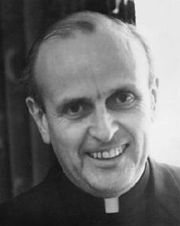
 Remember this guy?
If you were politically conscious in the 1970s, you may.
It’s the man who introduced a resolution for the impeachement against Richard Nixon.
But how could a priest do that? Don’t you have to be a member of the House of Representatives to introduce a resolution for impeachment?
Well, this man is a priest and was–at the time–a member of the House of Representatives.
He was a Democratic representative from Massachusetts, a Jesuit, and his name is Fr. Robert Drinan.
He was also vocally anti-war and vocally pro-abortion–at least in terms of the legality of abortion (he claimed to be privately opposed to it with one of those "personally opposed but . . . " rationalizations of babykilling).
And Drinan’s disgraceful performance is one of the reasons that, when the 1983 Code of Canon Law was released, it was made absolutely clear that priests are not to hold such offices. Already, under the 1917 Code, there were severe limitations on what kind of political offices priests could hold, and the Drinan scandal was so shocking that John Paul II took steps to get him out of office (Drinan eventually complied by not running for re-election to a fifth term) and to ensure that in the future priests would not follow in his footsteps. Thus the current Code of Canon Law provides:
Canon 285 §3
Clerics are forbidden to assume public offices
which entail a participation in the exercise of civil power.
So why are there now reports of a Canadian priest trying to become the Robert Drinan of the Great White North?
ED PETERS POINTS OUT HOW CANONICALLY SUSPECT THIS ALL IS.
PREDICTION: This dog won’t hunt. The Holy See will become involved in the question and order the Canadian priest not to hold elective office if he doesn’t back off on his own.

I wonder if I-am-personally-opposed-but-Catholics ever actually think about the ramifications of their positions. What if, at their personal judgments, God says to them: “I am personally opposed to your going to Hell, but I am not going to impose My views on you and interfere with your freedom of choice.”
Bill, thanks for the visual. That’s likely to become a classic.
Agreed. That is actually quite the way it would go.
The Holy See will become involved in the question and order the Canadian priest not to hold elective office if he doesn’t back off on his own.
Ha ha ha. That’s the funniest thing I’ve read all week.
BillyHW,
Here is an interesting post and update on the subject.
Take care and God bless,
Inocencio
J+M+J
good link inocencio. but why did “diogenes” say this solution might satisfy a canon lawyer, but not normal people? the whole point of my posts is that this DOES NOT satisfy canon law.
i can see it coming: canon law is again going to get blamed for permitting a situation to arise, when in fact it is the DISREGARD of canon law that makes it possible. oh well. shouldering on here.
Ed Peters,
Here is a prayer to keep you shouldering on.
Take care and God bless,
Inocencio
J+M+J
Ah, Drinan. I remember thinking he was so cool back when I was young and mis/un-informed. (I went to a “Catholic” Jesuit university in the 1970s.)
Then I got me some learnin’ (in good part from the fine folks at Catholic Answers and from Mr. Akin), and I Know Better.
‘thann
I thought the large number of Jesuits who were actively part of the Sandinista regime in Nicaragua was also a strong motivational force behind that change in canon law too.
–arthur
“I am personally opposed to your going to Hell, but I am not going to impose My views on you and interfere with your freedom of choice.”
Bill,
That’s brilliant! A colleague of mine is running for CA State Assembly. He’s a “peronally opposed” Catholic. I’ve taken him to task and am trying to educate him, but that line may be the best approach!
Cheers.
I thought the large number of Jesuits who were actively part of the Sandinista regime in Nicaragua was also a strong motivational force behind that change in canon law too.
Drinan caused scandal, but the Sandanista government, with the Jesuit Priest Ernesto Cardenal as cultural minister, purposely humiliated Pope John Paul II when he visited Nicaragua.
wow.
folks, click on inocencio’s link above to a cool prayer. i had never seen it before, in fact, i’d never heard of it. really neat. thx. edp.
Well that’s just s-s-super.
Why do all Canadian clergymen (Anglicans, usually) who run for office have to do it with radical left-wing parties? It’s always either the NDP or the Bloc, parties whose agendas could not be further from Christian morality, and most of whose members cringe at the word “Christian.”
bill912,
You have out done yourself again. I will make sure and give you credit when I use your quote.
Take care and God bless,
Inocencio
J+M+J
So, adding to the growing list of names for nominal Catholics we have:
Cafeteria Catholics
C&E Catholics — Christmas & Easter
CINO Catholics — Catholic In Name Only
POB Catholics — “Personally Opposed But…”
Seems like there were more. Am I forgetting some?
Actually I have used a similar quote before (And I use ot often at RCIA) but I cannot think of where I got it from:
The existence of Hell is a perfect example of how much God respects our freedom of choice.
My favorite are what I call “Ethnic Catholics”: people who view their Catholicism as if it were merely their ethnicity.
“Yeah, I’m Catholic. But my religion is Wicca.”
You guys are too kind. (Why does my hat feel so tight today?)
Pseudomodo, I once heard Scott Hahn say that Hell is God’s respect for our freedom of choice.
If Hell is “God respecting our freedom of choice,” wouldn’t Bill’s quote actually be in *support* of POB Catholics?
Perhaps, Jeremy, if God had created us for something other than spending eternity in Heaven worshiping & praising Him.
God gave us freedom of choice, a free will, & He respects that. Unlike many of our Protestant brothers & sisters, Catholics don’t believe that some are predestined to Heaven & some to hell. God does not compell us to follow Him but allows us to make that choice for ourselves. Because of that, our choice to follow Him is so very meaningful to Him.
If I’m off base here, other are free to correct my understanding. 😉
John E,
My mother in law talks about A&P Catholics (Ashes and Palms); they only come when they can get something free!
Jimmy,
Why did you have to bring up such a bad memory as Robert Drinan? I have a headache just remembering him.
Michael,
I have vivid memories of Ernesto Cardenal kneeling in front of JPII and THE GREAT lecturing him and wagging his finger at him. This in front of the international press. I don’t think JPII got the less of that exchange.
A priest-friend of mine who was studying in the Montreal seminary at the same time as Raymond Gravel, told me he should never have been ordained.
He has since become the “chouchou” (sweetheart) of the Montreal French-speaking medias for his opposition to the moral tenets of the Catholic Church. I am also told that he is very popular with his parishioners and that his church is full on Sundays (which is quite rare!).
So, his going into politics may not be canonically right, but it may be a blessing by removing him from preaching in church…
Let us pray that his parishioners now get a priest in line with the Church’s teachings.
Is it just me or does the priest in the picture look almost like Rudy Giuliani?
Nathan:
“Why do all Canadian clergymen (Anglicans, usually) who run for office have to do it with radical left-wing parties? It’s always either the NDP or the Bloc, parties whose agendas could not be further from Christian morality, and most of whose members cringe at the word ‘Christian.'”
Be fair – they don’t cringe when they see an opportunity to hold up their “Christian” candidates as why orthodox Christians are just so darned wrong about EVERYthing… :-p
Kasia,
I hope you weren’t directing that to me. I just asked if it was just me or if the priest in the picture look almost like Rudy Giuliani?
John E,
One more for the list of “nominal Catholics”… heard this used in a homily once.
“Hatch, match and dispatch Catholics” (folks who only show up at their baptism, marriage and funeral)!
🙂
Actually, the best I’ve heard so far (which might be the more preferable kind as opposed to the former) are “Recycled Catholics”.
I remember Fr. Andrew Apostoli mentioning the need for such folks who’ve left their faith and hoped they’d be coming back.
I have vivid memories of Ernesto Cardenal kneeling in front of JPII and THE GREAT lecturing him and wagging his finger at him. This in front of the international press. I don’t think JPII got the less of that exchange. You have something on me. I have only read of the exchange. I have seen photos of the Pope on a stage in front of a revolutionary sandinista poster.
And despite the appearance that Pope John Paul got the better of the exchange, Cardenal did not regularize his status as directed to by the Pope.
Thanks Bill912, it probably was him!!
There are too many people that believe that they can reject God with impunity as if it were totally unfair that they may go to hell just because they chose to go it alone.
Bill912 hits it well in his first quote above and it’s true!
It’s not that God doesn’t love the souls in Hell, he loves them absolutely; but they have chosen to reject his love and, therefore, he has justly condemned them to Hell, or they have condemned themselves.
God respects the freedom of individuals as we should respect them as well. We love them. See, love doesn’t mean you force people. Love doesn’t mean coercion. It doesn’t mean, ‘because I love you, I’m going to force you to accept God’.
No, love is many-faceted but one of the aspects of love is that “I love you enough to respect your freedom” and God says that to us.
“I love you so much that I will let you go to Hell if you want to, because that is the gift of freedom that I have given you”, and we, as human beings, will look at the people in Hell in the same way, ‘I love you, but you have chosen this and this is what is just for you’.
If Hell is “God respecting our freedom of choice,” wouldn’t Bill’s quote actually be in *support* of POB Catholics?
Hardly. The “God gave us free will” argument that religious supporters of abortion often use proves way, way, way too much if it proves anything at all. God’s granting me free will includes not just performing abortions, but also refusing to wear seatbelts, using drugs, owning machine guns, beating up annoying people, raping women, flying planes into buildings, setting off thermonuclear devices in heavily populated areas, etc. That God allows us to do something has NO bearing on whether we should make it unlawful or not.
How does a guy with his beliefs, “Pro Gay Marriage, Pro Choice” even become a priest, or even maintain his preisthood status?
“And despite the appearance that Pope John Paul got the better of the exchange, Cardenal did not regularize his status as directed by the pope.”
That’s Cardenal’s problem. Anyone know if he’s still alive? He could probably use some prayers.
Wasn’t he the one that was gunned down in Central or South America?
Andy, could you be thinking of Bishop Romero?
“How does a guy with his beliefs, “Pro Gay Marriage, Pro Choice” even become a priest, or even maintain his preisthood status?”
The Church in Quebec in a very bad spot. In Montreal, they have been closing up to ten churches a year. Mass attendance is lower than in any other Canadian province, and dissent among the clergy is very common. While some bishops would like to discipline their priests (many of whom publicly support same-sex marriage, etc.), they would be faced with tremendous opposition from the other priests in their diocese. So pray for Quebec (formerly very Catholic), and especially for the bishops.
Bill912,
Thats the one. Nevermind.
I never heard of Drinan, but I remember all too well the scandalous Sister Mansour.
In my family, we have a few “carry ’em, marry ’em, bury ’em” Catholics. We just hope they’re shriven before the last part.
Dave,
I will. Don’t you think that these compromises actually hurt the church rather than help it?
Dave is quite right about the situation in Quebec.
For anyone unfamiliar with the sad story of the Church in Quebec since the 1960s, Google the “Quiet Revolution.” Eye-opening stuff.
Fr. Drinian. Wasn’t he the captain of the Dawntreader?
“Washington DC, Oct. 24, 2006 (CNA) – Georgetown University Law Center has named a human rights chair for a controversial priest who has been actively supportive of abortion during and after his time as a U.S. Congressman.
Dean T. Alexander Aleinikoff announced the establishment of the Robert F. Drinan, SJ, Chair in Human Rights at a formal ceremony Oct. 23; Yale Law School Dean Harold Hongju Koh gave the keynote address.
“Few have accomplished as much as Fr. Drinan, and fewer still have done so much to make the world a better place,” Aleinikoff reportedly said. “This new Chair honors Fr. Drinan’s lifelong commitment to public service and will allow us to bring distinguished human rights scholars and advocates to Georgetown Law.”
Fr. Thomas Euteneuer, president of Human Life International, has called the naming of the new Chair “deeply disturbing” and “hypocritical.” The university has established a human rights chair “in the name of a heretical priest who has spent much of his lifetime advocating for the most heinous of human rights violations: abortion,” he said in a statement……….
Since 1981, Drinan has been a professor at Georgetown Law.”
http://www.catholicnewsagency.com/new.php?n=7898
See the commentary after the article and you will see what needs to be said about “Father D” has been adequately said.
And remember Rule 1 !!!!
The documentation on Father Drinan’s political birth is an amorality play. Deceit, guile, all means to an end. Simply tools to build a platform. The result is millions of aborted children and millions of women wounded physically, emotionally and spiritually. Now there is a new challenge and it is faced by a Boston jesuit once again. Same sex marriage is required by Catholic justice as the state’s response to human love. Abortion to homosexuality, contraception to abortion, pride to contraception. It all ends in death.
Michael:
And despite the appearance that Pope John Paul got the better of the exchange, Cardenal did not regularize his status as directed to by the Pope.
On the other hand, watching that was the beginning of Daniel Ortega’s return to the Church. It’s funny how things work, and in which fields the seeds are sown and grow.
On the other hand, watching that was the beginning of Daniel Ortega’s return to the Church. It’s funny how things work, and in which fields the seeds are sown and grow.
I don’t wish to imply otherwise. I was only agreeing that the situation of some politically active priests in Nicaragua during the Sandinista regime also influenced the change in canon law. It was not just Father Drinan’s shenanigans.
It would appear that Fr. Gavel did not have the “green light” from his bishop after all. Fr. De’Sousa has an excellent piece on the topic.
http://catholiceducation.org/articles/facts/fm0088.htm
Tomorrow come never… Dolora