SDG here with a belated follow-up on my mystery photo post — and a bunch of photos.
First, as I acknowledged in the combox, the two mystery photos show me in Geneva and Rome, posing with large statuary representations of John Calvin (among others) and St. Peter — an echo of my faith journey from the Calvinist milieu of my upbringing to the Catholic faith I hold today.
But what else do Geneva and Rome have in common? After all, I wasn’t there as a Tiber-swimming pilgrim first and foremost. As I mentioned in the combox, the trip was movie related — and the specific connection was mentioned in earlier comments. In fact, Geneva and Rome are both important settings in … Dan Brown’s Angels & Demons, the movie version of which opens in May.
Earlier this month, I was one of a number of journalists from around the world that converged in Switzerland and Italy to view settings from the story and to interview the filmmakers, among other things. We also saw some excerpts from the as-yet-unfinished film.
In connection with the trip, I’ll be writing a piece for Christianity Today magazine on anti-Catholicism in Hollywood. I’ll also be reporting on all things Dan Brown in a number of Catholic venues, both print and radio.
In Geneva we visited CERN, the European Organization for Nuclear Research (official site | Wikipedia), a particle physics laboratory that figures in Angels & Demons. (The bad guys steal about a gram of anti-matter from CERN in order to blow up the Vatican. (How plausible is this? Short answer: CERN does make anti-matter, in infinitessimal quantities — a few atoms at a time — which are almost instantly annihilated. They can’t store anti-matter for any length of time, and even if they could it would take something like 10 million years for them to make enough for a bomb. A gram of anti-matter would, however, cause a lot of damage if annihilated all at once. For more, see CERN’s highly entertaining and informative Angels & Demons FAQ.)
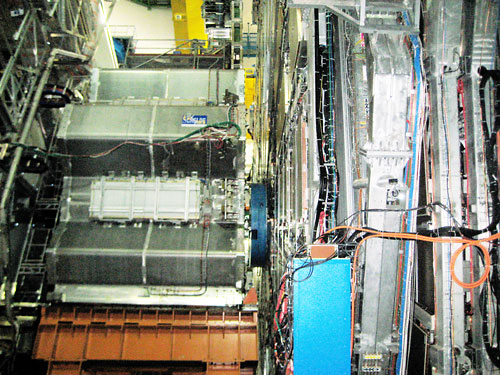
We got to go down into the Large Hadron Collider, or rather the ATLAS project, a ginormous detector that measures particle collisions in the LHC. How ginormous? There’s about as much metal in ATLAS as in the Eiffel Tower. This photo is only a tiny portion of what I could see from where I was standing, and what I could see was only a tiny portion of the whole.
The LHC is really big too: it occupies a big, circular, underground tunnel with a circumference of about 17 miles. (Why underground? Because above ground there’s all houses and roads and stuff and it’s hard to build a 17-mile circular tube somewhere where people can live close enough to work on it.)
We also got to talk to some of the scientists who work at CERN. (Favorite quote: “If Dan Brown got the Vatican as wrong as he got CERN, we [at CERN] have a lot less to complain about.”) To my surprise, I discovered that I knew two of them: An online friend from Arts & Faith named Jeff emailed me just before my flight from the US to let me know that he lives in Geneva and works at CERN, and when I got there I was approached by a Decent Films reader with whom I’d corresponded in the past, and who conducted our tour of ATLAS.
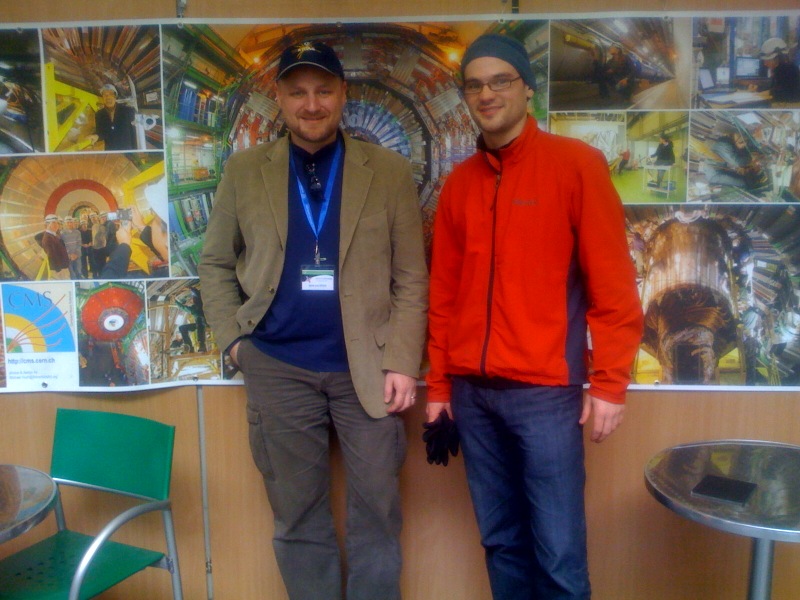
I also got a tour from Jeff of a lot of the CERN campus that wasn’t on the A&D tour, which included (or excluded, if you follow me) most of CERN except for the big exhibit dome and ATLAS. (Jeff tells me how lucky I am to have seen ATLAS — like many CERN folks on different projects, even he hasn’t seen it, and soon CERN will be closing ATLAS permanently to visitors without formal radiation training.)
Ironically, Jeff and I lived in the same state for a couple of years in the 1990s, Pennsylvania. How strange that we had to travel a quarter of the way around the globe for our paths to converge at such an unlikely location.
Anyway, I’ll post more pictures of Geneva later, and I’ll talk more about covering Angels & Demons in Rome. For now, I’ll just jump to posting some photos from my time in Rome. (You know what they say about pictures and words!)
It doesn’t give you a clue how big St. Peter’s is, but you can get a sense of the division of space in this shot.
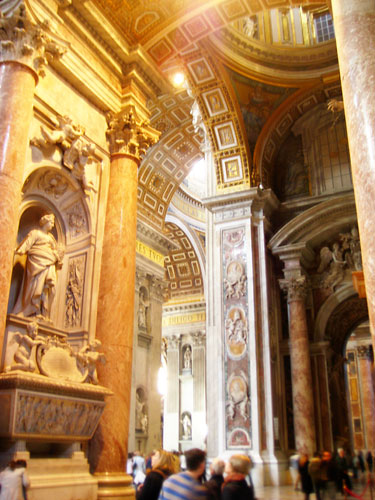
From up in the dome at St. Peters.
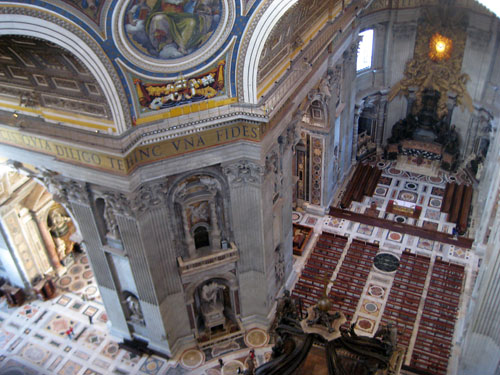
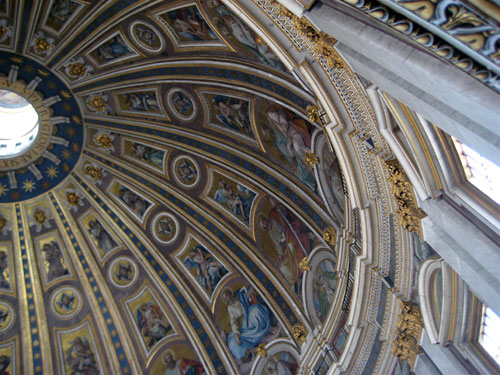
You are Peter and on this rock…
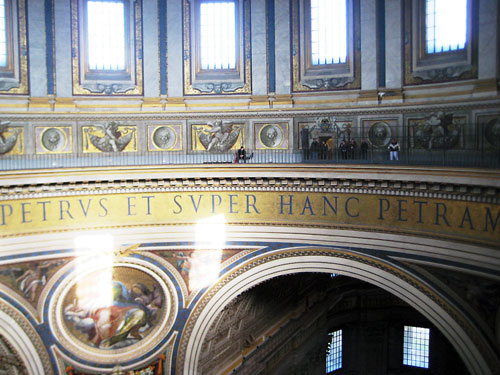
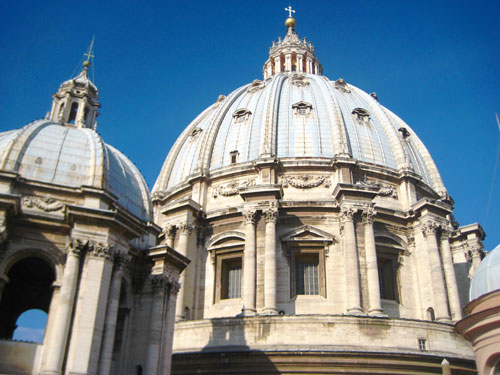
From the roof, looking up at the dome.
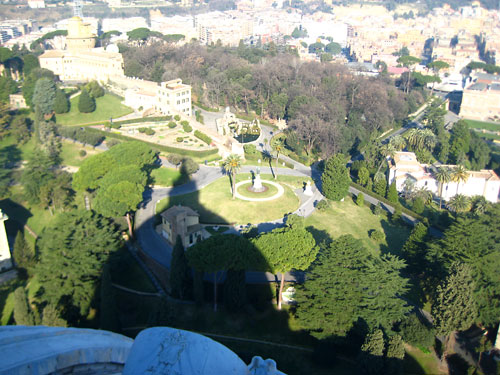
Vatican City, under the shadow of St. Peter’s, viewed from the cupola.
I think you probably know this statue. It’s at St. Peter’s, in the first chapel on the right (north) side of the nave.
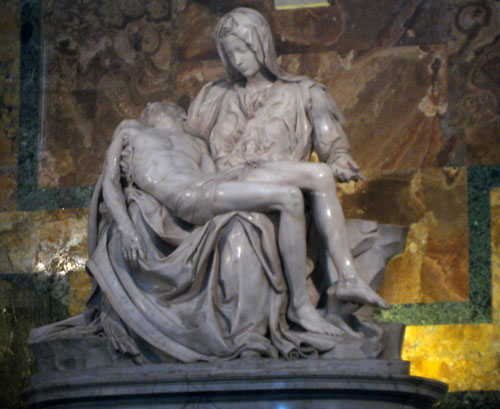
Here’s a similar subject at St. John Lateran, the pope’s cathedral. Michelangelo really was a genius, wasn’t he?
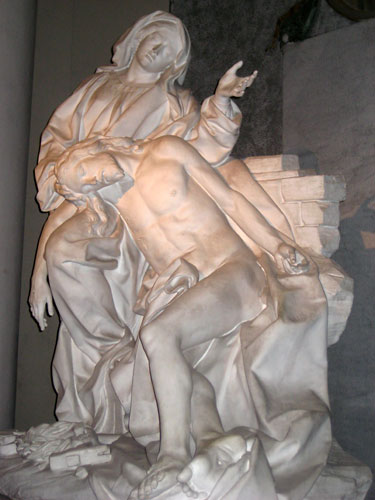
St. John Lateran.
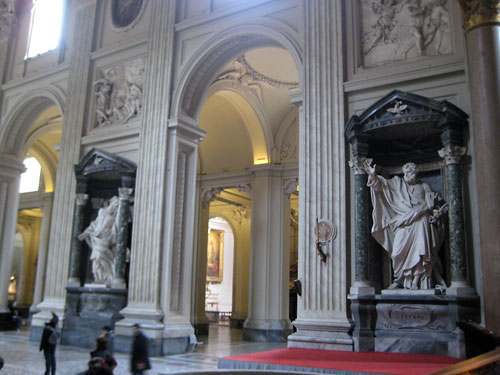
Angel from the Bridge of Angels with St. Peter’s in the background (Terry Mattingly pointed out this shot to me).
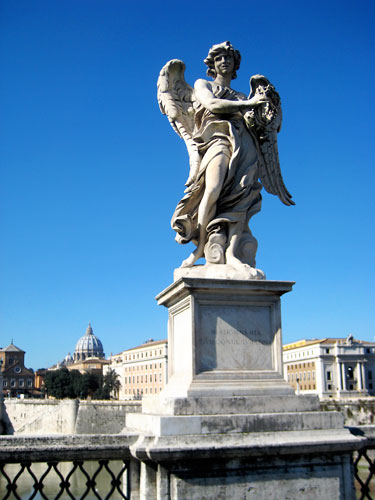
A similar shot by night.
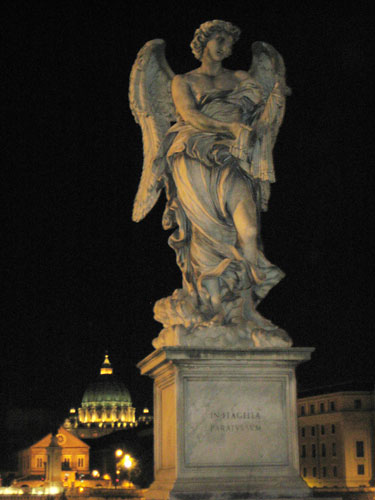
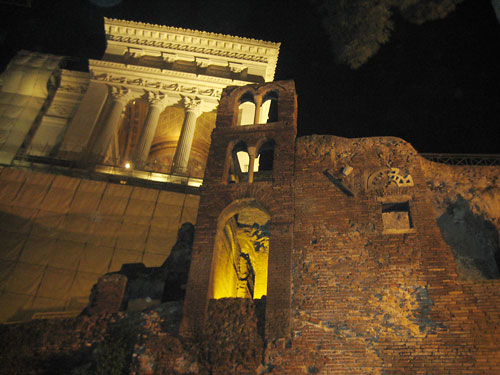
Here’s a shot I really like: old Rome and “new” Rome side by side.
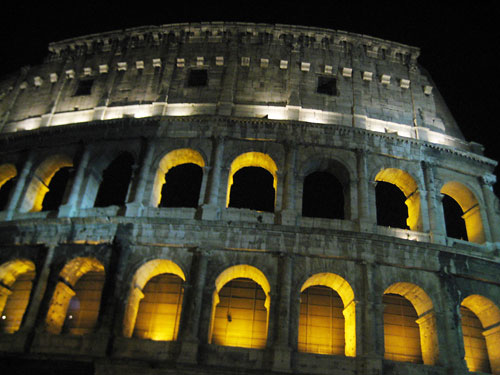
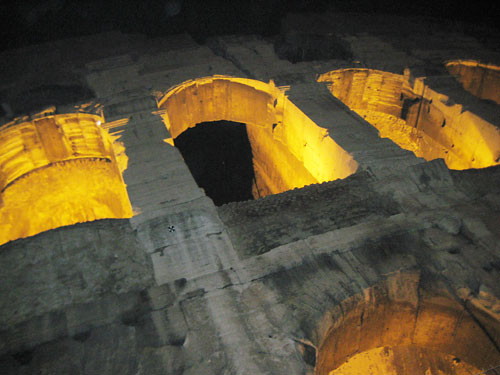
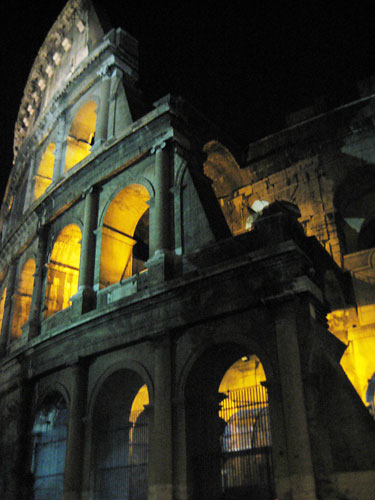
If you go to Rome, visit the Colosseum at night. You can’t go inside, but there are no crowds and you get great photos.
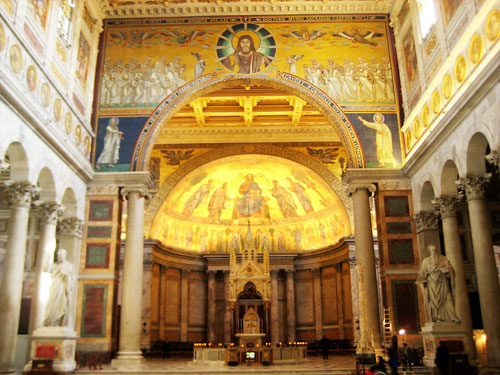
St. Paul’s Outside the Wall’s. In this shot you can see the statue of St. Peter I posed in front of as well as the apse icon from the 360-degree presentation a comboxer posted.
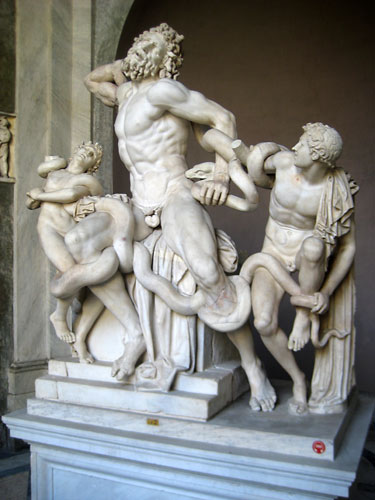
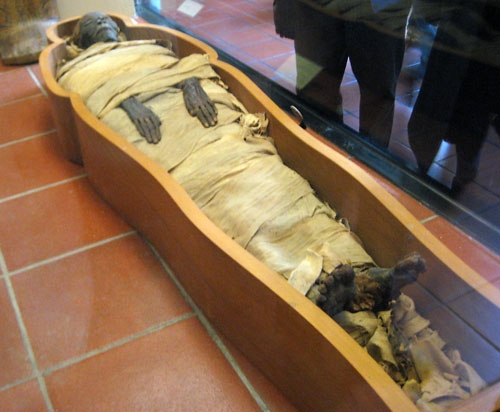
A few pics from the Vatican museums.
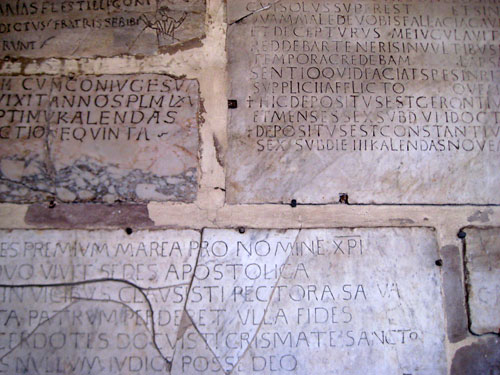
Ancient Christian graffiti, embedded into the narthex at Santa Maria in the Trastevere.
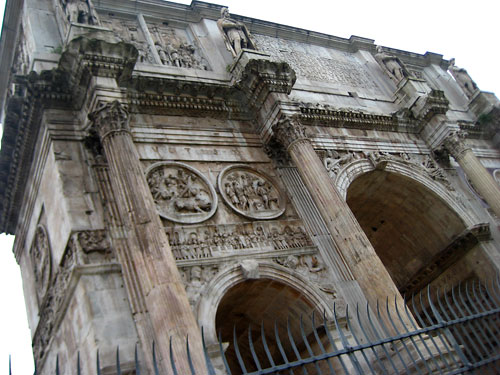
Constantinian Arch.
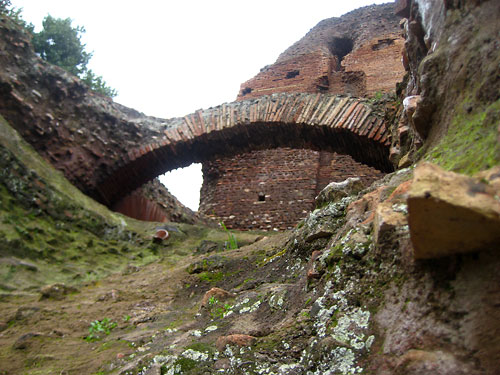
Arch from an old Roman fort near the Colosseum.
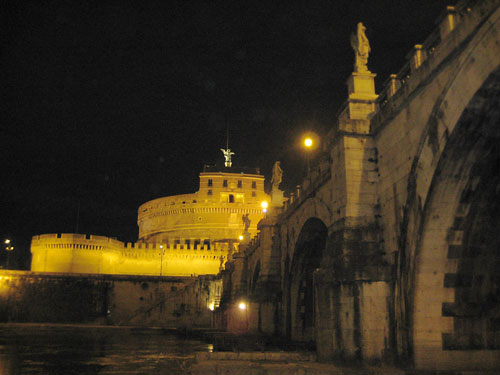
Castel D’Angelo and the Bridge of Angels by night.
So I guessed right! I had no idea that Angels and Demons had anything to do with Switzerland, but besides knowing something about the Dan Brown stuff, I just remembered the überphony CGI St. Peter’s Square from the movie’s trailer.
What a great trip! And beautiful photos, also. Are they from a cell phone, too?
That’s interesting. Do you have an estimation about your international readership on percentage terms?
Awesome. Just awesome.
Only the shot of me and Jeff. The others were taken with a digital camera. The iPhone pics aren’t that good, especially indoors and at night. (FWIW, I did some light Photoshopping on the other pics too, enhancing contrast and such.)
None at all. I don’t even know what my stats are lately. More to come (although these are probably the best).
I’ve taken a look at the stats on Alexa, once, but I was thinking about the folks who interact with you in the Mail section. Taking that as a reference, what do you think it would be?
And by the way
So I suppose it was a general press event, not a specifically Christian PR thing?
Thanks for sharing these pics! I hope I get to visit Rome at least once before I’m done Here.
Wow. I’m quite jealous (I’m a first-year physics grad student). It’s hard to describe how excited everyone involved in physics got when the LHC started up, but you probably got some sense from the visit.
And I love the “If Dan Brown got the Vatican as wrong as he got CERN…” line.
Great pictures, SDG.
It sounds like DB is writing pure fantasy.
“(Why underground? Because above ground there’s all houses and roads and stuff and it’s hard to build a 17-mile circular tube somewhere where people can live close enough to work on it.)”
Not to mention there’s a bit of radiation now and again at the targets and the synchrotron radiation at the bends in the path. This way it is dissipated harmlessly into the ground.
Welcome to gradual school, Joe. (That joke will make more sense later, trust me.) Do you know what you want to study? (I finished graduate school in physics in 1995.)
I meant to say that they used to have a page at the CERN website complaining about all of the bad physics in Angels and Demons.
“If Dan Brown got the Vatican as wrong as he got CERN, we [at CERN] have a lot less to complain about”
I think I like this quote if I understand it correctly. My mistrust of the media and Hollywood partly stems from the fact that they so often misrepresent items in medicine and medical research (two fields in which I have some knowledge) that I have to assume they also misrepresent items in religion, economics, politics, etc. (fields in which I’m ignorant).
However, by this this quite, does the physicist mean that if Dan Brown gets Vatican wrong as badly as he got CERN wrong, they (at CERN) have a lot less to complain about because the Vatican is maligned in the movie and they are just misrepresented? This is how I took it.
“But what else do Geneva and Rome have in common?”
Turkish toilets!
In 1972 I spent a little time in Geneva and discovered, at the most inopportune time for a non-seasoned eighteen year old traveler, that the train station in this extremely clean city had Turkish toilets. I was in utter disbelief and suffered, mostly silently, until, quite literally I was “relieved” to arrive at the University dorms, where I was at last in comfort.
The next, and only so far, time I was in Europe, in May 2007, I asked my eighteen year old son, who was then living in Rome, if there were any Turkish toilets in Rome. To my great delight he informed me that, indeed, there were some and we were going to visit one place in particular which had some, the Vatican.
As does a person who is thrown from a horse have to remount, so I felt the calling, for the sake of “closure” and accomplishment, to remount, what had “thrown me”, so many years ago. It could have only been better if it were at the train station in Geneva, but I had to settle for Rome. At least it was at the Vatican. It was a truly “religious” experience when I entered the “echo chamber” and saw, this time with an almost “misty-eyed” appreciation(much in contrast to the earlier time) my “steed”. It was a wonderful ride, wholly, fulfilling in every way. My son did appreciate my “experience”, although he chose not to share in it on his own. I guess he was not quite as “adventurous” as his father.
Then my son took me on his tour of what was accessible to us at the Vatican, and as we walked about he told me, very appreciatively, of the personal tour he had been taken on by Father Reggie Foster, whose Latin Class my son was taking at the time. He wore me out on that trip but it was priceless. The blisters on my feet eventually healed but the memories are always fresh and delightful.
That is one perspective of what Geneva and Rome have in common.
Thank you, for reminding me of these precious memories.
Karl
Matheus:
I’d hesitate to put a number on my non-US readership — I might guess 1 in 10 — but Alexa tells me that barely 60 percent of my readership comes from the US.
I see Slovakia is the #5 country for Decent Films readers (at about 1 percent). I know I have a fan there — whose name, Matus, I once used to confuse with yours, Matheus! — who has translated a number of my pieces into Slovak. That’s very flattering.
Correct. AFAIK there were only five of us from the Christian world, all brokered through Grace Hill Media. Whereas I’d guess there was at least seventy or eighty journalists in all, most not from the US from what I could tell.
Hans:
Would that it were so simple.
Much of Brown’s universe could be dismissed as “fantasy” in the sense that it’s wildly distorted, inaccurate or wishful thinking. But his world is sufficiently tethered to reality, and specifically to a particular construal of reality — a universalist-feminist-neopagan affirmation of everything human except revealed religion and patriarchy — to be a corrosive cultural force. (That and the fact that his writing is so monumentally awful and people seem to think it’s all right.)
Do you mean this page that I linked to in the post above?
That’s not how I initially took it, but the more I think about it the more I think you could be right. I originally took “We have less to complain about” to mean not “less than the Vatican,” but “less than we would if it were only us that Brown was misrepresenting.” In other words, if the grievance is distributed to more parties, one party doesn’t bear the whole weight of it. But your reading makes a lot of sense.
Thank you for sharing your story. I also have some stories about foreign commodes that I pecked out via iPhone and sent home, with photos, while I was abroad. However, unless one of a very select group of recipients does something unexpected, that is all the vast majority of readers here will ever learn. 🙂
At least we have an answer to a very important question re the LHC…
http://hasthelargehadroncolliderdestroyedtheworldyet.com/
SDG, who or what is that pic with the guy in the coffin?
“Do you mean this page that I linked to in the post above?”
Ah yes, I missed the link, and that’s probably the same page, but updated. I’d remembered it as more acerbic.
And I suppose I should have said ‘bad fantasy’.
Dear John
From what I understood, the coffin is possibly from an early Christian cemetery in the Roman catacombs.
Or not?