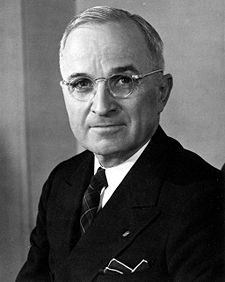
 As a result of recent discussion of torture (which is not the subject of this post, so don't veer into that topic in the combox; I may do a post on the subject of torture soon), the question arose on The Daily Show of whether Harry Truman was a war criminal.
He should have stuck to his guns. He was right the first time.
At least, I'd say that with a few of words of clarification.
First, we have to be clear about what is meant by the term "war criminal." This term could be construed in terms of then-existing or current international law regarding war crimes. That is not my area of expertise, and I am not presently interested in whether Truman's actions violated human law.
I am interested in the question from a viewpoint of moral theology, and in that framework the question of what counts as a war criminal will not depend on whether one has violated human law but whether one has violated the fundamental moral jus in bello, or the moral law as it operates in wartime.
A person is a war criminal, as I am using the term, if he commits acts that objectively speaking violate the moral jus in bello.
2312 The Church and human reason both assert the permanent validity of the moral law during armed conflict. "The mere fact that war has regrettably broken out does not mean that everything becomes licit between the warring parties."
One of the things that is never licit is the direct and voluntary taking of innocent human life. John Paul II writes in Evangelium Vitae 57:
[B]y the authority which Christ conferred upon Peter and his Successors, and in communion with the Bishops of the Catholic Church, I confirm that the direct and voluntary killing of an innocent human being is always gravely immoral.
For purposes of our present discussion . . .
A person is killed directly if that person is the target or part of the target in the act of killing. That is, the person is not killed as "collateral damage" that results from the attempt to destroy a different target.
A person is killed voluntarily if his death is foreseen as a result of the contemplated action and it is carried out anyway.
A person is innocent if he is not a combatant or a person engaged in proximate material cooperation with combat activities (e.g., military officers who, while not directly in combat, do support work for the war machine; civilians working in munitions plants).
Remote material cooperation in combat activities (e.g., as in the case of farmers who grow food that soldiers eat) is not sufficient to deprive a person of the status of "innocent civilian," for in time of war virtually everyone in society has–at least through the payment of taxes–remote material cooperation in combat activities, which would obliterate the very distinction th
at the Church is at pains to draw in its teaching regarding not killing civilians during wartime.
at the Church is at pains to draw in its teaching regarding not killing civilians during wartime.
If one accepts these premises then it follows that Harry Truman's bombing of Hiroshima and Nagasaki were war crimes–that is, they occurred during time of war and they violated the moral jus in bello.
This is because entire cities were targeted to produce the greatest psychological effect on the Japanese and these cities included innocent civilians who were part of the target.
Don't get me wrong. I'm not a prude about the use of lethal force or about the use of atomic weapons. I can envision hypothetical scenarios in which their use would be legitimate, but a set of rigorous conditions would have to be met. Specifically, there would have to be a sufficiently high value combat-related target to justify the collateral damage incurred from the use of the Bomb and there would have to be no cost-effective alternative that would result in less collateral damage.
Such conditions were not met in the case of the atomic bombings of Hiroshima and Nagasaki. The cities themselves were targets, including their innocent civilians.
Harry Truman was thus a war criminal in the sense I am using the term.
In saying this, I don't pass judgment on him. I don't know the state of his soul, and I have no idea whether he has the intellectual formation needed or–given the pressures of wartime–the psychological wherewithal to analyze the issue in the way just presented.
Maybe he did; maybe he didn't. That's between him and his Creator, and I'd be among the first in volunteering to pray for his soul.
But, objectively speaking, he was a war criminal in the sense described.
And I'll go you one better.
The bombings were also acts of terrorism.
While I can't point to an official definition of terrorism endorsed by the Magisterium, it seems to me that sufficient conditions are present for terrorism, morally speaking, if
1) The grave harm of innocents (as defined above) is directly and voluntarily threatened or inflicted and
2) The purpose of (1) is to generate a sense of fear (i.e., terror) in some party and
3) This fear is either an end in itself or a means to accomplishing another goal.
These conditions were present in the bombings of Hiroshima and Nagasaki. Grave harm was inflicted on innocents to generate fear in the Japanese leadership as a means of compelling them to surrender.

And some people still vote Democrat.
Hi Jimmy,
I enjoy reading the article. I am not sure whether you are say that it is ok to use an nuclear weapon
at some point provided there is ” a sufficiently high value combat-related target to justify the collateral damage incurred from the use of the Bomb and there would have to be no cost-effective alternative that would result in less collateral damage”.
If you are saying this, I am afraid I disagree with you. The immediate to long lasting effects don’t justify it use at all. Such a weapon will always effect innocent people.
Hi Jimmy,
I enjoy reading the article. I am not sure whether you are say that it is ok to use an nuclear weapon
at some point provided there is ” a sufficiently high value combat-related target to justify the collateral damage incurred from the use of the Bomb and there would have to be no cost-effective alternative that would result in less collateral damage”.
If you are saying this, I am afraid I disagree with you. The immediate to long lasting effects don’t justify it use at all. Such a weapon will always effect innocent people.
Hi Jimmy,
I enjoy reading the article. I am not sure whether you are say that it is ok to use an nuclear weapon
at some point provided there is ” a sufficiently high value combat-related target to justify the collateral damage incurred from the use of the Bomb and there would have to be no cost-effective alternative that would result in less collateral damage”.
If you are saying this, I am afraid I disagree with you. The immediate to long lasting effects don’t justify it use at all. Such a weapon will always effect innocent people.
Gertrude Elizabeth Anscombe, analytic philosopher and Catholic convert, agreed with the war crimes charge.
Tying the issue in with the Obama controversy, in 1956 she protested Oxford’s bestowal of an *honorary degree* on Truman “because one can share in the guilt of a bad action by praise and flattery, as also by defending it.”
Her pamphlet “Mr Truman’s Degree” also contains other choice excerpts. Here she is about the college official bestowing the honor:
“He must make a speech which should pretend to show that a couple of massacres to a man’s credit are not exactly a reason for not showing him honour. . . . The defence, I think, would not have been well received at Nuremberg.”
To my knowledge, it was Anscombe who first used the word “consequentialism” as it is used in contemporary ethical thought and Catholic moral theology.
Also look up Andrew Cusack’s post at the New Criterion collecting other reactions to the attacks. Here’s one quote:
‘A 1947 editorial in the Chicago Tribune, at the time a leading conservative voice, claimed that President Truman and his advisers were guilty of “crimes against humanity” for “the utterly unnecessary killing of uncounted Japanese.”‘
Another:
‘Bishop Fulton Sheen, the popular television personality, called it “our national sin” while Fr. James Gillis, a Paulist priest who was the editor of the Catholic World and a leading figure in the circles of the American right, called it “the most powerful blow ever delivered against Christian civilization and the moral law.”‘
And Military historian Maj. Gen. J.F.C. Fuller wrote:
“Though to save life is laudable, it in no way justifies the employment of means which run counter to every precept of humanity and the customs of war. Should it do so, then, on the pretext of shortening a war and of saving lives, every imaginable atrocity can be justified.”
Admiral William D. Leahey:
“the use of this barbarous weapon at Hiroshima and Nagasaki was of no material assistance in our war against Japan. . . . My own feeling was that in being the first to use it, we had adopted an ethical standard common to the barbarians of the Dark Ages. I was not taught to make wars in that fashion, and wars cannot be won by destroying women and children.”
I too wish Stewart hadn’t backed down. Maybe we should send him this information for his edification?
It soulds like the problem is that the definition of “war crimes” might be a bit to vague.
After reading the evidence from the CCC, I think there is clarity there. It reminds of of the deep sorrow and confusion I experienced when I watched a documentary produced by HBO 3 years ago. This documentary made it clear to me that there Hiroshima was a heavily populated Catholic town. Most of the deaths there were Catholic.Even a church was blown up. Now, from above, it is very easy to see the “cross” which makes the aerial view of a church. But yet, they dropped bombs directly over it. Most of the survivors still cling to their faith. It was moving.
That day, America divorced herself from morality in the quest for a new brand of freedom.
So FDR and General Marshall (and I’m sure others, especially Gen. Lemay) would also be considered war criminals due to the fire bombings of Japan before Hiroshima and Nagasaki?
I’m also guessing that some of those B-29 crewmembers are still alive. Should we round them up?
Joe S, perhaps you should read again the part where Jimmy explained the sense in which he used the term?
“A person is killed voluntarily if his death is foreseen as a result of the contemplated action and it is carried out anyway.”
This sentence seems to contradict or at least confuses the issue with the Principle of Double Effect, which has been demonstrated not to apply to Truman’s decision to drop the atomic bomb.
I appreciate Jimmy taking the time to define what he means by ‘war criminal’ and ‘terrorist’ in denouncing Truman.
However, inasmuch as those who advance the argument that Hiroshima was just tend to point to the actual deliberations and historical context which compelled the United States to do so — as noted here — it may be worthwhile for Jimmy to engage this directly in making his case.
I did read it. Jimmy said targeting cities was a war crime.
The fire bombing raids targeted “cities” just as the atomic bomb droppings. And just as the British did when they conducted night area bombings of Germany.
The atomic bombs did it with just one plane instead of hundreds or thousands. And many of the fire bombing raids on Japan killed more than the atomic bombs did.
For an excellent history of the decision to use The Bomb, read “Downfall” be Richard Frank.
The first chapter discusses the fire bombing raids and how horrific they were.
Jimmy is using the term “from a viewpoint of moral theology”. He *nowhere* implied that surviving B-29 crewmembers should be arrested.
I have seen Truman’s “massonic order regalia” photo. Just 6 at the time, I could not understand what it meant. As knowledge grew, I understood that it was like a “party” to the democrats, who gave Truman a gift for killing so many Catholics. Yet God showed us the “gift” of truth, when 8 memebers each, of the Jesuit houses, at ground zero where unaffected by the bombs. At both cities, the priests were kept safe because they lived their marion devotion. Just recently the last one died a natural death. The great men of our military were used, or “owned”, by that president, to do the order’s will. The bombs are still being dropped in the abortion mills.
“hazardous moral decision”
Kind of like how choosing abortion is a “difficult decision for the mother”.
Is it wrong? There’s your first clue.
adoremus,
Truman’s desire was to kill Hiroshima’s Catholics and fulfill the bidding of his Grand Masonic Masters.
It all becomes so clear now. Thank you for spelling it out for the rest of us.
bill912: Fair enough.
An argument could be made that the Bombs (and the fire bombing) meet Jimmy’s two part test.
Much of the Japanese “war industry” was scattered throughout cities in small machine shops in and near peoples’ homes. So “the cities” were combat-related targets.
Second, continuing the fire bombing would have cost both more allied lives and also more Japanese lives than the bombings took.
Frank’s book goes into details about deaths from starvation that were expected of both allied populations under occupation (and POWs) and Japanese civilians as the stranglehold of the bombings and minings of the harbors continued. Especially if the war continued through the winter of 45-46.
It’s important to realize that no argument about the usefulness of the bombings, or whether the bombings were “necessary,” or whether more deaths were prevented by the bombings than were caused by the bombings, is at all relevant in the question of whether they constituted the morally illicit direct targeting of the innocent.
From what I understand, the bombings were not sneak attacks. Leaflets warning about the possible destruction of the major Japanese cites and the days of the bombings were dropped on 35 Japanese cities. These had a warning to evacuate. Newsbusters had something on this. While it does not mitigate the damage done, I would say it does have some bearing on the culpability, albeit a small amount.
http://www.newsbusters.org/blogs/noel-sheppard/2009/05/02/newsbusters-reader-pjtv-give-jon-stewart-history-lesson
Nice post, Mr. Akin! I agree with your reasoning here, and I was wondering what you considered of the concern regarding targetability of nuclear weapons generally. I would argue that in no case could a nuclear weapon be used near a populated area, simply because the targetability to discriminate to any degree between bystander and combatant is absent.
First, radioactive fallout is like a biological weapon or a dirty bomb; you have no control at all over who is and is not affected. Consequently, in any populated area, you will have introduced an uncontrolled life-threatening weapon.
Second, even with respect to the blast itself, the explosion is so large that, hit or miss, it is likely to destroy an entire metropolitan area. So-called “tactical nuclear weapons” of limited radius might escape this difficulty, but not the problem with fallout.
My suspicion is that the licit use of nuclear weapons would only be something like bunker busters used in deserted areas or remote military installations (say, nuclear missile silos).
I think the weakest premise of Jimmy’s above revolves around this premise and it’s application to this situation:
A person is killed directly if that person is the target or part of the target in the act of killing.
I do not know the details of this campaign of dropping leaflets warning of the attacks. But if it were done properly, it seems that it weighs heavily in the consideration of whether innocents were the “target or part of the target”. If a deliberate, good faith, and substantial effort was made to warn innocents, and they chose not to leave a military target during a known conflict, then it seems difficult to make the case that they were part of the target rather than collateral damage.
I think it would have been better to surrender on Dec 7, 1941 to Japan’s moral attack on Pearl Harbor. That way, we could have endured 60+ years of religious persecution under the Japanese and the Germans. This would have made us better centered Catholics looking forward to glory, than sitting at our computers looking back.
Dear Jimmy,
Reasonable people disagree about this—meaning Truman’s decision to drop the bomb. People who have studied the history much longer and deeper than you have arrived at no clear consensus. While, as an historian, I disagree with Truman’s decision, other reasonable and ethically-considerate historians demur.
As for ~your~ ethical analysis, it’s basically too presentist. And it goes to why historians disagree. You’re applying just war principles that have developed immensely in the 64 years that have passed since the action—in great part because the bomb was dropped. You’re also not considering the conflicting cost estimates (in terms of soldier’s lives, time, etc.) that were in Truman’s hands circa July 1945. This was total war, not a constrained war. Just war principles seem to apply most readily in constrained war scenarios.
Finally, where is this all going? It’s not news. Robert McNamara himself, in *Fog of War*, pointed out that he, Curtis LeMay, and Truman would’ve all been tried as war criminals for the fire-bombing of Tokyo if the U.S. had lost the war.
– TL
According to Wikipedia, Hiroshima did not receive leaflets before the bombing:
http://en.wikipedia.org/wiki/Atomic_bombings_of_Hiroshima_and_Nagasaki
This seems confirmed by the Truman library, which indicates leaflets threatening more nukes were dropped on Nagasaki after the Hiroshima bombing, but no mention is made of leaflets for Hiroshima prior to the bombing:
http://www.trumanlibrary.org/whistlestop/study_collections/bomb/ferrell_book/ferrell_book_chap11.htm
Sorry Jimmy, I disagree. What I read from the Truman library is that there was a psychological warfare campaign including leaflets. Attached to the site are two leaflets that were used after the first bomb, but nothing that says there were no prior leaflets.
Wiki’s sources cited say there was no warning. The Smithsonian says there was and other sources (google for LeMay Bombing leaflets).
Don’t misunderstand me, I’m not excusing away the innocent lives. I’m just trying to get a full picture.
I agree with you Jimmy, but I wonder if you aren’t forceful enough on the maintenance of nuclear weapons. I was under the impression John XXIII had sealed the deal when he wrote “nuclear weapons must be banned” in Pacem in Terris. Similarly, Pope Pius XII had very strong words against such threats of mass destruction. The matter is rather simple — nuclear weapons render just war inert. To suggest that a “tactical” nuclear war could be fought is ridiculous and purposefully ignorant of the nature of war. War, by its very nature, escalates. And by this escalation, one can expect that not only tactical nuclear weapons (which someone else already showed are very questionable) but the big boys as well (MIRV’d ICBMS, SLBMs, etc.)will be used.
The question becomes is it within our moral capacity to allow the death of millions? Is it morally illicit to burn children and parents alive? To poison entire regions with radiation? To destroy all food sources, sanitation, electricity, and medical help — essentially, all necessary aspects of civilization? We should make no mistake — war becomes total, and a total nuclear war can, in no wise, be moral.
I am a Catholic priest and a veteran. I have never met a veteran of WWII, especially of the Pacific theater, who thought we should have not dropped the atomic bomb. Yet, Nagasaki was one of the largest Catholic populations where Maximillian Kolbe and the OFM CONVENTUALS had a large following and evangelization center. Irony here.
At least one of the crew of the Enola Gay, B29 carrying the bomb, joined a Trappist or Carmelite monastery after the war. Numerous accounts exist of bomber crews who have undergone psychiatric treatment after leveling cities.
Fire bombing of Dresden Germany killed more people.
We must come to grips with our Catholic faith and how we respond/relate to violence and war. American foreign policy is incredibly incongruous, or simply nonsensical. For the purists out there; think of how few times the US has delcared war through Congress, as the constitution provides. Furthermore, do Just War principles apply to what it truly means to be Christian?
Some things to ponder…
What concerns me here is the definition of terrorism. It seems… um… vague. Vague like a vague thing.
For example, if you run a haunted house, it would seem that you are performing a terrorist act.
1) The grave harm of innocents (as defined above) is directly and voluntarily threatened or inflicted and
2) The purpose of (1) is to generate a sense of fear (i.e., terror) in some party and
3) This fear is either an end in itself or a means to accomplishing another goal.
Harm is threatened in many haunted houses, even though everyone is aware that it’s just a threat. The purpose is to generate a sense of fear, albeit a pleasurable one, and to collect money, albeit in small amounts.
Ergo, this is a pretty darned vague definition.
The other thing that occurs to me is that all just war scenarios do seem to include justified threats and fears. The implied status of nation-states or people who have some kind of defense in hand is, “If you hurt me, I _will_ hurt you back. Fear this, and as a rational being, act accordingly.”
The above incredibly vague definition would seem to make this rather basic stance an illegal one. Until someone does hurt someone else, everyone is an innocent, so innocents are being threatened. Fear is being generated on purpose, for a specific goal.
Sigh. This is why all this law and philosophy stuff makes me tired. It’s nothing but loopholes and vagueness, no matter how hard people try to write clearly.
My objection to the premise above rises and falls on the strength of the assertion that the leaflet campaign or similar measures were taken to warn innocents.
However, I think the assertion that an open act of war (the bombing), committed against an agressor with whom you have been openly at war with (at their own declaration no less) for years, constitutes “Terrorism” is patently ridiculous. At the very least, it requires a definition of “Terrorism” that is ridiculously imprecise.
Interesting discussion. With the absence of anything remotely similar to surgical bombing capabilities in WWII, wouldn’t every single urban bombing campaign (Dresden, Berlin, Tokyo) fall under the same category of “targeting civilians”? I’m pretty sure we killed more innocent civilians in those campaigns, than in the combination Hiroshima/Nagasaki.
That said, in spite of the troubling aspects of the A-bombings, I would like to consider the good that did come out of it:
1) The prevention of a necessary land invasion of Japan, which would have easily killed upwards of a million military personnel and innocent civilians across not only Hiroshima/Nagasaki, but Tokyo. And where do Japanese refugees go in such a scenario? Given the likelihood/certainty that this would be an issue, how would a land invasion be any less a targeting of civilians., i.e., an attempt to reduce Japanese civilization to ruins as incentive for the gov’t to submit…
2) The discouragement of Stalin turning on the U.S. and driving towards the English Channel, which would have resulted in the enslavement of most of Europe to communism. It’s no secret that the bombings were as much for Stalin’s consumption as they were for ending the war.
3) Complete and total submission of a Japanese government that expected civilians to fight to the death. If one looks up the word “fanatic” in the dictionary, it should include a picture of Hirohito and Tojo. Whereas it may be possible to claim that the U.S. targeted civilians, it is a certainty that they were already marked for death by their own gov’t in the event of an Allied land invasion. There are many accounts by military personnel of the particularly startling ends to which Japanese civilians were willing to sacrifice their own lives in the face of astronomical odds, taking on Allied soldiers during the island invasions. There was enough governmental brainwashing that convinced the gen. population that they were worthy cannon fodder for the sake of their “divine” Emperor. By all appearances, the A-bombings caused the Japanese nation to “snap out of” its idolatry of the Emperor and their expansionist aspirations. That they became one of the great democratic nations of the 20th century – and a great friend of the United States, is a miracle of sorts.
4) It also must be stated that Harry Truman was very likely influenced in his decision by his experience as a battlefield solder in WWI. At the time of the Armistice, the U.S., French, Canadian, and British armies were driving the Germans out of France, over the Rhine and back to Berlin. There were very divided opinions on how to manage the end of the war. Whereas the French and British and American diplomats wanted a quick cease fire when the iron was hot, many others were certain that without getting a full, unconditional surrender of the German army, there would be a reckoning at some point in the future. General Pershing was among those who believed that by allowing the German army to simply march back to Germany without total surrender, they could live under the illusion that they didn’t really lose, but simply “stopped fighting”. Truman was on the front lines when the Armistice took place. It turned out the critics of the Armistice were right about the grave mistake in letting the German military save face. As president, this was likely a prominent influence in bringing the Japanese and Germans to their knees. There would be no saving of face, but total unconditional surrender from both foes. And the A-bomb was the shortest path to that conclusion.
But we still come back to the belief that the ends do not justify the means. I can’t reconcile it. On the one hand, I agree with Jimmy on the black-and-white definition of war crimes. On the other hand, the enormity of the carnage already sustained across the world, plus the looming final act of conventional warfare almost certainly blurred the ability of anyone in power to compartmentalize a decision of such magnitude by considering absolutes. At some point, the soldier with the shattered leg on the battlefield just wants someone to cut it off to stop the pain, even if it could eventually heal with proper medical care. We need to be extremely careful of how we apply such labels as “war criminal” to those who were operating in situations far FAR worse than we’ve ever encountered in our own lives.
Tim Lacy writes: “You’re applying just war principles that have developed immensely in the 64 years that have passed since the action—in great part because the bomb was dropped.”
The charge of presentism is refuted by the evidence referred to and reiterated in my 12:16:38 posting, which quoted from near-contemporary criticisms of the attack.
Dear KJJ,
All of those cited in your 12:16:38 comment wrote after the fact—with perfect hindsight. Near contemporary is not the same as contemporary. Again, many estimates received by Truman ~prior to the bombing~ foresaw horrific losses for U.S. forces in the context of a total war scenario (i.e. civilians were recruited as combatants).
– TL
As for ~your~ ethical analysis, it’s basically too presentist. And it goes to why historians disagree. You’re applying just war principles that have developed immensely in the 64 years that have passed since the action
When I say that a medieval doctor killed a given patient by the treatment he gave him, I am applying medical principles that developed immensely since then.
You know what?
He still killed him.
My mother-in-law is Japanese. She was a teenager living in Tokyo during the war and lived through U.S. bombing and almost starved to death. Yet she bears no ill will to Americans. She even married one.
She does not recall being told to fight to her last breath, or being given any military training at all. She says most people just wanted the war to end. This does not sound like a civilian population that would have offered much resistance.
She vividly recalls being on a train platform filled with children on their way to school that was strafed by a U.S. fighter plane. It came in at low altitude and she says the pilot must have known he was killing kids.
Something that hasn’t been brought up here yet (but perhaps alluded to by Chris) is that we didn’t have to take the war to the Japanese mainland. There were diplomatic openings for a negotiated peace with Japan, but Roosevelt, then Truman, felt that only an unconditional surrender was politically palatable. So the choice between using the bomb and invading the mainland was a false dichotomy.
First, why is anybody taking Jon Stewart’s opinion on anything seriously? Stewart is a comedian who plays the host of a satirical, faux news show. Why don’t we just ask the “anchors” on Saturday Night Live’s “Weekend Update” for their opinions on such matters?
Second, this whole discussion misses an important point: At the time, the only alternative to dropping atomic bombs was a massive invasion of Japan that — according to military estimates at the time and serious historians — would have resulted in massive American casualties (more than 1 million) and prolonged the war into 1946, perhaps 1947. Moreover, the Japanese civilians were being trained by their government to be guerillas (women were ordered to make bamboo spears so they could impale invading troops), so they would have no status as “non-combatants.”
As the commander-in-chief of American armed forces, Pres. Truman had the primary moral obligation to protect as many soldiers and sailors under his command as possible while pursuing victory. In addition, the Americans told the Japanese government to surrender unconditionally or face a destructive new weapon. The Japanese knew what the surrender terms were and rebuffed them; they wanted to maintain the army and the emperor, which was unacceptable to the Allies (and why should it be acceptable, given Japanese atrocities since their invasion of China nearly 15 years before?).
The party that’s most morally responsible is the militarist Japanese government. They rebuffed surrender, even after Hiroshima (which means they were primariliy responsible for Nagasaki). Only the emperor’s radio address after Nagasaki resulted in surrender — and, even then, the more militant factions of the Japanese government wanted to continue fighting; young officer candidates attempt a coup to topple the emperor and killed the head of his bodyguard.
Pres. Truman is not a “war criminal.” He is a hero. He ended a bloody, costly war — and, as a result of the nuclear attacks, the Japanese made a provision in their new constitution never to engage in war again.
Third, these kind of moral “analyses” mock Catholic thought. They lack any connection to the real world. They seem to be conjured up in the rarified air of an esoteric academe that posits a perfectable world. Any smug, self-righteous twit who never had to make such decisions, let alone face their consequences, can criticize those “in the arena,” as Theodore Roosevelt would have put it.
Finally, I cannot give moral credibility to a Church that conjures up these schemes at the expense of disciplining the corrupt prelates in its midst — and, Jimmy, I cannot take your moral pronouncements seriously when you and your fellow apologists fail or refuse to hold to account those among your number who 1)constantly misrepresent opposing arguments 2)construct rhetorical straw men 3)issue personal attacks when all else fails or 4)embarass anonymous blog commenters by posting private information about them.
You know which two people I’m talking about, Jimmy. Save your moral pronouncements for your own.
Consequentialism.
For a human perspective on the city firebombings, rent “Grave of the Fireflies”, a Japanese anime. I recommend it. SDG has a review up on it at Decent Films.
Mary – Absolutely I agree that the fire bombings were essentially targeting civilians, and deplorable from the perch we now sit upon.
I would also like to re-emphasize that we’re making a very broad assumption that the A-Bomb is the only kind of incident of civilian targeting. As you pointed out, the firebombings of Tokyo targeted civilians in order to create terror and/or spark popular uprisings against the gov’t, as did Dresden and Berlin. But anyone who thinks a two-million strong Allied invasion of the mainland wouldn’t also amount to civilian targeting isn’t thinking straight since they would have to slice through heavily populated cities on the way to Tokyo and to secure the neighboring isles, accompanied certainly by indiscriminate bombing.
Perhaps all of this hindsight is useless, but I would venture to say that the use of the atomic bomb not only spared more civilian lives than it took, but it also changed forever the way war is approached. Europe was the eternal battlefield. The idea of collective security or balance-of-power was constantly raised up and then violently overthrown in war after war after war, resulting in millions upon millons of deaths. Now that the world has seen a) the power of atomic weaponry, and b) the willingness of someone to use it, I submit that we will never see the kind of carnage the first two world wars produced (and the wars before them) ever again. In a sick, twisted way, the atomic bomb forced nations with centuries of historical belligerence toward each other to get along – or at least stop resorting to diplomacy at the end of a gun.
So, good came from bad. It doesn’t “justify” the bad, but we have to take solace in the good things that resulted. I choose not to judge those who believed it a greater good to end the war quickly. They may have been objectively wrong, but as Jimmy pointed out, it’s impossible to judge their souls, given the extremity of circumstances unfolding…
I disagree with the comments made in this article. The writer of this article does not question the cowardly attack on Pearl Harbor nor does it question what the Japanese did during their rape of Nanking, China. Likewise what the Japanese did when they experimented on prisoners of war in a Japanese POW camp in Manchuria. They were equally as bad as the Nazi’s in Europe and never apologized for their actions. I was training on the island of Okinawa in preparation for the landing on Japanese home land islands when President Truman ordered the dropping of the 2 atomic bombs on Nagasaki and Hiroshima. I believe that by this method of shortening the war many lives were save on both sides.
A.M.D.G.
How about letting the dead rest in peace, Mr. Akin? What is the point in calling President Truman a “war criminal” sixty-four years after these events? There are two types of decisions during a war: bad and worse. Hindsight is always 20/20 and it is immensely easy to second-guess decades after the fact. We didn’t have smart bombs in 1945. The Japanese started it and Uncle Sam finished it as only we can. The loss of civilian life is obviously tragic but Japan has been as peaceful as a lamb ever since. The president’s duty is to protect the country and save American lives. He did that. How dare you call him a terrorist.
My Grandfather (God rest his soul) took a grenade in the arm at the Battle of the Bulge and many people reading this would not have been born had their dads or grandfathers had to invade the home islands. A hearty thank you on my behalf to President Truman for ending the war and to heroic men who fought it like my Grandpa Stanton and the gentleman who served in the Marines who posted above me. I enjoy speaking English and these brave men kept it that way.
One important point of clarification:
The way I read Jimmy’s post, he seems to suggest that soldiers are guilty of the inexcusable gravely immoral act of killing. In other words, that it is impossible to be a soldier in a war without committing grave sin. Thus, a few questions:
1) Is this what Jimmy intended to say?
2) Is it correct to say this about war?
3) If it is not true that combatants necessarily commit grave sin, how are we to understand the Church teachings on the subject, including the quoted documents? (That is, do opposing soldiers not fall under the heading of “innocent human beings?”)
Jimmy,
Thanks for a thought-provoking article. I think you’re wrong and many of the points have been covered above. Several thoughts:
a) The Japanese used biological WMDs on the Chinese and Allied POWs in Manchuria during the war. They apparently had chemical weapons ready for a homeland invasion. Once WMDs have been used, I think the calculus changes.
b) Fog of war is a real issue which I think many amateur Catholic moral theologians underestimate. Truman just didn’t KNOW what you know.
c) Your comments on terror are not just vague; they are extra-Magisterial, so as valid as many other opinions.
d) Given the use of terror bombing in WWII, every combatant in WWII was a war criminal.
e) Reading military history and what was tolerated in the medieval period to recently, one must conclude that the just war theory is a sliding scale.
f) And the biggie: In my opinion, Catholic just war theory is still incomplete, particularly when we are dealing with a population completely under the control of a tyranny. In such a case the wishes or opinions of the other side have no effect on their govt until their govt. is decisively smashed. In addition, the enemy govt. may use its own people as human shields. We have confronted this situation in Japan, Germany and Iraq and are likely to in the future. There is a big gaping hole in just war theory in such a case and I really think it needs to be worked on, unless we plan to surrender every time a barbaric tyranny threatens us with the death of its own population.
Bravo Jimmy.
I suppose we all struggle with conforming our lives and political values to those of the Gospel. My Catholic upbringing taught me that deliberate abortion was always wrong, regardless of the hard cases, wriggling and deliberate blurring of the issue – the absolute line of innocent life and death applied.
But when I considered Hiroshima and Nagasaki, I noticed that I was doing what many “pragmatic” pro-choice people were doing with abortion. “Sad unpleasant necessity, extreme case, lesser of two evils, no other alternative, there are other evils in the world, double effect?, musn’t surrender my freedom and opportunity”.
I was prepared to limit women’s reproductive options to protect innocent human life, yet I was reluctant to limit my military options to protect innocent human life.
What was the intention of dropping nuclear weapons on Hiroshima and Nagasaki? The ultimate aim was the noble one of ending the war. But the means included the killing of non-combatants as a means towards an end. This is what makes it illicit. If somehow, no non-combatants were killed at Hiroshima would Truman’s intention have been frustated? Yes, not least because there were very few combatants there.
This is one of the tests of intention in a genuine double effect. eg If somehow, no-one was killed in the hospital next to the arms factory being bombed, then the intention part of double-effect has been satisfied. (There are other conditions for a legitimate double-effect).
Faithful Catholics cannot be anti-abortion and pro-using nuclear weapons on cities.
The Second Vatican Council declared
With these truths in mind, this most holy synod makes its own the condemnations of total war already pronounced by recent popes, and issues the following declaration.
Any act of war aimed indiscriminately at the destruction of entire cities of extensive areas along with their population is a crime against God and man himself. It merits unequivocal and unhesitating condemnation.
Gaudium et Spes 80
A.M.D.G.
I’ll patiently await the entry from Mr. Akin commenting on these war crimes. The war crimes that President Truman put a permanent end to and prevented other American soldiers from enduring. These quotes are taken from Ann Coulter’s most recent article…
“What the Japanese did to their POWs made even the Nazis blanch. The Japanese routinely beheaded and bayoneted prisoners; forced prisoners to dig their own graves and then buried them alive; amputated prisoners’ healthy arms and legs, one by one, for sport; force-fed prisoners dry rice and then filled their stomachs with water until their bowels exploded; and injected them with chemical weapons in order to observe, time and record their death throes before dumping them in mass graves.”
“While only 4 percent of British and American troops captured by German or Italian forces died in captivity, 27 percent of British and American POWs captured by the Japanese died in captivity. Japanese war crimes were so atrocious that even rape was treated as only a secondary war crime in the Tokyo trial…”
“The Japanese version of ‘waterboarding’ was to fill the prisoner’s stomach with water until his stomach was distended — and then pound on his stomach, causing the prisoner to vomit.”
“Or they would jam a stick into the prisoner’s nose so he could breathe only through his mouth and then pour water in his mouth so he would choke to death.”
“Or they would ‘waterboard’ the prisoner with saltwater, which would kill him.”
Can anyone quote me chapter and verse from Gaudium et Spes about exploding prisoners’ bowels? Put yourself in President Truman’s position before you condemn his actions.
Might I ask for a slightly different wording of the title of the post? Harry Truman committed a war crime. To call him a war criminal would take the deliberation of a properly instituted tribunal. I suppose one could argue whether or not such a finding would be made, but we must tread somewhat lightly, here.
Just as a woman may have an abortion and yet not be excommunicated due to mitigating circumstances, just so, we do not know what knowledge Truman had available, his disposition of mind, etc. He objectively, committed a criminal act. His culpability is disputable.
It is hard to put oneself in the frame of mind of someone in 1945. The first atomic bomb blast was made only three weeks before Hiroshima was bombed and it was not even known at the time of the Trinity test exactly how much energy would be released. No one knew about the long-term effects of radiation, etc.. Most of the scientists were caught up in making the bomb rather than considering its moral implications. Does anyone know of a single scientist who dissented about making the bomb (there might be some and it would be interesting to find out)? Few people, possibly including Truman, understood the true nature of the bomb before it was detonated at Trinity.
Once the bomb was detonated, scientists who had worked on the bomb, almost universally (with some exceptions, such as Edward Teller), became advocated of the abandonment of nuclear weapons.
What did Truman know or understand? He had been in office for only about 100 days when the Trinity test occurred. He had not even known about the bomb until he became president. According to Wikipedia::
Truman had been vice president for only 82 days when President Roosevelt died, April 12, 1945. He had had very little meaningful communication with Roosevelt about world affairs or domestic politics after being sworn in as vice president, and was completely uninformed about major initiatives relating to the successful prosecution of the war—notably the top secret Manhattan Project, which was about to test the world’s first atomic bomb.
Shortly after taking the oath of office, Truman said to reporters:
“Boys, if you ever pray, pray for me now. I don’t know if you fellas ever had a load of hay fall on you, but when they told me what happened yesterday, I felt like the moon, the stars, and all the planets had fallen on me.”
Truman took responsibility for the dropping of the bombs:
We have discovered the most terrible bomb in the history of the world. It may be the fire destruction prophesied in the Euphrates Valley Era, after Noah and his fabulous Ark. ”
—Harry Truman, writting about the atomic bomb in his diary,
and, in a 1963 letter:
“I knew what I was doing when I stopped the war… I have no regrets and, under the same circumstances, I would do it again.” [Quotes from Wikipedia article on Truman]
Whether these reflect Truman’s brusque, “The buck stops here,” mentality or whether he actually understood the consequences of what he did, I cannot say.
In any event, the person most properly responsible for the atom bomb and the war crime charge should be president Roosevelt. He built the bomb (would he have used it?); Truman pulled the trigger. Both men would have been charged if this had ever gone to trial. Also, what about the scientists, such as Oppenhiemer, who certainly knew, better than Truman, what the bomb would do?
The Chicken
Who isn’t a war criminal? Sins are crimes in the war of evil, making every sinner a war criminal.
The Church’s teaching on the immorality of direct killing contains a lot of complex subtleties that I don’t think I understand. I’ve always struggled to get my head around what I understand to be the lack of an “exception” for self-defense. The idea, at least as I was taught it, is that killing in self-defense is justifiable only under a double-effect rationale: your real intent is simply to stop the aggressor; his death is only an unintended byproduct of his being stopped. I see two big objections to this that must be addressed by the subtle (and perhaps latent) complexities that I don’t understand. First, I think it exaggerates the power of the human mind to make split-second distinctions between intended and unintended effects, especially in stressful situations. Second, and more fundamentally, it just totally misses the fact that a lot of the time an aggressor’s death is the means by which he is stopped, which precludes any application of the double-effect doctrine. As a result, at least superficially it looks like the only practical way to apply this teaching of the Church is to be a sort of semi-pacifist, and to forswear the use of force sufficient to defend one’s home or country against all but the weakest of attackers.
Of course, none of this applies when the person you’re intending to “stop” is not in fact an aggressor. As Jimmy points out, that certainly appeared to be the case at Hiroshima and Nagasaki– although the existence or not of the leafletting campaign is, to my mind, highly relevant.
The late Trappist Thomas Merton in his little book, “The Origninal Child Bomb”, suggested that there was a lot Presinet Truman did not know.
Only since the 40s have Veeps been more than ceremonial presiders in Congress and treated as political “outsiders” with little need to know all.
Another colorful Vice President remarked that his job wasn’t worth a “cup of spit” because the American people did not grasp the concept of the person holding that office being but a heartbeat away from the Presidency.
* The war in the Pacific had been raging for almost four years. The two battles immediately preceeding the bomb decision were Iwo Jima and Okinawa, two battles where the Japanese fought to the death and the cost in American casualties was horrific. It was predicted that the invasion of the Japanese mainland at the Island of Kyushu — scheduled for November of 1945 — would be even worse. The entire Japanese military and civilian population would fight to the death. American casualties — just for that initial invasion to get a foothold on the island of Japan would have taken up to an estimated two months and would have resulted in up to 75,000 to 100,000 casualties — up to 20,000 dead! And that was just the beginning. Once the island of Kyushu was captured by U.S. troops, the remainder of Japan would follow. You can just imagine the cost in injuries and lives this would take.
* Estimated US casualties for Operation OLYMPIC & CORONET were 250,000 along with 1,000,000 Japanese civilian casualties. In the parlance of the young, “this is a no-brainer.”
* It is not beyond the possibility that a million or more Americans could have been killed had we landed. The Japanese had correctly guessed where we intended to land, and were ready and waiting for us. The casualties would have been high. One American tanker walked around the area he was to have assaulted had we landed. According to him most of the “roads” marked on his map were not roads, but simply foot paths. He felt that tanks would have played a very small part in the fighting. It would have been more fighting against caves, and suicide attacks.
* The bomb was dropped with a desire to SAVE LIVES. It is a matter of math. How many Americans lost their lives fighting how many Japanese at Tarawa, Iwo Jima, Okinawa. The mathematical formula showed the closer we got to Japan the more we lost. Next, one must calculate how many Japanese military people were still in Japan. Add to that figure the fact that women were being trained to fight. Before you say the women would not fight please remember that many women on Okinawa committed suicide fearing all the stories they were told about what the Americans would do to them if they surrendered.
* Perhaps your grandfathers were among the 18-26 year old American GI’s who had managed to survive the war in Europe. If so, on August 6, 1945, they were with approximately a million other boys on the way to the Pacific. At least 50-80% of them were expected to die in the invasion of the Japanese home islands. Since most of these young men were not yet married, your grandfathers had not yet married your grandmothers, so if they did not come back, then your parents would never be born and therefore you would not be here to second-guess historical decisions.
* People can argue all they want about what the true U.S. government estimates of U.S. casualties in an invasion of Japan were. Doesn’t matter. I can guarantee you that 99.9% of the soldiers, sailors and airmen involved in the actual combat, or training for the upcoming invasion were convinced that the invasion of Japan would be a bloodbath. I have never heard or read of any American military person who was involved in the late stages of fighting in the war with Japan who was not glad that the atomic bombs were dropped to end the war.
People seem to forget,
Catholic first
Nationality second
Some interesting thoughts on the Hiroshima and Nagasaki bombs.
http://www.ux1.eiu.edu/~cfib/courses/Fussell.pdf
http://www.pajamasmedia.com/2007/08/a_worldchanging_anniversary.php
Let me throw some more thoughts in here. Given the atrocities committed by the Japanese (as mentioned above by Terrence M. Stanton and “WW2 Marine Veteran”), perhaps the bombing of Hiroshima and Nagasaki was a form of divine punishment? It wouldn’t be beyond God to do this; after all, in the OT, God ordered the anihilation of the Canaanites (for their idolatry and child sacrifice), Midianites (for leading the Israelites into the sex cult of Baal) and Amalekites (for attacking the vulnerable Israelites during the Exodus centuries before) as divine punishment.
Does this mean that I know with a shadow of a doubt, let alone beyond one, that God used Hiroshima and Nagasaki to express his condemnatory wrath? Of course not; no one knows or ever can know. Nor were the Japanese as a people anihilated. Nevertheless, perhaps there are more things here than meets the eye when it comes to the moral universe.
Whether it was divine punishment has no relationship to whether it was justified on our part. God can certainly use our sins to punish the guilty.
I was moved by Patrick Watson’s comment about his mother-in-law and the common Japanese views on the war at the time. It reminded me of this quote from the infamous war criminal, Hermann Goering, at Nuremburg:
“Why of course the people don’t want war. Why should some poor slob on a farm want to risk his life in a war when the best he can get out of it is to come back to his farm in one piece? Naturally the common people don’t want war; neither in Russia, nor in England, nor in America, nor in Germany. That is understood. But after all, it is the leaders of the country who determine policy, and it is always a simple matter to drag the people along, whether it is a democracy, or a fascist dictatorship, or a parliament, or a communist dictatorship. Voice or no voice the people can always be brought to the bidding of the leaders. That is easy. All you have to do is to tell them they are being attacked, and denounce the pacifists for lack of patriotism and exposing the country to danger. It works the same in any country.”
Even someone as barbarous as him could grasp this eternal truth.
Regarding the item noted above about self defense, and when it is allowable, the old on line version of the Catholic Encyclopedia:
http://www.newadvent.org/cathen/13691a.htm
If this entry is out of date, of course, I’m not aware. There may be newer thinking on the topic.
On the use of the bombs at Hiroshima and Nagasaki, while I’m far from a pacifist, I’ll confess that the morality of certain Allied bombing campaigns in World War Two bothers me. But it bothers me in a precise, Catholic theology way. Not in the sort of snarky neo liberal way some people who oppose anything the US has ever done sort of way you’ll see elsewhere.
In that context, this post by Jimmy is well thought out.
I’ve long ago concluded that, while World Word Two does stand out as a unique war in terms of the stark contrast presented between good and evil in the various sides of the war, the bombing of Hiroshima and Nagasaki with atom bombs does not seem justified. In order to justify it, you have to do so in a mathematical manner, really, which is a stark “how many would have died but for . . .” sort of way. I’m not sure that passes moral muster. We can always speculate how many combatants would have died, but we can never know, and Truman couldn’t have known at the time. The logic of it, however, strikes me as odd, as it suggest that the Japanese were going to go down fighting no matter what, unless the bomb was used. More likely, the better argument is that the Japanese were going to go down fighting no matter what, so why not give this a try? It just might work. That is, it certainly could not have been known at the time that a people so seemingly willing to go down completely in death would give up after two atomic bomb raids. This is all the more so given that they’d already endured some serious fire bombing. It might very well have been the case that large numbers of civilians would have been killed, and we would have had to invade anyway.
Anyhow, reducing a war to “we’ll kill lots of civilians if you don’t give up” is crudely barbaric.
In some ways, also, I think the moral fatigue of WWII had set in so much people were simply willing to suspend further thought on it. We went to war in WWI because we were horrified by German submarine warfare, but by WWII we were used to it, and engaged in it ourselves in the Pacific. We tolerated fairly imprecise night bombing by our British Allies, even though we knew they were missing the mark frequently. By 1945, the atomic bomb, wrong though I believe it to have been, probably just seemed one more thing, tragically enough.
I agree with you Jimmy.
One more thing: The whole reason that the United States even developed the atomic bomb was to beat the Germans, who were presumed to be doing so. Albert Einstein (no militarist he) even advocated by letter to President Roosevelt that the United States develop such a project.
Now, given the choices available at the time — and the morals of the protagonists — would you rather that the United States have the bomb or Nazi Germany?
This is not a course in esoteric moral thinking, as some people would like to believe. This is real life. Sometimes, people have to make choices between equally bad alternatives because those are the only choices available.
Remember, Jimmy, fighting “consequentialism” means never having to grow up morally. Just ask Mark Shea or Karl Keating.
Reason,
None of those stats matter. At all. It wouldn’t matter if dropping the bombs would have prevented the certain killing of 1 billion people. You can’t do something evil even if doing it stops a bigger evil. Period.
To hold your proportionalist position you must also then admit that there are circumstances when abortion, euthanasia, rape, murder, etc. are moral. You can’t have it both ways. What if raping someone would have saved 1 million soldiers? Would that be moral? Of course not.
Read Veritatis Splendor, if you get the chance. God bless!
Joseph D: Building nukes is not intrinsically evil so there is no issue there.
Jimmy, one of your best posts ever.
Jimmy,
I was trying so hard to ween myself from combox trolling, and you’ve just ruined it with your excellent post. I hope you can sleep at night with that on your conscience.
A few thoughts:
1)Those who argue that the pamphleting of cities prior to the bombing justified dropping the bombs should read the text of the pamphlets and give them some serious thought. According to the link provided by Baron Korf, the pamphlets listed 35 cities, “some or all of [which] will be destroyed by American bombs.” A few sentences in, the pamphlet states “We cannot promise that only these cities will be among those attacked but some or all of them will be, so heed this warning and evacuate these cities immediately.” Think about that. Here’s a list of cities. We may or may not attack any one of them, and we may attack other cities as well, so you’d better evacuate all those cities, and probably other cities as well. Where were all the citizens of all those cities supposed to go? Should they all have fled to the country sans any means of feeding and sheltering themselves and their families? On the word of a terror-inspiring pamphlet dropped on them by an invading army? Given the fact that Japanese civilians already had hard evidence of how deadly it could be to live in a Japanese city, did the pamphlets really make a big difference? Would any reasonable person have evacuated in the face of such a “warning?” How can anyone think that dropping pamphlets like these somehow alleviates the guilt of dropping the atom bomb on a civilian target?
2)As for whether there are any veterans of the Pacific theater who disapprove of the use of nuclear weapons on Hiroshima and Nagasaki, let me give you the example of my grandfather. He flew for the Navy, and it was his unit that (he later discovered) took out the submarine that had shelled the southern Californian coast in 1942. He used to speak bitterly of the torments his fellow Americans faced at the hands of the Japanese whenever they were captured. He also told me how betrayed he felt when he discovered that the only condition holding back a surrender prior to the atom bombs was the condition that Japan be allowed to keep its emperor. Considering the fact that Japan was allowed to keep its emperor after the unconditional surrender makes the bombs seem mighty unnecessary.
3)Given the fact that other options existed for securing a surrender, claims that the atom bombs saved us all from a land invasion are simply false.
4)Claims that the Japanese government were more responsible than the American government for the actions of the American military are even sillier.
5)Stories of atrocities committed by the Japanese military against other civilians do not somehow justify wicked actions by the US military against Japanese civilians.
6)Arguing from consequence is silly as well. For one thing, we can only speculate about cause and effect. Is Japan a good friend to the US now because of the bombs dropped, or is Japan a good friend to the US because of the substantial material aid offered after the end of the war? Normally, a conquered nation suffers under the boot of her conqueror, but instead of turning Japan into a US possession, the US offered Japan sovereignty, material support, and military protection for the next few decades. That might count for something, in spite of the brutality of the war. Might that not have more to do with why Japan has been so peaceful, prosperous, and friendly towards the US? I tend to think that good trees bear good fruit, and that no one gathers grapes from thornbushes.
Can God bring good out of evil? Of course. That doesn’t mean the evil act somehow becomes good. If it seems to anyone that those insisting on mercy and restraint, even in war, “lack any connection to the real world” I would advise that person to read 1 Corinthians 1:25. It’s significant that Rome was converted by martyrs, not crusaders.
Jimmy,
I have to question the term innocent.
In the confetior we admit we sin in what we have done, and in what I have failed to do. The failing to act, brings with it guilt.
The Japanese citizens did NOT act to condemn the action of their government. The Japanese citizen did NOT take act to stop the actions of their government. Through their inaction, countless lives were lost.
The children can be the only ones counted as innocent. However, it is not unheard of where children are punished for the sins of their fathers.
And while Harry Truman authorized the action that resulted in the taking of lives, the Japanese people authorized the actions of their own government through their inaction.
Based upon your criteria, the following notable leaders would also be considered war criminals: Moses, Joshua, Saul, Ezekiel, David, Aaron and the list goes on.
I think you are opening a bigger can of worms than you think.
A friend of mine is a retired methodist minister. He was a Navy corpsman with the Marines in the Pacific during World War II. After the Japanese surrender he was sent to Nagasaki to help set up a field hospital to help treat the victims of the atomic bombing. He was horrified by what the people had suffered. He grew to like the Japanese and made friends with many of the civilians. He has told me that he often asked them if they would really have fought an American invasion. He said that almost every man, woman and child told him they would have fought to the death if the Emperor had not told them not to. Years later he met Harry Truman. He asked Truman if he had ever lost any sleep as a result of the bombings. Truman said that he cried like a baby the night before because of all the deaths that would occur as a result, but that after the bombings he firmly believed that they saved many more lives by ending the war quickly and that he never lost a second of sleep thereafter.
When Oppenheimer told him in 48 that he, Oppenheimer, had blood on his hands, Truman took out his handkerchief and told Oppenheimer to wipe his hands clean, because the decision had been Truman’s alone. People are free to say whatever they want to about Truman, but that was a man for whom the phrase “The Buck Stops Here” was not just a catchy slogan.
Since the annual debate on the atomic bombings on Saint Blogs is getting under way early this year, participants might wish to read Hiroshima: The Myths of Revisionism. Below is a review by Richard B. Frank whose Downfall I consider the best one volume history in English of the ending of the war in the Pacific. If we are going to debate something, at least let us try to get the facts straight.
http://hnn.us/roundup/entries/42108.html
“This is not a course in esoteric moral thinking, as some people would like to believe. This is real life. Sometimes, people have to make choices between equally bad alternatives because those are the only choices available.”
Yeah, sometimes Real Life just offers you no alternative to crushing the testicles of a nine year old… for the greater good, of course.
Moral maturity such as that is a high and lonely destiny…
Irrelevant. Dropping the bomb was not an exercise in punishing the guilty (you don’t do that in war, you do it in war-crimes tribunals after the war).
Dropping the bomb was a tactical act, aimed at winning the war.
The question is, how was it aimed at winning the war? By seeking to degrade the enemy’s ability to make war, by attacking a tactical target, a target that posed a threat?
No. Hiroshima and Nagasaki were not tactical targets. They were psychological and moral targets. We annihilated
millionshundreds of thousands of people, not because they were a threat, but in order to horrify and demoralize a nation into surrendering.Jimmy is right. It was a crime against humanity, and an act of terrorism.
Millions? Where do you get those numbers?
You’re right, my bad. It was less than a quarter of a million. Large numbers, small brain.
Again, we can learn from this decision and use it as an example of what not to do in the future. However, we can only judge the act and not the people themselves, for we are not their judge.
I restate what I said earlier. ” Ithink it would have been better to surrender on Dec 7, 1941 to Japan’s moral attack on Pearl Harbor. That way, we could have endured 60+ years of religious persecution under the Japanese and the Germans. This would have made us better centered Catholics looking forward to glory, than sitting at our computers looking back.”
We really have to be thankful we are not undergoing a test like that today.
SDG,
They (the Japanese people including the civilians) were a threat. But that is not the point I am making.
You are correct, you don’t use war to punish the guilty. But at the same time, to acknowledge these people were guilty, and then condemn the use of the bomb by saying “innocent” lives were taken is a contradiction. Either these people were innocent and we took innocent lives, or they were guilty and the consequences of their guilt meant they died.
I contend that through their own inaction they were guilty, except for the children, at which point the culpability for those deaths lies at the feet of their parents, not Harry Truman.
Suppose that, e.g., the Palestinian people have legitimate and serious grievances with Israeli authorities. And suppose that the Israeli people do nothing about their government’s mistreatment of the Palestinians. That would make the Israeli people guilty. If that’s the issue, then, if a suicide bomber strikes in a public space, does the culpability for the slain children lie with the parents?
Claims that the Japanese government were more responsible than the American government for the actions of the American military are even sillier.
No, Sleeping Beastly, they’re not. For what are leaders morally responsible? The Japanese government knew the surrender terms. They chose not to accept them in order to pursue a war that they could not win — and they knew it! The only thing they would be doing would be “preserving their pride” as dictated by the warriors’ code of bushido. That is something for which people should die, all you advocates of “just war”? Moreover, the Japanese governmnet refused to surrender even after Hiroshima, so they were morally responsible for the destruction of Nagasaki!
Pres. Truman had only this moral responsibility: to preserve as many American lives as possible (since he was the Americans’ commander-in-chief) while pursuing victory over a despicable enemy. He fulfilled that responsibility; the Japanese militarists did not fulfill theirs.
Yeah, sometimes Real Life just offers you no alternative to crushing the testicles of a nine year old… for the greater good, of course.
Well, Tim J., considering that fact that you criticized a paegant contestant for not being forceful enough when she publicly challenged the homosexual agenda, I would expect such a snarky, nonsensical comment from you. Why don’t you bring some real thought — or are you only capable of the snarky and nonsensical?
Claims that the Japanese government were more responsible than the American government for the actions of the American military are even sillier.
No, Sleeping Beastly, they’re not. For what are leaders morally responsible? The Japanese government knew the surrender terms. They chose not to accept them in order to pursue a war that they could not win — and they knew it! The only thing they would be doing would be “preserving their pride” as dictated by the warriors’ code of bushido. That is something for which people should die, all you advocates of “just war”? Moreover, the Japanese governmnet refused to surrender even after Hiroshima, so they were morally responsible for the destruction of Nagasaki!
Pres. Truman had only this moral responsibility: to preserve as many American lives as possible (since he was the Americans’ commander-in-chief) while pursuing victory over a despicable enemy. He fulfilled that responsibility; the Japanese militarists did not fulfill theirs.
Yeah, sometimes Real Life just offers you no alternative to crushing the testicles of a nine year old… for the greater good, of course.
Well, Tim J., considering that fact that you criticized a paegant contestant for not being forceful enough when she publicly challenged the homosexual agenda, I would expect such a snarky, nonsensical comment from you. Why don’t you bring some real thought — or are you only capable of the snarky and nonsensical?
Claims that the Japanese government were more responsible than the American government for the actions of the American military are even sillier.
No, Sleeping Beastly, they’re not. For what are leaders morally responsible? The Japanese government knew the surrender terms. They chose not to accept them in order to pursue a war that they could not win — and they knew it! The only thing they would be doing would be “preserving their pride” as dictated by the warriors’ code of bushido. That is something for which people should die, all you advocates of “just war”? Moreover, the Japanese governmnet refused to surrender even after Hiroshima, so they were morally responsible for the destruction of Nagasaki!
Pres. Truman had only this moral responsibility: to preserve as many American lives as possible (since he was the Americans’ commander-in-chief) while pursuing victory over a despicable enemy. He fulfilled that responsibility; the Japanese militarists did not fulfill theirs.
Yeah, sometimes Real Life just offers you no alternative to crushing the testicles of a nine year old… for the greater good, of course.
Well, Tim J., considering that fact that you criticized a paegant contestant for not being forceful enough when she publicly challenged the homosexual agenda, I would expect such a snarky, nonsensical comment from you. Why don’t you bring some real thought — or are you only capable of the snarky and nonsensical?
[RULE 1 VIOLATION DELETED]
[RULE 1 VIOLATION DELETED]
[RULE 1 VIOLATION DELETED]
Mr. D’Hippolito: Stay on topic, do not abuse other posters and try not to be gratuitously offensive.
JOSEPH D’HIPPOLITO, THIS IS YOUR RULE 1 WARNING.
KNOCK THIS OFF IMMEDIATELY OR LEAVE THE BLOG.
–JIMMY AKIN
JOSEPH D’HIPPOLITO, THIS IS YOUR RULE 1 WARNING.
KNOCK THIS OFF IMMEDIATELY OR LEAVE THE BLOG.
–JIMMY AKIN
JOSEPH D’HIPPOLITO, THIS IS YOUR RULE 1 WARNING.
KNOCK THIS OFF IMMEDIATELY OR LEAVE THE BLOG.
–JIMMY AKIN
It is disturbing to open WWII matters using today’s information and values.
Truman and most of us knew little about radiation when we dropped those bombs. If you wish, we can compare the terror and murders of the Japanese military and we would fall way short.
A Japanese doctor at Tachakawa AFB in the year after the war told me the Japanese would have lost at least six to ten milllon people if we invaded them. He also told me one in four homes in industrial cities were small factories for the war effort, so we eliminated a number of factories in both cities on which we dropped our bombs.
American Admiral Zachias who was a friend of one of the Japanese negotiators in Dec. or 1941, broadcast, in Japanese, to Japan about the coming super weapons and the death and destruction to follow. He advised people to leave the cities and hide in the mountains.
Saburo Sakai, noted Japanese fighter pilot often told of leaflets having been dropped prior to the super weapons.
Last but not least, war is final and terrible.I flew several missions against Japan and would have had no inhabitions to flying in the atom bomb – then or today!
Information and changing values don’t really have anything to do with it.
The immorality of targeting civilian populations is not a new insight. At the outset of WWII, it was Allied policy to use aerial bombing only to attack tactical targets, not civilian populations. AFAIK, only the Germans had used terror bombing during WWI, and they continued to do so during WWII.
Allied tactics changed during the course of the war, and by the end both British and U.S. forces were indiscriminately bombing civilian populations in order to try to erode morale. It was thought to be necessary. That doesn’t mean it was right, or that it wasn’t contrary to moral principles that were evident at the time.
The greatest atrocity of WW II came on December 7, 1941. Thousands of innocent people, both military and civilian, were slaughtered with conventional weapons. With no warning, no dropped leaflets, the Japanese started WW II for the US.
Now as to the people on Hiroshima and Nagasaki, why do you call them innocent. Do you honestly believe that had they been transported to the shores of the US and handed a weapon that would have hunted down a public atthority and surendered their weapon? The fanatical attitude of the average Japanese citizen, their total conviction that the US was evil and deserved to be destroyed,in my opinion, took away their innocence.
I remember the days the bombs were dropped and, believe me, it didn’t take the Japanese long to throw in the towel. And every minute saved represented several living US service men that got to go home to their families.
[RULE 1 VIOLATION DELETED]
Jimmy, if you can’t handle the truth, that’s not my problem, son.
All I will say is that Pres. Truman did a better job performing his moral responsibilities than Pope John Paul II did in performing his. Good day.
The greatest atrocity of WW II came on December 7, 1941.
I’m pretty sure the murder of six million Jews has that beat.
Does anybody notice a certain dissonance between the two sentences below?:
The fanatical attitude of the average Japanese citizen, their total conviction that the US was evil and deserved to be destroyed,in my opinion, took away their innocence.
I remember the days the bombs were dropped and, believe me, it didn’t take the Japanese long to throw in the towel.
So… were the Japanese lunatics who would fight to the last man, woman and child, or pushovers who bailed almost before they knew what was happening? If they were such fanatics, how come the US occupation of Japan was not marked by decades of guerrilla warfare against the Americans they hated with such deathless fanaticism? Something about this narrative doesn’t square with reality.
The Emperor told them to surrender Mark. That made all the difference in the world. The fanatical attitude of the Japanese prior to the Voice of the Crane speaking is not doubted by those who possess even a cursory knowledge of the history of World War II.
On Okinawa from March-June 1945 our troops sustained 50,000 casualties, over 12000 of them KIAs. Approximately 107,000 of the Japanese garrison were killed with around 7400 POWs. Over 100,000 Japanese civilians died, many as a result of mass suicides.
Anyone who doubts the fanaticism of the Japanese in World War II should find reading the book Tennozan: The Battle of Okinawa an eye-opening experience.
http://www.amazon.com/Tennozan-Battle-Okinawa-George-Feifer/dp/0395700663/ref=sr_1_1?ie=UTF8&s=books&qid=1241870947&sr=1-1
I definitely do not want to get into the terror discussion (I am a chicken, after all), but I have a really interesting question or perhaps just a stupid one.
Jimmy stated as two of his criteria for terrorism:
2) The purpose of (1) is to generate a sense of fear (i.e., terror) in some party and
3) This fear is either an end in itself or a means to accomplishing another goal.
Suppose someone invents a weapon that hyper-activates the amygdala in the brain causing the person to become deathly afraid while the beam is turned on, but otherwise does no harm. Is it morally wrong to use this weapon in war to make your enemy either run away or drop his gun? Does this meet Jimmy’s definition of terrorism.
It would seem to me that it does, but this leads to a more general question: are mood altering processes, in general, a part of terrorism? I suppose the answer is, yes. So, my all-purpose laughing ray is out of the question?
The Chicken
Given that, by mid-June 1945 Hirohito was actively trying to figure out a way to negotiate a peace with the West, it would appear then that the bombs were unnecessary, if his power over the minds of the “fanatical” Japanese populace was such that his mere word could cause them all to lay down their arms and offer no resistance.
In his book “Moral Theology” (which I purchased from Catholic Answers a little over a decade ago) Fr. Heribert Jone characterizes the moral use of atomic weapons thusly:
Atomic Warfare:
The fourth condition required for positing an action that has an evil effect that there be a sufficient reason, i.e., a proportionate resulting good, to permit the evil effect. The morality of using either the atomic or hydrogen bomb as a weapon of war is therefore, not a question of principle, which remains unchangeable, but a question of fact, and the fact questioned is whether there can be a military objective so vital to an enemy, the destruction of which would be a sufficient reason to permit the death of a vast number of civilians who at most contribute only remotely and indirectly to the war effort. We think this proportion can exist 1) because today’s concept of “total war” has greatly restricted the meaning of the term “non-combatant”; 2) because in modern warfare the conscription of industry, as well as manpower, greatly extends the effort on the home front; and 3) because it is difficult to set limits to the defense action of a people whose physical and even spiritual existence is threatened by a godless tyranny. Therefore, while use of atomic weapons must be greatly restricted to the destruction of military objectives, nevertheless, it may be justified without doing violence to the principle of a twofold effect. (Moral Theology #219 pp. 143-44 1961 Edition”
While Fr. Jone’s formulation is not binding, but I think we can all agree that it is legitimately Catholic.
In regards to the first reason Fr. Jone gives for his belief that the use of atomic weapons can be justified, the line between combatant and non-combatant had been completely erased by Japan during WWII. That’s a fact, which no credible WWII historian would dare deny. MacArthur biographer William Manchester notes:
“Hirohito’s generals, grimly preparing for the invasion, had not abandoned hope of saving their homeland. Although a few strategic islands had been lost, they told each other, most of their conquests, including the Chinese heartland, were firmly in their hands, and the bulk of their army was undefeated. Even now they could scarcely believe that any foe would have the audacity to attempt landings in Japan itself. Allied troops, they boasted, would face the fiercest resistance in history. Over ten thousand kamikaze planes were readied for “Ketsu-Go,” Operation Decision. Behind the beaches, enormous connecting underground caves had been stocked with caches of food and thousands of tons of ammunition. Manning the nation’s ground defenses were 2,350,000 regular soldiers, 250,000 garrison troops, and 32,000,000 civilian militiamen, a total of 34,600,000, more than the combined armies of the United States, Great Britain, and Nazi Germany. All males aged fifteen to sixty, and all females ages seventeen to forty-five, had been conscripted. Their weapons included ancient bronze cannon, muzzle loaded muskets, bamboo spears, and bows and arrows. Even little children had been trained to strap explosives around their waists, roll under tank treads, and blow themselves up. They were called “Sherman’s carpets.” This was the enemy the Pentagon had learned to fear and hate,a country of fanatics dedicated to hara-kiri, determined to slay as many invaders as possible as they went down fighting. [William Manchester: American Caesar: Douglas MacArthur 1880-1964, pg. 510-511)]”
Once this astonishing fact is taken in to account, Jimmy’s assertion that the U.S. was targeting non-combatants is proven false. So, his citing of Evangelium Vitae is a non-sequiter. And given the fact Jimmy is well aware of the mass conscription because I myself and at least one other person has pointed this out to him in great detail and he doesn’t even interact with this fact (as any honest moral analysis of this issue would require) I believe he is being intellectually dishonest. And no, the November 26, 2006 Xenocide post does not address the issue of the mass conscription in any meaningful way nor would any serious person respect this kind of argument, including Jimmy himself if an adversary of his tried this kind of reasoning against him.
President Truman may have been a lot of things, but a war criminal was not one of them. Nor were the atomic bomb drops on Hirsohima and Nagasaki acts of terrorism. President Truman was a man faced with a situation so terrible that the dropping of two atomic bombs was the most merciful solution he had available to him.
Let us hope and pray that no U.S. president or any other Head of State is ever faced with such a situation again.
Eloquently and intelligently stated, Greg.
Greg,
That’s a nice piece of proportionalist theology there. You kind of give yourself away when you only evaluate point 4 of the double effect. Father McBrien would be proud.
Unfortunately, proportionalism is a condemned theology (this is clearly explained in Veritatis Splendor). You simply make a case that an action is moral solely based on the good effects. Even if the good effects are very very good.
Everytime Catholics twist themselves into justifying the atrocities of Nagasaki and Hiroshima they are bolstering the pro-abortion and gay marriage movements, for without their theological method, those movements would not hold in Catholic circles.
God bless!
Everytime Catholics twist themselves into justifying the atrocities of Nagasaki and Hiroshima they are bolstering the pro-abortion and gay marriage movements, for without their theological method, those movements would not hold in Catholic circles.
Rubbish, Patrick. When it comes to abortion on demand, the unborn child is not “at war” with its mother (despite feminist thought). And what does same-sex marriage have to do with the death of anybody?
Since you’re so morally smug, Patrick, please tell us what you would do if you were in Pres. Truman’s position? Remember, you’re facing an enemy that will not surrender, despite its tenuous position, and are the commander-in-chief of an army that has already taken horrendous casualties over a four-year period — and could very well take its worst casualties of the entire war on an invasion that would also send untold numbers of civilians to their deaths.
This is why I am losing respect for Catholic “moral teaching” (at least, as it is “applied” by the Sheas, Keatings and Akins of the world … who, btw, have no Magisterial standing of their own!). It has less and less to do with real moral problems that real people face and more and more to do with these esoteric “thought experiments” that come out of these pseudo-academic hot houses.
“Please tell us what you would do if you were in Pres. Truman’s position?”
This is the question that bugs me the most as someone who would definitely aver that just war principles proscribe taking innocent life.
That position looks at the a-bomb in the most favorable light and still, correctly, concludes it is wrong. Invasion seems impossible, if not, also wrong. Certainly tremendous life is lost and it could be construed as an act of terrorism. Doing nothing to stop the aggressor is tantamount to surrender, at least in the short term, and is also wrong. If the president can somehow see hope in diplomatic channels, that would seem correct, but I doubt that seemed a legitimate option in this case.
However, what is a person to do if he believes every possible course of action that he has been presented with, including non-action, is morally wrong? In my mind, that is the only potential avenue to legitimize the a-bomb. The leader in such a position prays for guidance, but ultimately claims moral stupidity, and does the action that seems to cause the least harm to him. Even then, one could argue that the intrinsic acts of evil are still automatically worse than the non-intrinsic acts of evil. Is that statement morally sound, or can you argue that once an act is considered evil, it no longer matters whether it was intrinsic or not, in order to determine which was more evil?
Sorry dude, I didn’t know there was another ‘Ben’ commenting on this site. From now on I’ll go under ‘Benchwarmer’ to avoid the confusion, cheers!
So far, no one has commented on the following irony: out of all of the cities and civilians that might have died fighting the Allies by the emperor’s command, Nagasaki was the least likely, having, at least in 1929, 63,698 out of the total 94,096 Japanese Catholics in that city (it, also, being an archdiocese), who certainly knew that the emperor was no god and were not morally bound to fight for him.
One may claim that there would have been fierce fighting by the civilians for the emperor, but not in this city. It is mostly innocent of the possibility of being a city that would have fought to the death. The dropping of the bomb on this city (it was a secondary choice, since the original was cloud-covered, if I recall correctly) was possibly the worst of all possible actions if one wanted to defend any type of moral permission.
The Chicken
I’ve struggled with the question of Nagasaki and Hiroshima.
I guess, from those who defend Akin’s argument, the only acceptable alternative to nuking Japan would be to have negotiated an armistice. That is, the U.S. doesn’t invade Japan (thus avoids all those casualties on both sides), stops the firebombing (immoral for the same reasons as the atomic bomb), and negotiates a cessation of hostilities with Japan’s military government. A little like the end of the Korean War. The U.S wouldn’t have gotten a victory.
In regard to the “peace feelers” put out by elements of the Japanese government prior to Hiroshima, there is no evidence that Japan was prepared to surrender.
http://books.google.com/books?id=NQHSxnDN0_gC&pg=PA82&lpg=PA82&dq=japan+peace+feelers+prior+to+Hiroshima&source=bl&ots=GtCRuSADw4&sig=FzTV3QExIL9l5MihMpHCOO0vI9I&hl=en&ei=r5cISpLEDJH4MbWVwckH&sa=X&oi=book_result&ct=result&resnum=2#PPA84,M1
The proof of course as to how far Japan was from surrender prior to the atomic bombings is that the Japanese government did not indicate its intent to surrender until August 14, 1945, five days after Nagasaki, and Hirohito did not address the nation by recording until the following day.
Mr. D’Hippolito,
Although there are many points I wish I could address to you, I’ll stick to just two.
1) Anything that is sinful is to be rejected. As Pius XII said “For the sake of saving the entire world, we cannot commit a single venial sin”.
2) The target chosen for the 1st bomb in Hiroshima was the *Catholic cathedral* in Nagasaki.
Unfortunately, sir, you appear to be an American who happens to be Catholic rather than a Catholic who happens to be an American.
Very good post.
Regarding the dropping of leaflets: I used to work with a man who was a child living in Hiroshima at the time. Because of the leaflets, his father apparently decided that it would be prudent to take the family for a vacation somewhere else, which is how they happened not to be in the city when the bomb was dropped.
The question that is always missed/ignored in this discussion is: why didn’t we bomb a military target?
Mr. D’Hippolito and IB Bill seem to skip that obvious question and assume that it was a civilian population or no bombing at all, and this is where Jimmy was making his point:
To intentionally bomb a civilian population INSTEAD OF a military target was gravely immoral.
Once, just once, I would like to see an objective argument explaining why a military target was the WRONG choice over a civilian city.
These comments are a perfect synopsis of the Catholic mindset. Everything comes back to abortion, sin, etc… Thank god (pun intended), that our leaders haven’t yet bowed to the Catholic mindset. It is truly frightening.
Unfortunately, sir, you appear to be an American who happens to be Catholic rather than a Catholic who happens to be an American.
Given the respective attitudes toward evil and preventing it — the American attitude of trying to do something and the Catholic one of couching things in esoterics while refusing to confront, especially when it comes to evils w/in the Church, such as the clerical sex-abuse scandal and the general abuse of episcopal authority — I’ll take that as a compliment. Catholicism is becoming Anglicanism w/o the “Anglican.” IOW, it is venturing toward apostacy.
As Pius XII said “For the sake of saving the entire world, we cannot commit a single venial sin”.
IOW, orthros, you and Pius X would allow a ghastly war to continue for a couple more years, at least, and claim many more lives merely in order to adhere to academic, esoteric versions of morality? And you don’t think that’s sinful?
The target chosen for the 1st bomb in Hiroshima was the *Catholic cathedral* in Nagasaki.
You make no sense. How can the target chosen for one city be a cathedral in another? Try again.
You also fail to address my challenge: Since the Japanese government knew what the bomb could do after Hiroshima, it had the choice either to surrender or continue fighting an unwinnable war. It chose the latter, knowing that the population would pay a heavy price. Why is that never brought into consideration?
Mr. D’Hippolito,
First, my errata: It had to have been the Catholic cathedral in Hiroshima. I couldn’t remember which of the two cities was the target, my wife (by far the better half, and a political science major) reminded me, and in true inelegant style, I didn’t preview to proof my submission. Sloppy work on my part, really.
As for your other points, I would say that I hadn’t realized that you weren’t Catholic, or for that matter if I may read between the lines, a theist, so my arguments aren’t overly influencing since we’re starting from different premises.
That said, I do think there’s a bit of logic fallacious thinking in your approach.
I am not a philosopher, but there is a problem in your argument that I will call “Either-Or” fallacy: EITHER we bombed innocent civilians OR we did nothing and sent millions of Americans to their deaths, as well as the many Japanese deaths, etc. Binary forced choice, if you will.
Independent of the morality of the situation, I am not convinced, based on historical evidence, that these were our only two materially available choices.
As for my Pius XII quote, I do wholly stand behind that. If you don’t believe in God, then there’s no such thing as sin, and I follow your line of logic in passionately rejecting that belief, but again, I would humbly submit that your basic premise (i.e. rejection of Catholicism) is in error.
It also appears that you believe that death is the worst thing that can happen to a man, again based on your premise. I believe that there are multiple things worse than death… one in particular, damnation, that is infinitely worse.
To be a bit provocative, but utterly truthful: It may have been better, morally speaking, given our current state of society, if many of the people born in the U.S. because of the Hiroshima and Nagasaki bombings (i.e. the lives of our grandfathers being saved) had NOT been born.
God alone knows the net impact to the world, and (more important) whether these individuals will ultimately be saved or damned.
So that I am clear and not making more assumptions: Do you believe in God, heaven, hell, some/all/none of the above?
orthos, you are attempting to change the subject by focusing on me because your own arguments not only lack logic but any historical fact. Allow me to butress my case:
From the New York Daily News:
LAGRANGEVILLE, N.Y. – Sixty years later, Tomiko Morimoto West still remembers the low drone of the B-29 that flew over Hiroshima and changed her life forever.
She was just 13. The horrific atomic blast on Aug. 6, 1945, all but wiped out her hometown in an instant. Her widowed mother was killed, and her grandparents would die later in agony.
“They left me all by myself,” she said.
All alone, she suffered the effects of radiation sickness, which may have contributed to her inability to have children. But she is not bitter.
West, now 73 and a retired Vassar College lecturer, believes the atomic bomb that robbed her of her family and her innocence saved countless lives – Japanese and American.
“If it was not for the atomic bomb, we [Japanese] were in such a mental state, we would have fought until the last person,” said West, who was taught as a little girl how to fight with a sharpened bamboo stick in the event of an invasion.
From William Manchester’s biography of Douglas MacArthur:
All males aged fifteen to sixty, and all females ages seventeen to forty-five, had been conscripted. Their weapons included ancient bronze cannon, muzzle loaded muskets, bamboo spears, and bows and arrows. Even little children had been trained to strap explosives around their waists, roll under tank treads, and blow themselves up. They were called “Sherman’s carpets.”
This was the enemy the Pentagon had learned to fear and hate –a country of fanatics dedicated to hara-kiri, determined to slay as many invaders as possible as they went down fighting. [William Manchester: American Caesar: Douglas MacArthur 1880-1964, pg. 510-511)
The fact is that Truman really had only these choices: Use the bombs or risk an invasion that would kill many more Americans and Japanese. Even if he had tested one bomb for Japanese authorities on a deserted space, would they have been convinced, especially if they were encouraging their citizens to fight to the death?
As I’ve said before, a commander-in-chief’s primary moral responsibility is to protect the troops under his command from excessive casualties, whether he pursues victory or avoids defeat. I don’t know how old you are but if you ever lost a loved one in war, you would understand.
You say you stand behind Pius XII’s quote. Do you realize the ramifications of what he said (and what you apparently believe) when applied to the situation we’re discussing?
I was baptized and raised a Catholic but the more I look at threads like this — and the more I see the pervasive corruption that the Church refuses to confront — I truly believe that the Church really doesn’t care about the innocent or about human life (except for politically correct groups like immigrants and the unborn). The Church cares more about its own traditions and esoteric theories born out of its own arrogance and isolation.
A sovereign, righteous God will scourge a Church that for centuries has become infatuated with temporal, secular power; He may be doing it now through the bankruptcies of various dioceses and archdiocese as the result of the clerical sex-abuse scandal. He will certainly judge that same Church — just as you have done the with the sons and daughters of many American servicemen [It may have been better, morally speaking, given our current state of society, if many of the people born in the U.S. because of the Hiroshima and Nagasaki bombings (i.e. the lives of our grandfathers being saved) had NOT been born.] — for its apostacies and arrogance.
It may have been better, morally speaking, given our current state of society, if many of the people born in the U.S. because of the Hiroshima and Nagasaki bombings (i.e. the lives of our grandfathers being saved) had NOT been born.
Just for that comment, orthos, I hope someday that the 82nd Airborne, the 101st Airborne and the Israeli Defense Force join ranks, attack the Vatican, place the pope under house arrest at St. John Lateran, arrest and execute summarily anyone wearing a cassock (especially the Curia), declare that the Vatican City State ceases to exist, enters negotiations with the Italian government to return the territory to Italian control — and, for good measure, turns St. Peter’s into a synagogue.
NOTE: FOR MULTIPLE, INCORRIGIBLE, FLAGRANT RULE VIOLATIONS, JOSEPH D’HIPPOLITO IS DISINVITED FROM PARTICIPATING ON THIS BLOG.
Mr. D’Hippolito,
As long as you’re not bitter. 🙂
Regards,
orthros
By the way, to clarify my statement that set off Mr. D’Hippolito, I include myself in that number (i.e. those who may not be born).
I love life, my wife and children, but God’s will is paramount, and if doing God’s will would have resulted in my non-existence (an eerie thought, I admit)… then Thy Will, not my will, be done.
Since Mr. D’Hippolito is no longer welcome to participate, I’d rather refrain from further interaction with his posts.
“I love life, my wife and children, but God’s will is paramount, and if doing God’s will would have resulted in my non-existence (an eerie thought, I admit)… then Thy Will, not my will, be done.”
Amen.
It may have been better, morally speaking, given our current state of society, if many of the people born in the U.S. because of the Hiroshima and Nagasaki bombings (i.e. the lives of our grandfathers being saved) had NOT been born.
Thanks for that, Orthros. My father had “invasion of Japan” on his enlistment papers for the Marine Corps. Truman dropped the bomb before the invasion. He later met my mother and had three children, the youngest of which is me. So, in all likelihood, you’re talking about me not being born. Or at least to somebody else.
As far as my argument about “we couldn’t invade,” I stand by my argument … not as actual policy or what I would do, but instead saying that’s exactly where the anti-consequentialist premises lead. You can talk about “double effect” all you want, but “you can’t do evil that good may come” disallows victory over Japan.
Perhaps that’s what God wanted — perhaps a negotiated cease fire would’ve avoided the Mutually Assured Destruction (MAD) policy and the nuclear arms race to follow. But perhaps the Soviets would’ve invented the bomb and since our official policy is “you can’t do evil that good may come,” we couldn’t have armed, we couldn’t have threatened to nuke them back — because that would be doing evil that good may come. Perhaps we’d face a standoff with a militarized, aggressive, fascist Japan to this day, and that Japan would’ve invented the bomb. Could we, a nuclear disarmed nation, could have contained both the Soviets and the Japanese? I dunno.
First of all, an armistice requires two participants, of which the Japanese would not have participated. So, it’s moot.
Secondly, an armistice would have been a farce, since it would have probably required validation Japan’s brutal occupation of Manchuria, and only left the Japan question to be resolved by the Soviet Union. Thus, Japan’s fate would have come down to either a “benevolent” United States that would rebuild their country, or a Soviet Union that would enslave them. Additionally, the U.S. had already decided to sacrifice Eastern Europe because we were simply burned out and not up to another knock-down drag out battle to take down Stalin. Only General Patton correctly foresaw the need to deal with the Soviets while the opportunity and motive was there. Churchill begged Eisenhower to take Vienna, Prague, and Berlin before the Soviets got there, and he simply declined.
It’s very likely Japan would have fallen to the Soviets since we were in no mood to engage them in war, and certainly not to save a mortal enemy in imperial Japan.
So that brings us back to the necessity of a land invasion that would have automatically involved targeting of civilians with conventional weapons.
I’d also like to point out that the whole “targeting of civilians” debate becomes irretrievably complicated where civilians are used as human shields.
If an enemy plants a missile silo on the middle of a populated city, in a schoolyard, are we consigned to our own destruction based on the just war theory?
If an enemy arms the general population to resist invaders and act as combatants, is there any reasonable way to limit targeting to only those who MIGHT be combatants? The Geneva convention REQUIRES that a “combatant” is described as such if he wears a uniform, and enjoys the rules of engagement BECAUSE he has taken on the uniform in order to differentiate himself from the civilian population. Terrorists and insurgents do not enjoy the same rules of engagement because they are deliberately camouflaged among the population, and so invite the death of civilians in the reasonable desire of their enemy to eliminate them.
” ‘you can’t do evil that good may come’ disallows victory over Japan.”
We will never know if one or two tactical demonstrations of the A-bomb (say in Tokyo harbor, or some place) might have persuaded the Japanese, because we never tried it.
As often as the idea has been suggested since, it seems highly unlikely to me that Truman, et al, had not at least considered it.
Wiping out hundreds of thousands of non-combatants right off the bat seems a pretty drastic way to make a point.
>We will never know if one or two tactical demonstrations of the A-bomb (say in Tokyo harbor, or some place) might have persuaded the Japanese, because we never tried it.
I’m sorry, but if you are going to say that, you are not being serious. Even after Hiroshima was bombed, Japan did not surrender. It took a second bomb and threats of more.
The fact is that Truman really had only these choices: Use the bombs or risk an invasion that would kill many more Americans and Japanese.
Not entirely: Truman could have used the bombs on MILITARY targets instead of cities. Thus, my question remains unanswered: Why were military targets not used? With all of the supposed access to unclassified documents, presidential libraries and letters, nobody ever seems to address this question.
To be a bit provocative, but utterly truthful: It may have been better, morally speaking, given our current state of society, if many of the people born in the U.S. because of the Hiroshima and Nagasaki bombings (i.e. the lives of our grandfathers being saved) had NOT been born.
Orthos, this comment is both crazy and despicable. And so is Joe D’Hippolito’s response to it. Catholics who make these kind of comments bring unspeakable shame upon both the Church and their own characters.
Dear Greg
As I understood, Orthos’ comment was applying D’Hippolito’s reasoning over the fact that the very people that was supposedly allowed to live because of the atomic slaughter happened to be the abortion-hunger baby boomers.
In that sense, it certainly looked less despicable and more coherent than the apostate americanophile chickenhawkism of the one who responded to it.
Greg,
My apologies. I certainly am *not* saying that all of you whose grandparents had “Invasion of Japan” stamped on their orders should never have been born. Even less am I saying that I care not about your grandfather and would have gladly thrown him to be cannon fodder in the war.
Nor am I a population control freak; I have 5 children, and God willing, will have many more.
What I am saying, which may not make sense because I am not a theologian, is simply this:
I’ll take God’s will, through obedience and resistence to sin, over the alternative, even if it means that I would never have been born.
I have absolutely zero control over my own existence, but if following God’s will would have led to my non-existence, so be it.
Fiat voluntas tua – The hardest phrase to pronounce in the English… er… Latin language.
IB Bill
My argument only makes sense if you accept my premises.
This is the same point that created the hang up with Mr. D’Hippolito.
Unless we have similar premises, all the arguments in the world won’t matter.
If I accept utilitarianism, then my argument is absolutely worthless.
If God’s will as revealed in His Catholic Church is the accepted basis, then there is no ground for reasonably supporting any of the following (guaranteed to offend all sides):
Abortion
Euthanasia
Fetal stem-cell research
Women priests
Firebombing civilian populations
Dropping atom weapons on non-military targets
Waterboarding prisoners
Usury
Oppression of the poor and widows
Failure to pay workers a just wage
Blanket condemnation of ALL war
Blanket condemnation of ALL use of the death penalty
My assumption was that most of the folks reading and participating on this blog accept the 2nd premise, above, and are just debating its application.
I am starting to feel like this is not actually the case. It certainly isn’t the case in Joe’s and Greg’s particular cases.
[DELETED]
Harvey: Elwood P. Dowd was a loser. And you’re an enabler.
Have to admit, though, I didn’t give you enough credit as a prose stylist.
This is one of those things, like the death penalty, that I was gung-ho about as a teen and young adult, but have had to seriously re-think as an informed Catholic adult.
It is unfortunate, because I love my country, but I am not willing to say “my country, right or wrong”. I love America enough to point out its flaws so it can be improved. (The beam in its eye is a beam in my own, so I am fully in my rights to point out its flaws.)
The only GOD from whom the comment above could be is the “god” from Star Trek V…I wish William Shatner were here.
Much of the Japanese “war industry” was scattered throughout cities in small machine shops in and near peoples’ homes. So “the cities” were combat-related targets.
Not too different from the US war industry. After all, those midwestern factory workers making arms for the Allies were as much a part of the war effort. I guess that makes Pittsburg a combat-related target.
All of those cited in your 12:16:38 comment wrote after the fact—with perfect hindsight. Near contemporary is not the same as contemporary.
I am sorry TL, but that has to be one of the weakest criticisms I have ever encountered. Of COURSE they couldn’t criticize the use beforehond because, umm, it was kind of a secret weapons program, remember?
Even if he had tested one bomb for Japanese authorities on a deserted space, would they have been convinced, especially if they were encouraging their citizens to fight to the death?
EXACTLY.
Truman no doubt did not believe they would be convinced. Which is exactly why the claim Hiro and Naga were selected because they were “military targets” is bogus. He wanted to to hurt the Japanese into surrender by attacking the Japanese and showing what he could do the them as a people/nation, not just their military.
Joe D’Hippolito:
Doncha kinda think that calling yourself “God” is curious way to fight blasphemy?
Blanket condemnation of ALL war
Blanket condemnation of ALL use of the death penalty
I was with you until those two. However, I would accept them with modification:
Condemnation of all war that does not meet just war criteria (in theory, one could meet it; in practice, exceedingly rare)
Condemnation of vast proportion of use of the death penalty (like above – in theory, could be used; in practice, very rare).
Joe D’Hippolito, just stop it.
Listen to the better angels of your nature.
Be the man you were in the e-mail that you sent in which you apologized.
That kind of person deserves respect.
Dear c matt
Perhaps one of us didn’t pay enough attention to the comment you quoted. I believe Orthros wrote:
Which would mean that both of you are in agreement.
I hope it was really Jimmy above.
I add my, “Amen,” to Jimmy’s comments, above, as well.
You know, if we had as much passion for feeding the hungry, clothing the naked, and forgiving our enemies as has been demonstrated above…
I’m just saying…
The Chicken
Joe D’Hippolito: Your malice and gall is nothing short of astonishing. Before God, how can you dare to write such things as “doing things that would honor Christ and His Kingdom” while lying like the Devil in Genesis 3, telling the truth with just enough of a twist to corrupt it?
You even implicitly indict yourself for your comments about the attack on the Vatican. Is this how you demonstrate contrition, by fraudulently and contemptuously abusing the trust of people like the Chicken, above?
In principle, Jimmy really might have written most of what you lyingly ascribed to him — with the glaring exception of the bit about “by calling him a war criminal, I’m judging the soul of a man I’ve never met,” which of course he wasn’t.
And maybe it’s just me, but the idea that I would ever say “Your idea about doing things that would honor Christ and His Kingdom is a good one” — as if this were an “idea” that had just occurred to me — is preposterous.
Jimmy reached out to you with mercy and genuine spiritual concern. This was how you repaid him. Is your contempt for Jimmy and me greater than your fear of God? Or do you imagine that God agrees with you and approves of your actions?
Now that was SDG.
Damn straight. And kudos, sir, for your (sadly) well-warranted caution.
I think this debate hinges on one simple question: Do the ends justify the means? From my undersanding, people defending Truman’s decision to drop atomic bombs on Hiroshima and Nagasaki is based on the presumption that not doing so would result in far worse casulaties on all sides. In other words, it is perfctly acceptable to knowingly kill thousands of innocent men, women, and children if doing so would save far more innocent people in the long run. But how can one play God and presume to know exactly what will happen in the future? I will stand by my values and principles and let the chips fall where they may. It is against my onscience to drop a bomb on a city that I know will kil thousands of innocent people. Period.
As one whose close school chum (Allen Franken) died in the Battle for Manila, whose other close friend (Joe Gaudet) was on Okinawa scheduled to be in the first wave ashore, and who was scheduled to be there for the invasion as a crew member on a troop ship, I was one of those cheering at the news of both drops, Hiroshima and Nagasaki. I find no reason to question anyone’s judgment, no regrets nor recall of my cheers. The Japanese committed many atrocious deeds, and it was their conduct that brought about the loss of many innocents in their own country. Do all the sanctimonious blathering you wish; the inescapable fact is that the bombs were dropped, other innocent lives were saved as a result, and it is over.
I saw 580 lives go up to the sky in a sheet of flame in an instant on the SS Paul Hamilton, April 20, 1944, off Algiers. There are few alive today who have witnessed anything like that. 580 young men died instantaneously!
It was a sight much like the Atomic bomb, only smaller.
A baby, a youngster, a teen-ager, is a maturing soldier, unfortunately. Is a soul judged by age?
Perhaps their fathers committed the sins for them in China and throughout the Pacific. One day all the answers you seek will suddenly become clear to you and every conception you have now may be different to you then. The answers that those 580 men, Army, Navy and Merchant Seaman, found that evening off the coast of Africa.
Oh yes, I forgot to mention that at the time the bombs were dropped, we were bring 1,800 soldiers back every two weeks from Le Havre, France, many combat veterans. They were to have 30 days of Leave, then report to a POE on the west coast for embarkation for the invasion of Japan. We all knew what we faced and newspapers contained estimates of casualties, around half a million. That half a million was because we made fearful underestimates of Japanese air planes (by about 50%) and subs, etc.
As I said, hopeless, stupid blatherings.
I didn’t mention losing one cousin on D-Day + 4, and another on a destroyer that rolled over in the Pacific.
We were there. You weren’t. Millions cheered, so don’t anyone offer any apologies for me. A historical fact is simply that, a report of what happened that brought a certain result.
Howard E. Morseburg