SDG here with a public service announcement:
If you have a child (or a nephew, niece, grandchild, etc.) under the age of ten … or an open-minded child of any age … or if you remember childhood well enough to watch films like Bambi and The Many Adventures of Winnie-the-Pooh with five-year-old eyes … there is a movie in theaters you really should see, from a filmmaker whose work you really should know.

Ponyo
It does not have commando guinea pigs or magical museum displays in it — thank goodness. In fact, other than Up, it may be the summer’s highest point for family audiences, if not the only other high point.
Ponyo, from Japanese animation master Hayao Miyazaki, opened modestly this weekend — too modestly for a film this charming and imaginative. That parents are taking their children to the likes of G-Force, Transformers and G.I. Joe at multiplexes where Ponyo is playing right next door is downright depressing.

My Neighbor Totoro
Ponyo is in the tradition of Miyazaki’s 1980s family classics My Neighbor Totoro and Kiki’s Delivery Service — and if you have a child (or a nephew, niece, grandchild, etc.) under ten, etc., you definitely ought to catch those films on DVD. (Recently at Decent Films someone asked me for my top picks for kids under five, and both films made the cut.)
Roger Ebert rightly included My Neighbor Totoro in his first collection of Great Movies, and it’s a close runner-up for my hypothetical all-time top 10 list, if I ever officially drew one up. Kiki’s Delivery Service is also a masterpiece, very similar in spirit — gentle, humane, nearly plotless, full of magic, wonder and humor.

Kiki’s Delivery Service
Ponyo isn’t in the same league as these two films, but how many films are? This weekend I went to see it with eight kids ranging from almost 15 to 3. Everyone enjoyed it, including the two 14-year-olds; the three-year-old was mesmerized (and commented on the action throughout), and the six-year-old loved it.
Miyzaki has also created a number of movies that aren’t this gentle and childlike, but are mostly near-masterpieces in their own right — or better. If you don’t know Miyazaki, trust me, he’s well worth checking out. (There’s a reason that Miyzaki is revered and looked to for inspiration at Pixar.)

Spirited Away
Miyazakis I particularly recommend include the Animated Film Oscar winner Spirited Away (widely — and rightly IMO — considered the director’s masterpiece) and the sci-fi action epics Castle in the Sky / Laputa and Nausicaa of the Valley of the Wind. All of these are favorites in our family, though we haven’t shown Spirited Away to the younger ones.
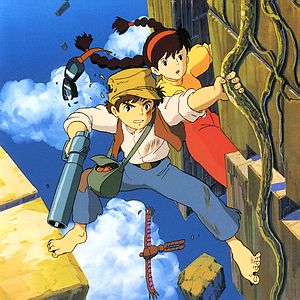
Castle in the Sky
Other Miyazakis include the critically acclaimed Princess Mononoke (which I’m not as fond of), the (rightly IMO) less acclaimed Howl’s Moving Castle, the comparatively overlooked but enjoyable Porco Rosso, and the offbeat The Castle of Cagliostro, an early effort in an independent series about an adventuring thief (lots of fun, but language warning on this one … and note that it’s the only Miyazaki in this post with a Region 1 DVD distributor other than Disney).
An issue to be aware of is that Miyzaki’s films often express reverence for nature and environmental concerns in imaginative idioms reflecting the filmmaker’s cultural background, i.e., animism and Shinto. Tree spirits, river gods and (in Ponyo) sea-goddesses inhabit many (not all) of his films.

Nausicaa of the Valley of the Wind
I’ve written about the moral issues this raises for Christian viewers in my reviews of My Neighbor Totoro and Spirited Away, among others. FWIW, Miyazaki films that do not raise significant issues along these lines include Castle in the Sky and Kiki’s Delivery Service (see my review for comments about the film’s thirteen-year-old witch protagonist).
I’d like to write up some more Miyzakis when I have some time (I did a DVD Picks column on most of these films for next week’s National Catholic Register), and maybe later this week I’ll do another blog post on Miyzaki’s main themes and things to look for in his movies.
For now, make plans to see Ponyo. You won’t be sorry, I think.
Have you seen Takahata’s “Sero hiki no Gôshu” from 1982? If not I recommend it for you and your family.
For those who may not know, Isao Takahata is Miyazaki’s long-time partner and co-founder with Miyzaki of Studio Ghibli, where Miyazaki has done all of his films since Nausicaa.
Mike, I’ve seen a few Takahatas — Grave of the Fireflies (another Ebert Great Movies pick), Pom Poko, My Neighbors the Yamadas — but not Gauche the Cellist (Sero hiki no Gôshu). I’m not even aware that it’s on Region 1 DVD (not that that would stop me if I really wanted to see it). Thanks for the recommend.
I don’t even know anybody who knows anybody who’s seen Gauche the Cellist. Talk about unobtainium.
I saw it, and was not as impressed. I didn’t think it was straight-up bad, only the worst Miyazaki film I’ve seen (and I’ve seen all you mentioned except Totoro and Cagliostro). The animation was beautiful at times but generally lacking creativity (compared to other Miyazaki), and the part where Ponyo races along the top of the fish was fantastic, but the rest of the film left me cold. The plot was simplistic, contrived and somehow also confusing (especially for the children in the audience). The environmental issue was completely dropped and mankind let off the hook despite showing no contrition. And you should definitely tell your readers to get out of the theater before the credits roll, or their ears will be tortured by a terrible pop tune from Noah Cyrus.
More movies I need to see. And here I thought that I was well-informed about movies. BTW, Whadda ya think of District 9, SDG?
David B: Just getting back from a week’s vacation, have to catch up.
Michael:
If it weren’t for Howl’s Moving Castle, I would cheerfully agree, with the proviso that the “worst” Miyzaki is better than at least 85 percent of Hollywood family product out there. (Howl’s and Ponyo aside, every Miyazaki I’ve seen rates at least 3.5 stars. Ponyo I rate at 3 stars / B-plus; Howl’s at 2.5 stars. So Howl’s aside, the “worst” Miyazaki is still a B-plus.)
Having seen both Howl’s and Ponyo twice, I find that Howl’s (a few moments aside) leaves me cold, except for the magnificent visuals, while Ponyo, sketchy and minimalistic though it is, leaves me with a smile on my face throughout.
Plotwise, Howl’s is at least as disjointed and incomplete as Ponyo. But Ponyo give me more in the way of characters, relationships and stakes I can care about. And I like the “Ponyo” song over the initial closing credits (whatever comes after that is surely skippable).
On first viewing I was underwhelmed visually with Ponyo, just because Miyzaki’s usual visual style is so astonishing, and this more minimalistic approach is clearly less ambitious. But on second viewing I find I appreciate the visuals more. The sketchy, unfinished colored pencil backgrounds have a storybook charm of their own, and I really like the squiggly way Ponyo treats objects distorted in water or seen in reflection.
I am ashamed to say that I’ve never seen a Miyzaki film.
I’m going to update my Netflix queue post-haste. (Man, that list is long . . .)
Thanks for the post, SDG!
Which film to start with?
Miyzaki’s films are nearly all vastly rewarding, but all have their own challenges too. The plots tend to be loosely linear at best, and not everything is explained.
For youngest viewers (or parents with young children), the best to start with may be My Neighbor Totoro and/or Kiki’s Delivery Service. Some viewers may be have a hard time with the nearly plotless story structures, although both films are carefully and satisfyingly structured once you get into their groove.
Many mainstream viewers find Castle in the Sky the most “accessible” point of departure into Miyzaki’s oeuvre. It’s exciting, visually spectacular, imaginatively astonishing, and funny. Drawback: somewhat tepid main characters.
Hard sci-fi fans might like to start with Nausicaa of the Valley of the Wind, Miyzaki’s most ambitious exercise in world-building. It’s densely plotted and feels like a fragment of a larger story — because it is (it’s a portion of a story that Miyzaki originally created as a manga).
My favorite Miyazaki is Spirited Away, his Animated Film Oscar winner. Some viewers might find its surreal, dreamlike logic and shifting realities hard to penetrate, but its imaginative achievement is (IMO) Miyazaki’s most perfect work.
Enjoy!
SDG –
It certainly does merit comparison with Howl’s, although I prefer Howl just a little bit more because it’s much more complex in the world-building. All of his movies are in such interesting settings – except this one. I might have been led astray by the moving beauty of the opening, which was so classic Miyazaki, because most of the rest of the movie was such a letdown. I probably won’t rewatch either Ponyo or Howl to compare, though, because I just didn’t enjoy them that much.
My issue with the art wasn’t the art itself – just that it wasn’t focused on anything interesting, for the most part. I did love how the static backgrounds appeared drawn with pastels, though. I do generally like movies which concentrate on the importance of daily rituals, but for some reason here I didn’t. Maybe it’s because it’s animated, and I prefer live action for such movies. Maybe not. It may also be that we got an initial sense of those rituals, but not of their repetition. I’m thinking now of Kabei: Our Mother, if you saw that excellent film.
I’m not sure I could ever enjoy a Miyazaki movie since he butchered the wonderful story and characters of Howl’s Moving Castle.
For the most part Miyazaki borrows very lightly from the ostensible sources of his films. Ponyo is very loosely inspired by Hans Christian Anderson’s “The Little Mermaid,” but it’s not much more of a connection than, say, the connection between Pixar’s A Bug’s Life and The Seven Samurai (or possibly Three Amigos). Ditto My Neighbor Totoro and Alice in Wonderland. There is seldom any reason to watch a Miyazaki as anything other than sui generis.
Howl’s was a mistake — it falls between two stools, neither independent enough to work sui generis nor successful as an adaptation. It’s a unique mistake in his oeuvre. There is no reason to let that one mistake stand between one and the unique pleasures of his other films.
Huh, interesting. I’ve been a Miyazaki fan since my childhood (I’m 21 now) and have re-watched every film of his countless times. That includes Howl’s Moving Castle at least five or six. And, as hard as it is to pick favorites for Miyazaki’s work, I have to admit that Moving Castle is close to the top for me.
Now, the thing is, I can’t mount any rational “defense” of that. I suppose it’s more that, for me, its a movie that bypasses the mind and goes straight to the heart. Which now makes me sound like the soppiest man alive. I loved Ponyo, too, for many of the reasons SDG explored in his review (and a few more besides).
SDG, one Miyazaki film I don’t think you’ve mentioned: Whisper of the Heart, beautiful romance that, for me, stands with Kiki’s Delivery Service and Totoro in making the mundane lovely. Miyazaki wrote and storyboarded the film (although someone else directed). I tend to consider it canon 😉
A final thought: Castle of Cagliostro is as close as it gets to a perfect movie. I’ve probably seen it a dozen times.
Pardon me if I rain on the parade, but I’ve never been able to stand anime, in any instantiation. It’s ugly, inane, and ugly again. I get my cars and my electronics imported, I don’t want my cartoons imported too.
Now I’ll clear out and let someone accuse me of cinema-racism.
Titus:
I don’t know about “cinema racism,” but to Miyazaki’s work is nothing if not beautiful. In fact, beauty is the one word, along with wondrous, that most expresses why I love Miyazaki. His work is suffused with beauty that is piercing, breathtaking, heart-stopping.
Look at the six images above. I’ll post some more soon.
Man of La Mancha, yes, Whisper of the Heart is a lovely film, one of the best coming-of-age slice-of-life films I’ve ever seen, animated or not. I’ve seen it twice and I have a deep affection for it.
And yeah, The Castle of Cagliostro rocks. I think it’s fascinating that already Miyazaki was working his fetish for half-flooded ancient ruins and such. Miyazaki’s water thing and his flying thing are very much connected. Not sure I’ve read any other commentator draw out that point.
As for Howl’s, I can appreciate your love of the film. It certainly is a visual feast, the fantasy bits are as brilliant as usual. It doesn’t come together for me emotionally or dramatically like the others, but that’s my take.
Another Studio Ghibli production to check out is “The Cat Returns”, which Miyazaki kickstarted, but gave to others to produce. It’s a very funny fairy-tale style story, in which a girl rescues an injured cat, then is appalled when the king of the cats shows up to inform her she rescued his only son, the crown prince, and so she must be rewarded by marrying him. He’ll turn her into a cat, and it’ll be happily ever after. Fortunately, the girl has other fantastic friends to rescue her from the cat kingdom, including a gentleman cat with a grey suit, a top hat, and in the dubbed version, an English accent.
A final thought: Castle of Cagliostro is as close as it gets to a perfect movie. I’ve probably seen it a dozen times.
I watched it lately, and yeah… It’s the best action adventure movie ever. Never would have guessed that an animated movie could win that spot in my estimation. The offbeat sense of humour, with the Tokyo police chasing the hero around a tiny Luxembourg-like country, never lets up. (Allegedly, they were working for Interpol.)
Titus, I never did like anime, before I discovered Miyazaki and co-creators’ work, and it really is different from the Sailor Moon sort of anime I loathed as a child. But, you might not like it after all. Different strokes for different folks.
We enjoyed it (ages 5-14). I also appreciated the way that it had a married couple (instead of you wondering where the dad is) and the way they are taking care of the elderly.
Oh, I’m so happy that somebody mentioned “Whisper of the Heart”. It is such a beautiful, tender and sweet romance, it kept me smiling and sighing for the longest time after I finished it. It is a must-see, I was puzzled SDG didn’t mention it in his post. Really folks, you owe it to yourselves to watch this movie, it is magical in an ordinary way. 🙂
Also, “Castle in the Sky” is by far and large my favorite Miyazaki movie. It is such an exhilarating adventure, good for children and adults of all ages. I think a re-watch is in order, I’ve not seen it again in years…
FWIW, here is Roger Ebert’s rave review of Ponyo. It’s an excellent review, though my enthusiasm for the film is slightly more modest, but I definitely hope it moves some people to see it who wouldn’t otherwise.
Veronica:
Only because Miyazaki didn’t direct — that’s the only reason! 🙂 We just rewatched it a few weeks ago. It rates very high with me.
We watch Castle in the Sky every few months or so. It’s not quite my favorite Miyazaki, mostly because I find Pazu and Sheeta a little bland compared to most Miyazaki protagonists, but the epic scale of the piece, the staggering brilliance and imaginative daring of the climactic set piece especially, typically gorgeous visuals and wonderful supporting characters (the Dola gang are a scream, even if the Disney dub juices the humor with extra punchlines and such) put it in solid contention (in my book) for the best Miyzakis that aren’t Spirited Away or My Neighbor Totoro — right alongside Nausicaa, Kiki’s Delivery Service and The Castle of Cagliostro. (Ponyo is a small step down for me, with Howl’s a slightly larger step down from that. I’ve never completely decided what to make of Princess Mononoke — haven’t seen the whole thing recently enough.)
Heh, glad some other folks didn’t like Howl’s Moving Castle— I thought my dislike was only because I loved the book so much, and it was so far from the book.
So far as “all anime is ugly”– that’s as silly as saying “all American animation is ugly.” There’s such a wide rang of styles that it boggles the mind that all of them would be ugly to someone. (I’d say the most arch-typical styles of each are exemplified by this fellow’s style and Disney’s old stuff, respectively.)
I just returned fronm seeing Ponyo with my 9 and 11 year olds. What a beatuful movie!
Ponyo’s father bore a distrubing resemblemce to Michael Jackson, but that was a minor distraction.
Over all, me and my kids give it six thumbs up!
Hm, I thought he was more of a David Bowie type myself — not unlike Howl, actually, although Howl is younger and less strange-looking.
Now that I think about it, the Ponyo production notes characterize Fujimoto (Ponyo’s father) as a sort of younger Howl.
Once again, a movie where dear old dad is presented as the problem. No thanks.
In the first place, Miyazaki created one of the most likeable family-film dads ever in My Neighbor Totoro. Not only that, the father in Kiki’s Delivery Service is also a swell guy and a loving father (though like his wife he’s only in the opening scenes and the denouement).
So Miyazaki hardly has it in for fathers per se — and, as noted in my review, the father issues in Ponyo appear to stem from the director’s own falling-out with his grown son, so, look at it as a sort of confession.
In the second place, with Miyazaki it’s almost never as simple as a character being “presented as the problem.” Myazaki has great empathy for nearly every character, even seemingly villainous or compromised ones (like Yubaba and the Witch of the Waste). Fujimoto (Ponyo’s father) is certainly compromised, but he’s not a “villain” per se, nor does the movie see him as “the problem.”
There’s no angry youthful rebellion here, a la Disney’s The Little Mermaid. (Well, almost none; there is the scene where Ponyo tells Sosuke and Lisa that her father “hates humans and keeps me in a bubble!” But that seems more humorously absurdist than anything.)
Certainly, by the third act it’s clear that Fujimoto is a loving father who wants what’s best for his daughter. He’s the one who calls Ponyo’s mother … well, I don’t want to give it all away.
Ponyo’s plot makes sense the way a dream or a fairy tale makes sense, or the way a little kid usually just accepts whatever happens because he has so little data about how the world works.
Howl really did fall apart in plot, mostly because Miyazaki let his own war nightmares take over the story when it was only supposed to be something ominous happening at a distance. And then, of course, he cut out several other important subplots and tried to pin everything to love. Well, it didn’t work with the intricate structure he’d already agreed to. It was like an animation version of a handwave.
Ponyo is much more balanced, much more controlled. In fact, it performs the remarkable feat of making something terrifying into something exhilarating for little kids. Good stuff.
Honestly, I was so constantly confronted with new delights in this movie that at times I couldn’t stop smiling or laughing.
Howl the thwarted pacifist was doubly hysterical, since Howl in the books had no problem using his magic for his adopted country’s rather inglorious wars, and finally got a bit of a come-uppance for that in the second book.
That just underscores all that was wrong with the movie. It wasn’t just that it changed plot, but that its hero had nothing to do with book Howl, who is one of my favourite literary creations. If the real Howl were to hide out from a war, it’d be to save his own skin, not for pacifist reasons.
You might consider boycotting this movie: Matt Damon
I don’t even want to know in what universe of discourse the name Matt Damon is prima facie grounds for considering boycotting a film.
SDG,
JohnD may be referring to Mr. Damon’s unintentionally humorous impression of Chicken Little in regard to Sarah Palin:
http://www.youtube.com/watch?v=C6urw_PWHYk
If I avoided every film with a flaming liberal in it, I probably wouldn’t go to any movies at all. :-7
David B-
ain’t that the truth….
//If I avoided every film with a flaming liberal in it, I probably wouldn’t go to any movies at all. :-7//
And? 🙂
Isn’t it funny that we wouldn’t be caught dead financially supporting an effort with famous racists in it, yet many are willing to put our dollars toward an effort with famous members of the culture of death.
JohnD-
Not true; the movie industry wouldn’t be caught dead financially supporting an effort with the wrong famous racists in it. There are a huge number of people who think that race gives you some special knowledge and ability– it’s just the ones that think it’s *pale* skin that are verboten.
Me, I keep in mind that it’s not supporting their views or opinions to purchase something that us utterly unrelated to said views. Same way that selling someone a meal doesn’t mean that I agree with or support their life choices, even if one might argue that without food, they wouldn’t be able to make those choices.
//Me, I keep in mind that it’s not supporting their views or opinions to purchase something that us utterly unrelated to said views. //
Let’s get concrete: Would you buy tickets to a movie that had a famous Neo-Nazi in one of the lead roles? Yes or no?
Amen Foxfier. You said it better than I could have. Just ’cause Burt Lancaster is in “Judgment at Nuremberg,” doesn’t necessarily mean it’s junk.
P.S. I wouldn’t mind JohnD giving me a list of his favorite films. I wonder if they include liberals. 😀
//Just ’cause Burt Lancaster is in “Judgment at Nuremberg,” doesn’t necessarily mean it’s junk.//
I didn’t say a thing about the quality. I’m trying to make you think about how you are directing your money with regard to the culture of death. Let’s not pretend that missing a movie is some sort of hardship.
A gentle, sweet Japanese cartoon does not become meaningfully entangled in “the culture of death” because a minor character is dubbed into English by a Hollywood liberal.
The 1995 Vatican film list includes films made by Marxists, homosexuals, atheists, adulterers, divorced and remarried filmmakers, etc. Is the Vatican promoting the culture of death?
Would we really be better off without films like The Gospel According to Matthew, Modern Times, Little Women (1933), or for that matter Casablanca, The Adventures of Robin Hood, The Lord of the Rings, or Raiders of the Lost Ark? Really?
Movies like G-Force corrode our culture. Movies like Ponyo enrich us. To deprive ourselves and our children of its sweetness because of an actor’s politics would be cutting off our noses to spite our faces.
I repeat, does JohnD have any films that he likes so that I can ferret out the liberals in them? 😀
This discussion is having an effect: I have the sudden desire to sit down and re-watch these great movies. ;-D
The more I think about the idea of “boycotting” Ponyo because of Damon, the more it bugs me. A boycott per se is effective only insofar as it sends a message. Boycotting Ponyo will not tell anyone “Don’t employ Hollywood liberals like Matt Damon.” Here is the only message it sends: “Dear Hollywood, we aren’t smart or discerning enough to appreciate a gentle, hand-crafted family film made without computers that doesn’t have explosions, musical production numbers, hip-hop slang, grotesque villains, innuendo, fight scenes and/or built-in franchise appeal. Please give us more films like Transformers, G.I. Joe and G-Force! Love, America.”
SDG apparently thinks that missing a movie is some sort of hardship. We will have to respectfully part ways.
I will go play with my kids and have our own adventures and sweet moments. I can wait for movies that are decent not only in quality, but also in its primary associates.
David, why not answer my question about buying tickets to a movie that employs a famous, real-life Neo-Nazi as an lead actor?
I fear the answer is only too uncomfortably clear.
“David, why not answer my question about buying tickets to a movie that employs a famous, real-life Neo-Nazi as an lead actor?”
Because I didn’t want to be repetitive, as SDG admirably answered you well. Also, because your implicit contention that buying a ticket to Ponyo is in any way analogous to supporting Neo-Nazis(!?!) not only invokes Godwin’s law but also is unanswerable for its ludicrousness.
P.S. Please be charitable when considering my motives, as I endeavor to be charitable of yours.
//Because I didn’t want to be repetitive//
Where is your first answer to the question? Or anyone else’s? I want a specific “yes” or “no”.
P.S. If you answer, “Yes, I would buy tickets to a movie that employs a real-life Neo-Nazi as a lead actor”, I promise I will not accuse you of being a Nazi, or a Nazi sympathizer.
Don’t be so defensive.
I’d feel more respected if you didn’t put words in my mouth. Poverty, chronic illness and oppression are hardships. Depriving one’s children of movies like Ponyo is not a hardship, but it is a privation of something that would enrich them.
Good for you, but art enriches them in ways different from imaginative play. Very young children today don’t have many opportunities to experience art as accessible and as Ponyo.
This comment really does beg David B’s question: Which movies would those be?
Probably not, but it’s a false analogy, for many reasons. I could start with Damon being a minor character rather than a lead actor, but since I recommend the Bourne films obviously that’s a secondary point for me. Suffice for now to say that while abortion is no less evil than the Holocaust, Nazis are more evil than Democrats, and a single popular neo-Nazi actor in Hollywood would present far more of a cultural stumbling-block than one more Hollywood liberal. Damon doesn’t really make that much of a difference in our cultural milieu; a neo-Nazi spokesman might.
SDG,
I appreciate the openness of your reply.
1. You still imply that missing a movie is a hardship, or as you would say, a privation, considering exposure to art, but the world is filled with art. I’m not hard pressed here.
2. My choice of movies is not on trial here. Even if I listed a movie that unwittingly had a major associate that promotes, say abortion, I would skip that movie if I was previously made aware of it. Maybe you could add to your website a grade on associates of movies. If Planned Parenthood made an otherwise great movie, you could give the Association Grade an F.
3. Progress made from the sudden or additional wealth of a Neo-Nazi or someone who advocates pulling babies apart are both grave evils. Just because the abortion agenda is further along, doesn’t make it’s further progress or entrenchment any less grave, in my opinion. Notice how closely the U.S. Supreme Court and our nation is divided. In that regard, abortion may be the more critical front precisely because it is so pervasive.
So, I don’t believe it to be a false analogy at all. But at least your answer seems to be that you would join me in avoiding a movie that has gravely evil associates, at least in one instance.
JohnD,
No I would not go to a film that has a Neo-Nazi as its lead actor. But we live in a nation in which the majority of voters recently chose the most pro-abortion candidate in history to be the president for the next 3 1/2 years. Thus, it is almost impossible to avoid doing business with those who contribute to “the culture of death.” These facts do not minimize abortion, they just show the times we live in.
And since we can agree that most all of Hollywood is infected even more so than the rest of America with the poisonous culture of death, we must address the value of seeing good films which are produced there.
The debate over the value of attending high quality films which feature famous liberals has been well covered already, and if you don’t know where I stand, I will tell you that I agree with what SDG has said.
I hope you consider your question answered.
JohnD,
You haven’t addressed the Vatican’s promotion, via its film list, of films which employed people whose lives probably wouldn’t end up in Butler’s Lives of the Saints.
David B.
It’s not at all “almost impossible” to chose entertainment, activities, or yes, even movies that are free and clear of the culture of death and its financial empowerment. Have you checked out Ignatius Press’s list of DVDs and independent films? As I mentioned to SDG, if he had an Associate Grade, it’d make things even easier.
Many choices for entertainment are free from cost altogether.
A representative from the Vatican evaluating film’s artistic value is not a command (magesterial or otherwise) to see the film, much less and an evaluation of the associates of the film or who stands to gain financially.
It cannot, therefore, judge the moral character of buying tickets for a film under a specific setting.
I’m glad you agree with SDG that he’d avoid movies with gravely evil assocatiates, at least, so far, in certain cases. Perhaps this dialog will help show the benefit of making this judgment in other cases of gravely evil association.
I can’t accept equating these terms, which seems to me to involve either (a) doing violence to the English language or else (b) trivializing those who experience real hardship and flaunting ingratitude to God for his blessings. Everyone experiences privation; not everyone knows hardship. I myself have nothing in my life I can call hardship, but I experience privation.
Who said anything about trial? I said it begged the question (in a non-polemical sense). Do you mean to say you won’t take the risk of naming a single film you like?
FWIW, popes have screened movies made by filmmakers whom they certainly knew led scandalous lives. That doesn’t mean you can’t scruple at it if you choose to, but suggesting a boycott seems to me unhelpful.
That would be someone else’s apostolate, not mine. See above.
Certainly abortion is the more critical front. Neo-Nazism is nowheresville at the moment. That’s precisely why a neo-Nazi actor could galvanize neo-Nazis and have a significant impact, whereas Damon has little if any impact.
The reality is that the vast majority of people who see Ponyo won’t even realize that he’s in it. Of the comparative few who do, fewer will have any idea about his political views, and a negligible percentage overall are likely to be influenced by his views in connection with his contribution to this film.
SDG,
Not seeing a movie, or even several movies has to rate as a very minor privation. If you substitute one art form for the missed movie, the impact is less than trivial. We are both agreeing that we are light years away from hardship here.
One movie? OK, I like Therese. Seems %100 irrelevant.
An abortion-promoter hauling in millions of dollars to tip the scale into continuing to kill tens of millions of babies via more lobbying, ads, campaigns and other political action is hardly insignificant.
Even if I thought the act of buying a ticket for a movie with a real-life Neo-Nazi actor would have little effect toward causing a second holocaust, I, as you, would still recoil in horror at the thought of doing so, merely on moral grounds.
Now, I just feel like a bumpkin.
I have never heard of this director. Of course, I never paid attention to non-American animation, but I was originally thinking about doing my doctoral work in music on cartoon music. I studied the genre and even joined the Society for Animation Studies and had a phone conversation with Leonard Maltin about his book, Of Mice and Magic.
It never occurred to me to study Japanese anime. Of course, back, then, such films were not as well-known as they are, now.
Here’s my question to anyone who has seen the film: there was a movement in the 1970’s to
“Westernize” Japanese music. Does that tradition hold in this film? Does the music sound impressionistic (which sometimes happens when some Japanese composers attempt to copy Western styles), has it fully assimilated the Western style, or has the music kept its Asian roots? Are traditional instruments used? Does the music track with the emotional subtext in a way which is recognizable to Westerners?
I doubt I will have a chance to see the movie anytime soon (the last time I was at a movie theater was three years ago – I don’t get out, much), but can someone give a description of the musical aspects of this film and Miyazaki’s works, in general. If SDG knows, are Japanese films largely culturally-driven or do they keep in mind that larger, non-Western audiences will go to see the film?
The Chicken
“It’s not at all “almost impossible” to chose entertainment, activities, or yes, even movies that are free and clear of the culture of death and its financial empowerment.”
That quote is out of context. What I said there was meant to illustrate the level of acceptance of abortion in this the culture. I mentioned films, entertain, etc., afterward.
“A representative from the Vatican evaluating film’s artistic value is not a command (magesterial or otherwise) to see the film, much less and an evaluation of the associates of the film or who stands to gain financially.”
So the fact that the Vatican made and published a list of films was thoroughly unrelated to promoting the purchasing/viewing said films? Why release a list, if not to affirm the worthiness of at least some of these films? Allow me to put it another way: if I made a list of films which perhaps included Ponyo, would you assume that I encourage others to see it?
P.S. I have some present duties to attend to, so if I can’t make it back to respond further, I hope you will understand.
JohnD:
Heck, I’ve contributed films to their catalog. But since you mention it, should Ignatius not carry The Fourth Wise Man or Inside the Vatican because Martin Sheen is a Democrat? Or The Bells of St. Mary’s and Inn of the Sixth Happiness because Ingrid Bergman was an adulteress and starred in some morally questionable movies? How about The Song of Bernadette, given that Jennifer Jones went on to be a twice-married adulteress, and both she and Linda Darnell (who played the Blessed Virgin) starred in some controversial films? How about The Passion of the Christ, given that Mel is a radical Traditionalist who rejects Church discipline, is now living in sin with his mistress, and has also obviously made some dubious movies?
The Vatican list of “Some Important Films” was published by the Pontifical Commission for Social Communications. Of course it has no magisterial or pastoral authority. But it does represent a responsible Catholic verdict, with Vatican approval from the pontifical commission charged with this very subject, that these films are worthy of Catholic attention.
Also, you’re ignoring the fact that, like I previously pointed out, popes have screened some of these and other movies, including ones made by filmmakers living scandalous lives.
For example, The Gospel According to Matthew was screened at the Vatican for the fathers of the Second Vatican Council, and was enthusiastically received. The film’s director was a homosexual Marxist atheist (who dedicated the film “the beloved, joyous, familiar memory of John XXIII”!).
Should the Vatican have rejected this film? Should the Council fathers have spurned it? Should the Vatican list have refused to include it? Countless people have been touched by this film’s portrayal of Jesus.
What are you talking about?
What if all the other filmmakers were Catholic and the movie were a brilliant and reverent biography of, say, Maximilian Kolbe? I would buy a ticket for that movie if the director were a neo-Nazi.
Heh. Okay, you win the Safety Award.
Chicken:
He won the Animated Film Oscar in 2002 for Spirited Away. You might also remember Princess Mononoke being in theaters in the late 1990s.
Miyazaki has always been influenced by Western film conventions. As for the music, according to this article from Nausicaa.net on music in Castle in the Sky, the music for that film was redone (by the original composer) for Western audiences to be more pervasive and more directly match the characters and the action, so that definitely speaks to the points you’ve raised. Now that I know that, I need to go back and watch the Japanese language track again and see if it uses the original music track!
Hm, well, you can listen to some it yourself.
David & SDG,
I think there are few misconceptions that can be cleared up right away.
1. As stated before, one aspect of the movie can be evaluated without evaluating other aspects of the movie, such as who stands to gain financially. SDG admitted that rating the associates of a movies was not his apostolate, but also admitted that there were cases where gravely evil associations would make him decide to miss a movie.
2. I am not advocating substituting missed movies for other movies. Let’s, for the sake of argument, say that the last unseen movie in a Christian or Catholic DVD catalog had as a major associate an abortion advocate. Should your head explode? NO. Should you rationalize morality away? NO. Just skip the movie. If you feel the need for an alternative, why must it be a movie?
A majority of the kind folks in heaven have likely never seen a movie ever during their journey through the world, but seem the pretty OK nonetheless (which would be an understatement). Are we so soft that we cannot lift a half ounce sword in the battle against the culture of death by engaging our decision-making faculties for a few seconds and maybe choosing alternate forms of art and entertainment?
***
As to my statement about an abortion promoter hauling in millions to tip the balance on life issues, I was talking in the context of a movie where an actor used their newfound wealth, or additional wealth to be an abortion activist through political activity.
When the blade is well chosen and the stroke significant, certainly. When you’re talking about hacking a messy path through a lovely garden of sunflowers and floxgloves and lilies for the sake of ever so slightly nicking (not significantly damaging) one remote tendril of poison ivy in a corner somewhere, I call it scrupulosity. The tendril of ivy was no appreciable threat to your children, and they would have been enriched by the sunflowers and floxgloves and lilies. Outside the garden the world is covered with poison ivy. Better to teach your children to appreciate the beautiful and fight the battles that really matter.
By my lights, the likes of Therese are too limited as gardens go for me to be entirely happy with restricting my children to play within their boundaries. I would rather give them more room to explore a wider world. Of course I shield them from gardens where poison ivy has grown to more than a tendril here and there. And as they grow older I teach them to recognize poison ivy for what it is, and deal with it appropriately. But keep them from Ponyo for the sake of Matt Damon, no.
Dear JohnD,
I read somewhere (in a book, so the odds of finding it on-line are slim) that it was Catholic understanding that a “bad” man can produce a good work of art, since, a) only God can judge the heart, b) most people mature in grace as they age – so, we should reject the works of St. Augustine before he converted? c) unless this is true, one could not even read at least 1/2 of all of the academic works in history, including both arts and sciences, because of the author, d) a bad man today may be a saint tomorrow and the questionable work may be a touchstone on the path of his conversion and may edify others in a similar situation, e) unless this is true, we should deny the works of Mozart, say, because he had some infantile tendencies, f) to say otherwise is the genetic fallacy, g) a man is judged good or bad only after he is dead (one may judge the works, by all means, but one must separate the work and the man for judgment – only one is allowed to be judged on earth).
The Chicken
Just to be clear, this is totally hypothetical then? Do you have anything against Damon other than that he thinks Sarah Palin is dangerously unqualified to be President and supported Obama in the last election? Is that the sum total of his entanglement with the culture of death, that he campaigned for Obama against McCain? Or is there more?
Outside the garden the world is covered with poison ivy.
Is this movie inside or outside the garden? You don’t have to answer. Poison ivy doesn’t bother me. If it weren’t for some people’s exaggerated so-called “immune” response to poison ivy, it would be seen as harmless. I hear there’s treatment available for those who have a problem with it. Probably also treatment available for people who have a problem with Matt Damon, Lily Tomlin, Cate Blanchett, Cloris Leachman, Betty White, Tina Fey, Noah Cyrus, Frankie “Bonus” Jonas, Disney and even (or odd) me.
“…Cloris Leachman, Betty White…”
Don’t all normal people have a problem with these two? ;-P
Spirited Away was quite possibly the weirdest movie I have ever seen in my entire life. No, leave off the “quite possibly” part.
I’m game. Is this new flick as weird as Spirited Away? Bring it on!
// so, we should reject the works of St. Augustine before he converted? //
Boy, I must really not be making myself clear! When I lend financial support to a person who *formerly* supported abortion, for example, I do so because I do not expect them to use that financial power to lobby for pro-abortion lawmakers, or give money to Planned Unparenthood.
Quite the opposite!
//I call it scrupulosity//
HUH?! The attititude I’m receiving from my suggestion of boycott has been strangely and irrationally defensive.
Would you have a similar reaction to:
*Suggestions to march for life on your state capital?
*Suggestions to write, call or e-mail your state representatives to let them know your opinions on the sanctity of life?
*Suggestions to fast for the end of abortion?
ALL of these measures involve a great deal more energy and sacrifice than the very passive decision to avoid certain movies with gravely evil associates.
I wonder if your involvement with a movies via your review work may be clouding your objectivity. I wonder if the materialistic cultural norm of entertaining ourselves to the point of nearly constant distraction also is distorting this issue.
I guess the point of my garden-sword parable was lost.
What I object to isn’t the expenditure of energy and sacrifice. (FWIW, this January 22 I drove six hours round trip to Washington, DC to stand in the cold with my eldest daughter and my father in a crowd of so many thousands we could barely move for over an hour, in order to march for life. When I lived in Philadelphia I routinely rose before 6am on (IIRC) first Saturdays to attend a Mass for life and rosary prayer march on a Planned Parenthood clinic, followed by Eucharistic benediction. I pray the rosary every day with my family, and regularly attend weekday Mass. So I’m not at all resistant to expending energy, on behalf of life or the Faith in general.)
Rather, what I resist here is the remoteness of the “good” to be achieved in this case. If I considered a movie significantly entangled with the culture of death, I would expend significant energy and sacrifice (in print, online, on the air) actively discouraging people from seeing it. Saying “This movie has a minor character who is dubbed in English by a Hollywood actor who campaigned for Obama, therefore fight the culture of death by boycotting this movie” seems to me the kind of overly remote connection-making that is typical of scrupulosity.
Scrupulosity does not necessarily mean expending a lot of energy. On the contrary, scrupulosity can easily lead to passive choices by discouraging people from engaging in basically harmless and wholesome activities for wire-drawn, remote reasons that have little moral impact, or whose moral impact is so divergent that it is not rational to single out one remote element to trump every other possible consideration.
You are free to entertain those speculations. FWIW, I don’t encourage anyone to entertain themselves to near constant distraction. Lots of things in life are more important than movies, and I routinely tell people that in my work.
SDG,
Let’s apply your standards to these examples again:
*Suggestions to march for life on your state capital?
*Suggestions to write, call or e-mail your state representatives to let them know your opinions on the sanctity of life?
*Suggestions to fast for the end of abortion?
One could argue that the good acheived is remote. So what? That doesn’t mean these activities involve scrupulosity! I can understand rationalizing that since the good acheived in these cases is “remote” (from one’s point of view) one may refrain from joining in them, *but what I cannot understand* is the irritation caused by suggesting such measures, or falsely condemning them as involving scrupulosity, or otherwise denouncing these measures.
Pardon me for coming so late to the conversation.
JohnD, I certainly agree that if you feel the need to boycott these kinds of films, you are free to do so and may even be admired for your sincere effort. I don;t think anyone is arguing that you should go see the film when it would clearly offend your own conscience.
My question is, do you hold that all right-thinking Christians must agree with you in your boycott, or that it would be wrong for any Christian to see such films?
That, I think, is another issue. I don’t think anyone is condemning your personal right to boycott whatever you see fit, do you condemn those who do not boycott?
There is a large measure of prudential judgment, here, that I think you may be dismissing.
The attititude I’m receiving from my suggestion of boycott has been strangely and irrationally defensive.
JohnD, I opened my heart to your “strange and irrationally defensive” boycott suggestion and was thus inspired to host a group of people to see the movie. Like little children, we enjoyed the movie and listened carefully and patiently for Matt Damon to speak his ten words. Had we not been listening for it, had you not made such a fuss over it, perhaps we might have missed it! Indeed, we might have missed the movie entirely. What an inspiration you are!
P.S. Matt Damon thanks you too!
Tim J.
I’ve already addressed your question in my latest response to SDG. I do not begrudge you your right to prioritize how you battle the culture of death.
Terry,
My suggestion of not giving financial empowerment to an abortion promoter was the TIPPING POINT for you seeing the movie?
I know you were trying to be funny, but babies getting pulled apart is not very funny at all.
I’m not sure we’re using the word “remote” in exactly the same way.
Remoteness in moral theology has to do with the directness of the relationship of a particular act and the end to which it is ordered. It is not a measure of total good achieved, but to the immediacy or degrees of mediation between the act and a particular effect or end.
I can elaborate further if necessary, but for now suffice to say that marches for life, letters to legislators and prayers to end abortion are all fairly directly (not remotely) ordered toward particular goals that, in turn, we hope will serve the cause of promoting the culture of life, or at least slowing the spread of the culture of death.
Marches and similar demonstrations are ordered toward the ends of raising consciousness, maintaining a visible presence, expressing visible solidarity with others of like mind, and collectively bringing to bear whatever pressure we can, however small, on our civic leaders. The size of the impact is not the point of immediacy; the relationship of the act and its end is.
By going to the March for Life, I have increased the effectiveness of the March for Life by exactly one person (or three people, if you count my daughter and my father). How effective that is, is beside the point. The weapon (attending the March for Life) is well-chosen for the end (making a statement about my commitment to life, expressing solidarity with other pro-lifers, etc.). The collective presence of all the marchers makes a clear statement that is as effective as we can make it.
Similarly, praying to end abortion is directly ordered toward the ending of abortion within the providence of God. The effectiveness of such prayer is a question we can only leave to God; we can only hope that life is promoted and abortion hindered by the prayers of the saints on earth and in heaven. In any case, the act itself is immediately ordered toward that end.
Although you mentioned “boycotting,” I suspect you may not really have meant to suggest a publicly organized and promoted effort to encourage mass non-patronage of this film by way of publicly pressuring Disney into modifying its behavior (presumably by not employing Matt Damon or other Obama supporters in the future?) — which is what a boycott properly so-called would mean.
If that really is what you meant, I suspect the vast majority of pro-lifers would agree that such an effort could only be counter-productive if it had any effect at all.
But perhaps you only meant that on a personal level pro-lifers might prefer to avoid this movie, thereby not contributing (even a small amount) to the (quite modest) domestic box-office performance of a film for which a (probably small) paycheck was given to Matt Damon, thereby (infinitessimally) contributing to a (quite large) personal fortune, some (not insignificant) portion of which could well go to fund some objectionable causes.
If that is what you meant, then I say that in a moral-theology sense the good to be achieved is too remote from the means (not just too small as such) to be a driving moral consideration, and that to be driven by such considerations is unnecessarily scrupulous.
Among other things, the teeny, tiny impact of my movie ticket on Matt Damon’s political activism is irrelevant compared to several more direct positive effects. Not least, my movie ticket helps to keep local working-class theater employees (my neighbors) gainfully employed, and helps to stimulate the local economy — impacts that are both far larger as well as more immediate than any impact on Matt Damon’s political activism.
Perhaps you feel like there ought to be another movie I could patronize, or another family activity I could organize, that would have similar helpful impacts on my community without contributing even a fraction of a penny to Damon’s evil agenda. Unfortunately, Therese isn’t playing in our local theater at the moment.
Anyway, going to see any movie at all, or spending any money whatsoever in our corporate economy market, probably has some bad impact somewhere down the line. Theater chains, unions, corporate policies, advertising agencies — dig far enough and you’ll find some evil or other in which you have remote material cooperation. Very, very remote, but still material cooperation — of a sort that Catholic moral theology permits.
We go to the zoo, the botanical gardens, the aquarium. Maybe some of our zoo ticket money goes to support environmentalist causes that I wouldn’t always agree with. We eat out occasionally. I’m sure the restaurants we patronize are in some way entangled in causes I wouldn’t agree with. When there’s a good family film in town, we catch it.
I see no reasonable basis in Catholic moral theology for scrupling about Matt Damon’s participation in a film like Ponyo on the grounds of his politics.
P.S. Again you seem to call Matt Damon an “abortion promoter.” Do you have any specific evidence on this specific charge, or is the whole weight of the thing on his Obama advocacy?
SDG,
I regret agreeing to name one movie. You keep bringing it up in quite an irrelevant way despite my previous rebuttals that I was not advocating for a replacement movie scheme. I didn’t name a movie to serve as some sort of model for all movies. I just named one because you seemed to indicate that you’d be satified and that you wouldn’t judge. But you’ve been laying judgments on my selection ever since.
Please avoid chasing straw men. I’m not “digging” as far as I can to find evil associations. If one confronts me, I avoid it, especially when it’s so easy. If you don’t want to join me, fine. But don’t call it scrupulosity, and please refrain from denouncing it.
I can use the same hammer as you. One could argue that marching for life might conceivable backfire (look how radical those folks are!) or at least not directly affect the good in a meaningful way since the news is so biased or because politicians are so closed-minded, for example. That’s still not a reason to denounce that measure or to falsely accuse those who march for life of being involved with scrupulosity.
JohnD,
I’m not denouncing anything or anyone. I have no brief against anyone who chooses not to see any movie for any reason. I’ve heard from people who choose not to go to movies in which an actor and actress kiss, or for whom the presence of a particular actor or actress arouses such negative associations that they avoid all movies with that individual.
I have no interest in movies costarring Katharine Hepburn and Spencer Tracy, due of their long-time extramarital affair. I’ll watch ’em separately, but I don’t want to see them together. I think in my whole life I’ve seen one Tracy-Hepburn movie, and I’d be happy never to see another. I would specifically avoid a movie for no other reason (I don’t know if it would absolutely prevent me against any counter-consideration whatsoever, but it’s a definitely a factor against it.)
OTOH, I don’t mind watching Bogey and Bacall, even though Bacall was Bogey’s third wife and thus the Church would regard them as living in sin. On the one hand, adultery is adultery, but somehow plain old adultery is more repellent to me (and somehow it matters to me that Tracy was Catholic).
I have no argument with anyone who wants to say I’m being inconsistent. I have no argument with anyone who chooses not to watch Bogey and Bacall movies, or who chooses to watch Tracy-Hepburn movies. From a moral theology perspective, none of these decisions involves any significant entanglement with grave evil. The question is best looked at as a sort of morally charged aesthetics, or aesthetic implications of morality.
I would thus not call for a “boycott” of Tracy-Hepburn movies, nor would I suggest that others share my aesthetic scruple on this point (I’m using the word scruple here in a non-technical sense). I might mention to others how I feel, but to suggest that others consider taking similar action would seem to me too close to real scrupulosity.
Similarly, the decision to avoid a movie in which one knows one of the actors campaigned for a pro-abortion politician is a perfectly legitimate one, with which I have no quarrel. Nor do I quarrel with you for mentioning how you feel.
However, from a moral theology perspective, it is simply not a question of significant entanglement with grave evil, and to regard it as such would indeed be scrupulous. Comments like “Should you rationalize morality away? NO. Just skip the movie” and “lifting a half ounce sword in the battle against the culture of death” do seem to me to suggest an overly scrupulous assessment of the moral implications of this very, very remote form of material cooperation.
FWIW, my comments about the probable counter-productivity of an organized boycott were prudential considerations, and had nothing to do with questions of scrupulosity, which were more in the area of moral theology. Likewise, any prudential rebuttal you might make about the possible counter-productivity of marches, etc. would not go to questions of scrupulosity.
SDG is correct. What we are talking about here is remote material cooperation with evil. A few years after graduate school while I was looking for academic work, I wound up doing some temp work for a major health insurance company. I left after a few days when I realized that my efforts could help fund someone’s abortion. Did I have to leave? No. The cooperation with evil was too remote to require this. On the other hand as a witness to life, it was a good thing.
In the end, JohnD is certainly attempting to do something virtuous by avoiding the film for the reason he states, however, his actions are in the realm of prudential judgment and perhaps a sensitive conscience. One can certainly imagine a person not knowing that Matt Damon did the voice work for the minor character and seeing only the good points of the film. Even if one knows that Damon did the voice work, the cooperation with evil is so remote that it does not rise to the level of sin, ordinarily. If one’s conscience says to stay away and one has done due diligence in understanding the moral theology, then, by all means, stay away. Each person is responsible to his conscience.
I have my own avoidance triggers for films as I am sure everyone does. There is nothing wrong with seeing this film from a moral perspective as long as one is not too sensitive about making Damon a few dollars richer. There are few films that star actors who do not have morally questionable stands. What can one do? I doubt, given the nature of Hollywood, that this will ever change. The whole “star” thing is a powerful temptation.
I certainly sympathize with John and if Damon were being paid more, had a larger role, and were more outspoken in supporting an immoral cause, things might be different and we all might be better off not supporting the film, but in this case, Damon’s presence is more of an irritation than a blackening of the film.
The Chicken
//Comments like “Should you rationalize morality away? NO. Just skip the movie”… do seem to me to suggest an overly scrupulous //
The comments was intended in the context of a person who did not want to associate with the hypothetical catalog movie due to evil associations. They were not intended to suggest that those who chose not to avoid such a hypothetical movie were therefore committing sin.
My very first post on this topic suggested that you *may* want to boycott (on a small scale) the movie in question. Hopefully, this would give away my position that this is a matter of prudential judgment, not a matter of objective sin.
P.S. Sorry, my exact wording was “might consider” rather than “may”.
JohnD, I wasn’t trying to be funny. Your accusations (or what you call a “suggestion”) prompted a closer look into the world of Devonian Teletubbies. If you’re suggesting that I not support a particular political party or candidate, what political party or candidate is so exclusively deserving that society should not spend a penny on a rival?
Terry,
Sigh… dare I ask? What “accusations” are you referring to?
Nope, I’m not suggesting political parties or candidates.
Could we cut JohnD some slack? Similar thoughts about other things have certainly crossed my mind. He seems to understand the issues. He is at one end of a permissible spectrum.
The Chicken
Sigh… dare I ask? What “accusations” are you referring to?
To begin, your comparison of Matt Damon to someone on the level of a “Neo-Nazi” or “racist”, and as SDG pointed out, “you seem to call Matt Damon an ‘abortion promoter.’ Do you have any specific evidence on this specific charge, or is the whole weight of the thing on his Obama advocacy?”
I’m not suggesting political parties or candidates.
Then where is your specific evidence apart from Matt Damon’s political activity? SDG has been asking you since Saturday. Again, his question to you: “Do you have any specific evidence on this specific charge, or is the whole weight of the thing on his Obama advocacy?”
Could we cut JohnD some slack?
He’s been cutting himself slack since Saturday.
Terry,
Making analogies to show a principle does not imply that I’m trying to make Mr. Damon out to be a racist or a neo-Nazi (I don’t believe he is either). The only common thread would be a promotion of evil.
Mr. Damon is a de facto promoter of abortion by supporting pro-abortion candidates that include, yes, Mr. Obama, and Mr. Kerry. He went so far to offer $1,000,000 to see the latter in office, however I do not know if he made good on that.
If those pro-abortion candidates belonged to a different political party, my position would be no different.
Are you going to return to your heckling now?
I’m with the Chicken. I think JohnD has made himself sufficiently clear at this point, as have the points on the other side. Let’s call it a combox (at least on this sub-topic).
Okay, so does that mean we have to discuss Cloris Leachmen? ;-P
Making analogies to show a principle does not imply that I’m trying to make Mr. Damon out to be a racist or a neo-Nazi
That’s fine. That’s why I said you compared him to someone on the *level* of a neo-Nazi or racist.
Mr. Damon is a de facto promoter of abortion by supporting pro-abortion candidates
Oh, I see, “de facto”. With the money put into the church baskets, the Church writes checks to people who support abortion or are pro-choice, and thus the Church (de facto) promotes abortion. Likewise, people who vote for a candidate like McCain who sought abortion exceptions (de facto) promote abortion. And because Sarah Palin supported her pro-fornication daughter, Sarah Palin was a (de facto) promoter of fornication. And of course, Jesus put Peter in charge knowing that Peter would deny him, and so Jesus (de facto) promoted denial. Is that what you mean, where everyone is a “promoter” in some sense? Thanks for explaining it.
Not quite. Mr. Damon is indeed morally culpable for supporting a candidate whose pro-abortion platform is antithetical to the root and foundation of all human rights, legitimate rule of law and social justice when a less objectionable viable candidate was available. Moreover, if Mr. Damon has any reservations about the morality and legality of abortion, he hasn’t expressed them that I know of. To that extent, Mr. Damon is certainly guilty of unacceptable cooperation in moral evil. However, Catholic moral theology will not support calling Mr. Damon “de facto promoter of abortion” on these grounds.
That said, Terry, I’m asking you to please stop the haranguing tone of your cross-examination of JohnD, if indeed you must continue your cross-examination at all. JohnD’s approach may play somewhat fast and loose with moral categories, but he seems to be trying to conduct himself with dignity and is not attacking other people. Let’s all try to take the high road and elevate rather than drag down the level of discussion.
supporting a candidate whose… when a less objectionable viable candidate was available
Apparently his calculus differs from yours. As may the calculus of some number of bishops.
“As may the calculus of some number of bishops.”
Evidence?
I only say that they may disagree. I don’t claim that they do or don’t or how many. Why should I speak for them? Fr. Reese described it as, “the most vocal bishops gave the appearance of speaking for all the bishops, and the others just kept silent.” Of course, there’s also Bishop Hollis who said, “I have been thrilled by Barack Obama’s victory and I thank God for it. For me, it represents a rare moment of hope and optimism which shows American democracy at its best and it is of seismic significance and potential for the whole global community.”
His calculus does not adequately take into account foundational premises of natural law, as lucidly set forth in Evangelium Vitae, as I have previously argued at length.
Portsmouth Bishop Gently Backs Away from “Thrilled” Obama Welcome
His calculus does not adequately take into account foundational premises of natural law, as lucidly set forth in Evangelium Vitae, as I have previously argued at length.
I don’t choose to judge his unknown calculus, just as you may perceive inadequacy and I don’t choose to judge your inadequacy.
Portsmouth Bishop Gently Backs Away from âThrilledâ Obama Welcome
I don’t believe his calculus changed.
Any calculus that arrives at an incorrect conclusion is per se inadequate. Beyond that, I make no judgment.
“I only say that they may disagree. I don’t claim that they do or don’t or how many. ”
Well, then why say it? The teachings of the Church are well known, that one cannot support someone (Obama) who takes an extreme position in favor of abortion when there is a viable candidate of significantly lesser evil. Furthermore, any silence from the bishops cannot be construed to mean that they dissent from the Church and support Obama.
“one cannot support someone (Obama) who takes an extreme position in favor of abortion when there is a viable candidate of significantly lesser evil.”
That is not to say that one could support Obama when there is no candidate of lesser evil.
Any calculus that arrives at an incorrect conclusion is per se inadequate. Beyond that, I make no judgment.
That does not judge whose conclusion is incorrect and thus whose calculus is inadequate, yet your previous claim was that “his calculus does not adequately take into account foundational premises of natural law”. Can it not be that your conclusion is incorrect? Just because someone else’s conclusion apparently does not agree with yours, even if you argue yours “at length” (length is not a measure of adequacy or correctness), that does not mean his conclusion is incorrect or his calculus is inadequate or even that it’s likely to be incorrect or inadequate.
The teachings of the Church are well known, that one cannot support someone (Obama) who takes an extreme position in favor of abortion when there is a viable candidate of significantly lesser evil.
What any candidate’s position is and the future effects, short-term and long-term, of any candidate’s election or support are not teachings of the Church. It’s speculation, guessing, sometimes called “calculus”, or whatever the favored term may be. If candidates are not outright lying, they may mouth empty words, dance about and flip flop, often like puppets on a string. People hold different opinions as to the significance. Perhaps you see voting or campaigning for X as supporting person X’s opinions or allegedly promised acts, but someone else may see it as supporting a speculative chain of events that extends until the end of the world which is labelled as X (or Obama). In comparison, that voter may speculate that chain labelled Y (or McCain) is the greater evil, even if candidate Y’s actions, if viewed in isolation, may be the lesser evil, because the chains being voted on are far more than just candidate X or Y’s actions. Or, some voters may view their personal best guess is to be made based on their perceptions of the candidates’ and/or candidates’ parties’ character. Just as different people may have different skills or gifts, so too may they use different methods to come to their conclusions.
Furthermore, any silence from the bishops cannot be construed to mean that they dissent from the Church and support Obama.
It can be construed just as I said, that the calculus of some number of bishops may differ from SDG’s. The unknown is unknown. If you see “support Obama” as “dissent from the Church”, that’s your opinion. To someone else, “support Obama” may mean support for the chain, in which Obama is temporarily president, as the lesser evil, or support for whatever good may be seen in connection with Obama, or support of the political process in which no candidate is all deserving, or whatever it may mean to someone else. I “support Obama”. Maybe you do too. For president, as president, however it may be. To do what is right.
No, I don’t believe so. Not if the Catholic moral tradition upheld and articulated by John Paul II, Cardinal Ratzinger and others is correct. But this is not the combox for that discussion. The whole question was barely ancillary to the already tangential question of boycotting Ponyo over the participation of Damon. Further cross-examination of the correctness of my arguments against Catholic Obama advocacy should be deferred to the appropriate forum. Thank you.
Further cross-examination of the correctness of my arguments against Catholic Obama advocacy should be deferred to the appropriate forum
For me, further examination of the question “Can it not be that your conclusion is incorrect?” was appropriate for the internal forum. Maybe you prefer another. I would not want your Ponyo movie discussion to be bogged down with discussion of the correctness of one-sided arguments on Obama, but nonetheless, may we rejoice and give thanks in all circumstances. Every joy and suffering, every event and need can become the matter for thanksgiving.
Thank you.
“You Who alone are good, may we give You all praise, all glory, all thanks, all honor, all blessing, and all good.”
Then you could have asked the question and left it at that. As it is, my point was not to identify the appropriate forum, only to identify an inappropriate forum.
Then you could have asked the question and left it at that.
I did, and you chose, of your own free will (and perhaps to your delight), to answer the question in this combox. FWIW, I’ve actually not been examining “the correctness of [your] arguments against Catholic Obama advocacy”, even if that’s how you’ve viewed it. Rather, someone had asked you whether “your review work may be clouding your objectivity,” and you responded, “You are free to entertain those speculations.” Perhaps you’re not as objective as you believe, and perhaps it has little to do with your movie review work, and perhaps we are not free to entertain those speculations (in this combox). To me, whether your opinion (on movies, Obama, whatever) is correct or not can be much like whether the wind is correct or not. It’s an unusual question, but one that may be more polite (if taken personally) than to ask if it’s blowing and how hard. It’s a variant on the common question, “How’s the weather by you?”
Or, to keep it in Ponyo terms, “Did Ponyo upset the balance of nature and threaten the co-existence of humans and the undersea population?” I’m sure Ponyo did not mean to do so, or did she? Or, how true is your love? Or, is this not the appropriate bucket?
You’re not tracking me, B’Art, doubtless intentionally. We’re done here. Have a nice weekend.
“B’Art”
Ah ha! I thought I recognized the bits of ultimately aimless rhetoric from some where!