Part 1 | Part 2 | Part 3 | Part 4 | Part 5 | Part 6 | Part 7 | Part 8
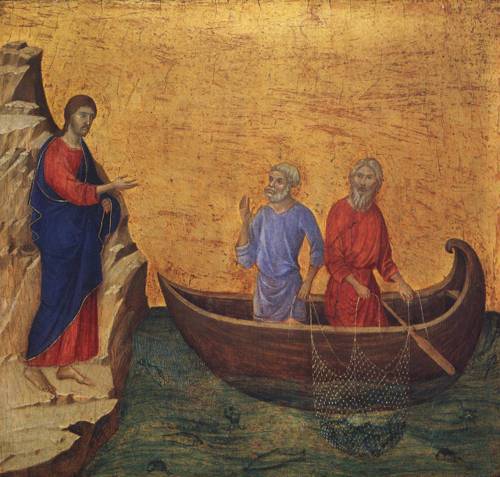
The Calling of the Apostles Peter and Andrew (Duccio di Buoninsegna, 1308)
NOTE: This series is a work in progress. See Part 1 updates including bibliography in progress. As I add sources and update past posts I will continue to expand the bibliography.
“So you are Simon the son of John? You shall be called Kephas (which means Petros)” (John 1:42).
All four Gospels tell us that Simon bar-Jona was renamed Petros (i.e., Peter) or Kephas by Jesus himself (Matthew 16:18, Mark 3:16, Luke 6:14, John 1:42). As John 1:42 indicates, Petros and Kephas are synonymous; both mean more or less “rock” or “a stone” (questions of nuance will be explored below).
Petros (Πέτρος) is cognate to petra (πέτρα), the usual Greek word for rock. Kephas (Κηφας) is a Grecized transliteration of kepha, an Aramaic word with the same basic meaning. (Kephas is often rendered in English as Cephas, following the Latin transliteration. This spelling works better in Latin than in English, though, since in Latin Cephas is pronounced “Keyfas,” while in English it is usually pronounced “Seefas.” For English speakers, Kephas is a better transliteration.)
Both Kephas and Petros are used by Paul in Galatians, apparently interchangeably (Kephas in Gal 1:18 and 2:9-14, Petros in Gal 2:7-8). Earlier, in 1 Corinthians, Paul uses Kephas consistently (1:12, 3:22, 9:5, 15:5), including the very early credal formula of 15:5.
The indications in Paul suggest that the Grecized form Kephas was used very early among Greek-speaking Christians, possibly before Petros. This reinforces the likelihood that Aramaic Kepha, to which Kephas in John 1:42 points, is the original form of Peter’s new name as given by Jesus, who would most likely have customarily spoken Aramaic among his Galilean disciples.
Thus, Simon Peter was probably first called Kepha (in Aramaic speech), then Kephas (in Greek speech), and finally Petros (again in Greek). Adding the final “s” or sigma for the Grecized form Kephas conforms the word in Greek to masculine nouns of the second declension, making it masculine rather than feminine, as befitting a man’s name. (For Greek speakers, the name Kepha without the final sigma would be taken for a woman’s name.)
In the same way, Greek petra is feminine (first declension), Petros masculine (second declension), so Petros rather than Petra is the natural equivalent of the masculine-form Grecized Kephas, and, again, appropriate for a man’s name.
Even after Peter receives his new name, the old name, Simon, doesn’t entirely disappear. In the Gospels Jesus himself continues to use Simon most of the time (Matt 17:25, Mark 14:37, Luke 22:31, John 21:15), though not always (Luke 22:34), and others use Simon at least occasionally (Luke 24:34). But the Evangelists almost never refer to Peter simply as Simon, except very early on. He is either “Simon called Petros” or “Simon Petros” (particularly in John), or else simply Petros, probably indicating the prevalence of Petros as the familiar version of the name at the time when the Gospels were written.
In Acts, Luke only uses Petros, except when relating how the men from Cornelius, sent by the angel, come seeking “Simon called Petros.” The angel in Peter’s vision addresses him as Petros (Acts 10:1-18). The only other echo of Simon in Acts comes from James, at the Jerusalem Council, who uses the form Simeon, a more Semitic form of the name. This form is also attested in the opening of 2 Peter, where it is conjoined with Peter: “Simeon Petros, a servant and apostle of Jesus Christ”; 1 Peter begins simply, “Petros, an apostle of Jesus Christ.”
Paul never uses Simon, only Kephas or Petros. From this, and from the prevalence of Petros in the Gospels and Acts, it seems clear that Peter’s new name was well established and widely used in the first-century church.
The surnaming of Peter by Jesus is unique in a number of respects. Mark’s Gospel mentions that the other two disciples of Jesus’ inner circle, James and John, received the collective nickname Boanerges, “Sons of Thunder.” But that lone mention is the only time this sobriquet is ever heard from; we never read, for example, that “Jesus took with him Peter and the Sons of Thunder” or any such thing. They are sometimes referred to collectively as the sons of Zebedee, but never the Sons of Thunder. Nor is there any mention of “James Son of Thunder” or “John Son of Thunder.” James is never called anything but James, nor John anything but John.
Likewise, the popular notion that Jesus changed Saul’s name to Paul is a misconception. Like many of his peers, Paul, a Jew and a Roman citizen in a Hellenized world, had simply acquired more than one name. The shift in Acts from Saul to Paul is merely the narrator’s way of transitioning literarily from the story of Saul’s Pharisaical Jewish origins to his better-known identity as the great apostle to the Gentiles. Symbolic, certainly, but there is no indication of a name change. The story of Paul’s conversion is related three times in Acts (once by Luke, twice by Paul), with no indication that Jesus ever called Saul anything but “Saul, Saul” (cf. Acts 9, 22 and 26). Then, at a certain point, Luke simply tells us that Saul was “also called Paul” (Acts 13:9), and goes from there. There is no parallel to the significance of Peter’s new name, especially as we find it expounded in Matthew 16, where it is part of a solemn commission speech.
In fact, the closest parallels in scripture to Peter’s new name are found in the Old Testament, particularly in the stories of Abraham, Sarah, and Israel, who all receive new names from God in passages with notable parallels to Matthew 16, as we will see.
Among other things, Jesus’ choice of Peter’s new name is in a way as paradoxical as the choice of Abraham (“father of a multitude”) for a childless old man. This is very different, probably, from the nickname “Sons of Thunder,” which likely reflects an assessment of the personalities or dispositions of the sons of Zebedee (possibly as seen in Luke 9:54). In the same way, the surname Barnabas (Son of Encouragement), given to Joseph of Cyprus by the apostles (Acts 4:36), was probably indicative of his personality. It is easy to feel that Kepha/Kephas/Petros is hardly illustrative of Peter’s personality in the same way.
On the contrary, Peter is well known as a man of shifting extremes — impetuous, unsteady, at turns fervent and foolish, faithful and fearful, promising the greatest fidelity, then failing most spectacularly — anything but rock-like, however nuanced or glossed the notion of rockness might be. This is not to say that Peter’s personality was not a factor at all, only that in itself it does not seem to be a sufficient explanation. As we will see, “Rock” seems to be primarily indicative of Jesus’ intention for the role he would give to Peter, rather than any attributes Peter possessed in himself.
Further heightening the drama of Peter’s name change is the apparent novelty in contemporary usage of Aramaic Kepha and Greek Petros as a given name. In subsequent Christian usage Peter became a popular name thanks to its apostolic namesake, but when Simon bar-Jona was first called that, it was apparently unheard of. (This point isn’t definitive; there is one apparent instance of Aramaic Kepha as a name in a legal document from the 5th century BC, and others might be discovered.)
(This is as good a point as any for a disclaimer to the effect that I am neither a student of language nor learned in ancient texts. In this post I’m reliant on a number of works that need to be sourced. I’ll try to come back in the near future and re-edit to credit sources. In the meantime, comments, queries and corrections are all welcome. As always, when a non-expert is synthesizing technical material, mistakes are possible. Further updates may be forthcoming on the basis of such feedback.)
Aramaic kepha is cognate to Hebrew keph, a rare word found only in Jeremiah 4:29 and Job 30:6, where it has the sense of mountain crags or rocky terrain. In both texts keph is translated petra (cognate to petros) in the Greek Old Testament translation, the Septuagint.
Aramaic kepha is more widely used than its Hebrew cognate. In fact, it can be used to translate any of the common Hebrew words for rock: sela‘ and tsûr (both usually rendered in the Greek Septuagint as petra) as well as ’eben, a stone (usually rendered lithos in Greek).
A word of explanation may be helpful here. As the above suggests, there is a broad distinction in both Hebrew and Greek between words that often mean something like solid rock, bedrock, rocky terrain, cliff wall, etc., and words that usually indicate a stone or detached rock on some movable scale: a boulder, a precious gem, a thrown rock, a shaped stone, etc. Hebrew sela‘ and tsûr (often used in parallel), and Greek petra, are typically “rock solid” language, while Hebrew ’eben and Greek lithos usually indicate rocks of the smaller and more mobile type.
The above I take to be fairly noncontroversial; but two other words, one Greek and one Aramaic, are sometimes controverted particularly in discussions about Peter. Greek petros and Aramaic kepha are asserted, usually by non-Catholics, to mean more or less the same as lithos or ’eben, i.e., a movable stone, in contradistinction to petra or tsûr, solid rock. (One sometimes encounters the claim that Aramaic shua‘, cognate to Hebrew tsûr, is the rock-solid equivalent of petra.)
Kepha first. It is true that kepha can mean a stone, boulder or small rock, and is accordingly used in Aramaic texts to translate Hebrew ’eben in the same passages where the Greek has lithos. Aramaic also has another word, ’evna, cognate to Hebrew ’eben, that may often have a similar meaning. But ’evna is apparently uncommon, leaving kepha, maybe, to pick up some of the slack.
However, kepha is also used in Aramaic texts to translate Hebrew sela‘ and tsûr where the latter indicate solid rock. The usual Greek translation in these cases is petra, indicating that kepha and petra can function more or less synonymously.
For example, the water-giving rock (sela‘) struck by Moses in the wilderness (Num 20:8-11), the rock (sela‘) on which the psalmist stands securely (Psalm 40:2), and the prophet’s “shadow of a great rock (sela‘) in a weary land” (Isaiah 32:2) are all rendered kepha in Aramaic targums (Targum Onkelos, Targum Jerusalem). Other targums attest kepha for tsûr in such texts as Deuteronomy 32:4 and Isaiah 17:10, where rock is used metaphorically for God himself (i.e., solid rock).
Significantly, discoveries in Qumran targums have found pre-Christian evidence for kepha referring to rocky mountain summits or crags (sela‘) in Job 39:1,28 and 1 Enoch 89:29. I am not aware of any corresponding evidence of Aramaic shua‘ (cognate of Hebrew tsûr) attested prior to medieval Aramaic texts; for all I know, that the word may not have been available in Jesus’ day.
For each of the above passages, wherever the Aramaic uses kepha for sela‘ or tsûr, the Greek Septuagint translation is petra (except where rock metaphors are lost in translation, e.g., Isa 32:2). Petra is the usual word for rock in the Septuagint, and also appears a number of times in the New Testament. The masculine form, petros, is virtually unknown in either, except as Peter’s name in the New Testament.
In the Attic Greek of classical poetry, petros is sometimes used in the sense of a stone or movable rock, perhaps more or less synonymously with lithos, in contradistinction to petra. In the common Koine Greek of biblical literature, this distinction is virtually unknown. As a rule, when the Greek biblical texts want to reference a movable stone, they use lithos, not petros. This rule is not, however, quite without exception: A single Greek Old Testament book, 2 Maccabees, offers two instances of petros referring to thrown stones (2 Macc 1:16 and 4:41).
On the other hand, petra need not always mean massive rock over against lithos (or petros) in biblical Greek. In Isaiah 8:14 in the Septuagint, and again in Romans 9:33 and 1 Peter 2:8, both apparently drawing on the Septuagint, we read of “a stone (lithos) that will make men stumble and a rock (petra) that will make them fall.” Lithos and petra are thus used in parallel, not opposition, referring to a stone capable of being tripped over.
Kepha is even more flexible. It can be used equivalently to lithos (a stone) or to petra in the sense of rock mass. Like the English word rock, kepha seems to run the gamut of meaning, and no specific sense can be insisted on in advance.
As with Aramaic kepha and Greek petra/petros, the Hebrew words sela‘ and tsûr are not used in the Old Testament as Hebrew personal names (though there seems to have been a Canaanite or two named Sur; see Num 25:15 and 1 Chron 8:30). Both tsûr and sela‘ are, however, metaphorically applied to God himself so frequently, particularly in Psalms and Isaiah, that “Rock” almost becomes a sort of divine title: “the Rock,” “our Rock,” “my Rock,” “the Rock of Israel,” “the Rock of your refuge,” etc. (e.g., Deut 32:4,15-18,31; 2 Sam 22:2,32,47; Psa 18:2,31,46; Isa 17:10).
Such rock language seems to have been exclusive to God; we never read that David or Moses was a rock, etc. It may be the link between rock language and God was generally considered too close to comfortably apply such language to men, whether as a name or as a metaphor.
But this rule, too, is not without exception. There is a rabbinic tradition that may well have gone back to Jesus’ day, describing one man as a rock: Abraham. Based on Isaiah 51:1-2 (“look to the rock (tsûr) from which you were hewn, and to the quarry from which you were digged; Look to Abraham your father and to Sarah who bore you”), a number of Talmudic and midrashic texts, the earliest of which go back to the mid-second century, interpreted Abraham as the “rock” from which God’s people were hewn.
What is the significance of Jesus renaming Simon Kepha or Kephas? In what sense is Peter a rock? It is time at last to turn to Matthew 16.
More to come.
Part 1 | Part 2 | Part 3 | Part 4 | Part 5 | Part 6 | Part 7 | Part 8
Thanks for the series SDG!
It’s extremely important for Catholics to know these Petrine facts so as to be able to respond when confronted with arguments against the papacy, development of Catholic doctrine and tradition.
I’ll be studying your series with great interest and highly appreciate your careful research.
Who is the Rock of Matthew 16:18?
Thanks, SDG, wonderfully informative.
A trivial point I’ve always wondered about: Presumably the first letter of the Aramaic kepha is the Aramaic equivalent of K. But Greek doesn’t have a letter C, so the first letter of the Greek transliteration must be K (kappa) too. So why is the letter rendered K in the direct English transliteration from Aramaic and C in the English transliteration from the Greek transliteration? In other words, why is it kepha and cephas instead of kepha and kephas? Apologies if you feel this will get us bogged down.
Pachyderminator,
It’s because Cephas is the Latin rendering of the Greek kephas.
I SAID let’s NOT get BOGGED DOWN.
No, seriously, thanks for this. Yes, the Greek for Cephas is Κηφας, and could reasonably be transliterated in English as “Kephas” — or “Kefas,” “Keyfas,” “Kayfas,” etc. But we get our traditional English reading by way of Latin, and the Latin transliteration is “Cephas.”
BTW, the correct Latin pronunciation of “Cephas” is more or less “Kefas” — not “Seefas.” It should probably be pronounced that way in English too.
Like the English word rock, kepha seems to run the gamut of meaning
Rocks are interesting, as are mollusks. Mention of the Greek association with the word for “head” might also be of interest in a discussion about Peter.
Yeah, that’s a weird thing, I’ve been pondering writing about that. Here’s another weird thing: There’s a theory floating around out there about an alternate explanation of the name Petros as Aramaic rather than Greek, in which case it could supposedly mean — get this — “Firstborn.”
So it looks like Peter is Cephas, the rock who could almost also be the “head,” as well as Petros, the rock who could almost also be the “firstborn.” It’s almost like God is messing with us on this one.
Okay. I revised the post to use “Kephas” rather than “Cephas,” and added some additional explanation in the top graf (in the process losing my tongue-in-cheek parenthesis about not getting bogged down). It’s better this way; thanks to Pachyderminator and Dr. Eric for their input!
Thanks for the clarification. How do you put Greek letters in the combox?
Easiest way is to copy them from somewhere else.
“How do you put Greek letters in the combox?”
If you are using windows, another way is to use the “character map”.
Programs > Accessories > System Tools > Character Map.
Yep, the Mac OS Finder also offers Greek and other characters, under Edit > Special Characters.
But it’s usually easier to copy them from somewhere else anyway, especially when you’re copying common words like Κηφας or Πέτρος.
If you know the unicode character’s number, in Windows, you hold down [ALT], then hit ‘+’ and type in the unicode number. Release the [ALT] and the character should pop up.
SDG
Great stuff. Catholics in largely Protestant areas of the US will especially use this aspect of the gospels defensively. But apart from the defensive aspect, those on the verge of conversion even if they are not in a hostile environment vis a vis Catholicism will be helped by the sheer intelligence of it all as they convert.
Parenthetically, an odd thing happens with the name change by the angel in regard to “Jacob” after the wrestling match which name becomes “Israel”.
The oddity is that the ensuing chapters call him “Jacob” nevertheless despite that (“Thy name shall be called no more Jacob, but Israel”) and then later God Himself appears to him and repeats that he should be called Israel henceforth and sometimes he is and sometimes he isn’t by the human authors of the Bible in the ensuing chapters even after that appearance of God Himself rather than an angel giving the injunction. Perhaps it was to symbolize the partial acceptance of God’s will even if He appears…. which is what happened with the appearance of Christ with even His followers and us sinning after He Himself appeared.
Just a word about why Kephas is pronounced with like Seyfas, improperly. I have two thoeries.
In Ecclesiastical Latin, certain consonants undergo softening after certain letters. C is one of them. In Classical Latin, C is always hard (pronounced like k), but in Ecclesiastical Latin, the C, in combination with soft vowels (e, i, y ae, and oe) is softened. It should not sound like an S, but more like an aspirated C.
Now, the passage from Jhn 1:42:
He brought him to Jesus. Jesus looked at him, and said, “So you are Simon the son of John? You shall be called Cephas” (which means Peter).
In the Latin Missal, which contained the Vulgate translation, this would have looked like this:
et adduxit eum ad Iesum intuitus autem eum Iesus dixit tu es Simon filius Iohanna tu vocaberis Cephas quod interpretatur Petrus
A priest/deacon trained in Ecclesiastical Latin pronunciation would be tempted to pronounce the work CHCephas, perhaps. In the midst of reading the very closely printed Missal, however, the final s of vocaberis and the first C of Cephas might have been run together so that the priest/decon might have pronounced the word like (s)Cephas which would be pronounced CHephas.
Over the years, the consonantal softening might have mutated into a soft C.
On the other hand, sloppy readers, especially modern Americans, who know little about either Latin or other foreign languages (so as to be alert for pronunciation problems), would probably pronounce the word as Sephas and once heard by a congregation, the pronunciation would be passed on.
In any case, proper names are pronounced as in their native languages (that should be implicit in why they are called proper names) unless a country adopts a dialectical variant. For instance, the operating syatem, Linux is supposed to be pronounced L(ie)nux, with a long i, but in the United States, most people pronounce it Linux with a short i (sorry, can’t do the phonetic markings). Properly, Cephas should be pronounced Kephas. Sephas is wrong and should be stamped out. Why can’t readers at Mass take the time to learn the correct pronunciation of proper names? Perhaps a footnote in the missalette would help.
The Chicken
Well, for what it’s worth Linus seems to think Linux is always pronounced the same way: http://www.linuxweblog.com/linux-pronunciation
TMC, I’d just be grateful if some learnt to say “Philippians” instead of “Philipines”.
And they say Latin is a dead language.
I realize it’s a totally tangential point, but for those who are interested (all one of you) and for the sake of correcting something I said, above, recordings in various formats of how Linux is pronounced by its creator, Linus Torvalds may be found, here. A discussion of the three common pronunciations may be found, here. As I said, above, dialectal variations for even words where the pronunciation is unambiguous can occur.
The Chicken
A post by a banned user has been removed.
Friend: You were banned for repeated obstinate rudeness unbecoming of a disciple of Christ and unacceptable on this blog.
You are abusive, vainglorious, unchastened by any number of disproved falsehoods and refuted arguments, unwilling to accept correction, and seemingly oblivious to your constant misreading of what other people say, which, if you had a mustard seed’s worth of candid self-criticism, would raise at least a ghost of a doubt in your mind whether your interpretation of the Bible is as right as you think, when your interpretation of people who are actually living and can correct your mistakes is so frequently wrong.
Only the latest case in point: At no time in this series have I claimed even once, much less “repeatedly,” that “the Papacy is a fact.” And since I have only quoted the Bible, it’s hardly surprising that I “have not quoted one father before the 5th century.” LEARN TO READ.
At the very moment when you should repent and apologize, you renew your misbehavior. You drag the name of Christ through the mud with your self-justifying behavior. Whether you are near or far from the kingdom of God is not for me to say; what I can say with confidence is that your behavior on this blog has not been of a sort to help anyone else come closer to the kingdom.
If you have anything else to say, feel free to contact me through my own website. God bless you.
Hmmm…I just noticed something.
Let’s put John’s gospel’s giving of Peter’s new name in perspective:[Jhn 1: 39-43]
He said to them, “Come and see.” They came and saw where he was staying; and they stayed with him that day, for it was about the tenth hour.
One of the two who heard John speak, and followed him, was Andrew, Simon Peter’s brother.
He first found his brother Simon, and said to him, “We have found the Messiah” (which means Christ).
He brought him to Jesus. Jesus looked at him, and said, “So you are Simon the son of John? You shall be called Cephas” (which means Peter).
The next day Jesus decided to go to Galilee. And he found Philip and said to him, “Follow me.” [RSV]
Notice, that Jesus renames Simon in the context of choosing his disciples, very early on in his ministry. In fact, in Matt 4: 18, it says:
And Jesus, walking by the sea of Galilee, saw two brethren, Simon called Peter, and Andrew his brother, casting a net into the sea: for they were fishers.[RSV]
and in Mark 3: 14 -17, it says:
And he appointed twelve, to be with him, and to be sent out to preach and have authority to cast out demons:
Simon whom he surnamed Peter;
James the son of Zeb’edee and John the brother of James, whom he surnamed Bo-aner’ges, that is, sons of thunder; [RSV]
and in Luke 6: 14, it says:
Simon, whom he named Peter, and Andrew his brother, and James and John, and Philip, and Bartholomew,[RSV]
It would seem from this data that Simon was called Peter early on. Notice that Matthew, does not say, “Simon, who would later be called Peter.” Admittedly, it is hard to say whether or not Matthew, Mark, and Luke are simply retrojecting an established fact earlier than it occurred, but these passage matches that of John, which would seem to imply that Simon’s name was changed fairly early. Notice, that while Matthew mentions other names for James and John, Mark and Luke do not. This would imply that their name changes were not important, while Peter’s was. I suspect that Jesus was teasing James and John by calling them, “Son’s of Thunder.” Notice, also, that James and John are never called, “Sons of Thunder,” ever, again, in Scripture. Peter’s change was important; theirs was not.
There seems to be another tradition, which SDG points to, that Jesus renamed Simon at Caesaria-Phillipi, at least a year or two into his ministry. Suppose, however, Peter’s name had already been changed and in this passage, Jesus is explaining why he made the mysterious change at the beginning of his ministry? In other words, instead of being a simple declarative: “You are PETER,” suppose Jesus said, “You ARE Peter,” to emphasize that he was now explaining why he was called Peter.
Why did Jesus rename only Peter, James, and John? Why is it that whenever Jesus performs a miracle that reveals his Godhood that he only takes Peter, James, and John? It would seem that they have special roles to play. It would seem that their special roles might have made Jesus change their names to indicate this. The interesting thing for those who want to note the name changes is that when Jesus changed James’s and John’s name, he did not, then, refer back to himself. He did not say, “You shall be called, ‘Sons of Thunder,’ but I am the real thunder heard on Mount Sinai.” Why, then should one assume that when Jesus changed Simon’s name, that he referred back to himself?
The Chicken
I’m getting there, Chicken. 🙂
I know you can’t tell it from all of my grammar and spelling mistakes, above, but English IS my native language 🙂
Any thoughts on how to resolve this early/late name change problem?
The Chicken
I’m getting there, Chicken. 🙂
“Notice, also, that James and John are never called, “Sons of Thunder,” ever, again, in Scripture.”
It sounds more like a nickname than a name change. I think Jesus must have been amused sometimes at their ham-fisted zeal.
“Admittedly, it is hard to say whether or not Matthew, Mark, and Luke are simply retrojecting an established fact earlier than it occurred”
That is how it always seemed to me, even before I was a Catholic.
Notice that Jesus said;
“So you are Simon the son of John? You shall be called Cephas”
By the English, anyway, Jesus uses the future tense… “You *shall be* called Cephas”. He could mean “you will from now on be known as Cephas” or “You will later be known as Cephas”.
It seems odd, though, to tell someone you are going to change their name, and tell them the name, but then not really change it until later. What’s the point?
If Jesus did change Simon’s name to Peter years before the events of Matthew 16, it becomes even more implausible that Jesus was referring to Peter’s confession (“You are the Christ…”) as “the rock” on which he would build his church.
By the English, anyway, Jesus uses the future tense… “You *shall be* called Cephas”.
The simple future in English would normally be, ‘You will be called Cephas.’ Shall, in the second person particularly, is the language of commands. (To be approximately technical, it is the durative form that corresponds to the punctual form of the ordinary imperative.) Thou shalt not kill does not mean ‘At some time in the future, you are no longer going to kill.’ It means, ‘Don’t do it, now or ever.’
Of course, points of English grammar are not dispositive for a text not originally written in that language. What tense and mood are used in the Greek?
Sorry, SDG. I am sure that in 2000 years I am not the first person to have noticed the early/late problem. I did not mean to anticipate your next post.
Another question: in Luke 9: 18- 22 it says:
Now it happened that as he was praying alone the disciples were with him; and he asked them, “Who do the people say that I am?”
And they answered, “John the Baptist; but others say, Eli’jah; and others, that one of the old prophets has risen.”
And he said to them, “But who do you say that I am?” And Peter answered, “The Christ of God.”
But he charged and commanded them to tell this to no one,
saying, “The Son of man must suffer many things, and be rejected by the elders and chief priests and scribes, and be killed, and on the third day be raised.” [RSV]
In this passage, Peter’s name was not changed. The discussion is about Jesus’s crucifixion. In fact, at no point in Luke does it say exactly when Jesus changed Simon’s name. The discussion about building a Church is not in Mark, Luke, or John. In Mark and Luke, Peter’s confession is followed by a warning not to tell anyone, followed by Peter’s rebuke (in Matthew and Mark), followed by a discussion of the crucifixion and the kingdom. The discussion about building a Church and the keys of the kingdom exists only in Matthew as an interpolation. I suspect (I hope I am not preempting SDG, again) that this is because Matthew is writing to a Jewish audience and the discussion about building a Church would have been seen by a Jewish audience to be a reference to the Temple.
He says, “and on this rock I will build MY Church.” To what other Church was he contrasting HIS Church to? The idea of building a Church is interesting because, prior to this time, there was no real concept of Church (the first time the word, Ekklesia is used is in Matthew), but, rather, an assembly (the forerunner of the ekklesia), which met in a Temple to worship God. What rock was the Temple to be built on? It was built on the Temple Mount. The Temple Mount was, according to Jewish tradition, the site on which God chose to, “rest his Name and Divine Presence” (from the Wikipedia article on the Temple Mount). What was built on top of the Temple Mount? Other rocks. Into those gathered and formed rocks (the Temple), the Holy of Holies was placed.
Jesus said that where two or three were gathered together in his name, there he would be in the midst of them. Thus, the Church to which Jesus was referring must have been a place where two or three (or more) could gather and he would be in their midst as God was in the Temple.
The interpretation of either Jesus as the rock or Peter’s confession of faith as the rock in Matthew 16: 18 makes no sense in terms of the context of the passage. This is a Jewish passage, written for a Jewish audience. They would have recognized the importance of the sacred assembly in what Jesus was saying. Jesus is saying that he will build his sacred assembly, his Church, around those people who would gather around Peter, just as the Temple was built around the stones that gathered around the Temple Mount and in this Church his Presence would dwell. In his Church, his presence would be in three ways: in the Eucharist (note that this passage follows the feeding of the five-thousand, which prefigures the Eucharist), in Scripture (in the Temple, the Holy of Holies was the tablet of the Ten Commandments and the Law), and in the People.
It is the people that is the new addition to the formula. In the Old Testament, God dwelled WITH his people. In the New Testament, God dwelled IN his people, because of the indwelling of the Holy Spirit, which was merely external to man in the Old Testament because Christ had not yet died and restored man to an intimate relationship with God.
Thus, one may argue that if one wants to understand this passage, one must do so in an anthropological sense. Peter is the person around whom all believers would gather to form the Church which Jesus would build. Now, this is all only possible once the Holy Spirit comes to men after the Resurrection, since it is the Holy Spirit which enables God to actively dwell when the Church assembles. Thus, the rock of Matthew 16: 18 must be capable of receiving the Holy Spirit. This points to a man and the only man mentioned in the passage is Peter.
Sorry for all of the stream of consciousness writing, above. I hope I haven’t covered too much of what SDG will say in his posts. I just started thinking about these things and I got carried away. That, plus having a migraine, I ‘m not sure I have made any sense.
In any case, my question is, why is the name change found only in Matthew at this point. Maybe I’ve answered my own question, but I’d still like to hear SDG’s take on this.
The Chicken
Of course, points of English grammar are not dispositive for a text not originally written in that language. What tense and mood are used in the Greek?
The word is καλέω kaleō. It is in the future passive indicative sense. It is difficult to tell whether or not this is meant for the present into the future or at some time in the future, because the exact same verb is used in Luke 1: 76 when Zachariah says of John the Baptist, “you, my child, shall be called the prophet of the Most High.” Obviously, he wasn’t saying that John was already the prophet, because he was still just a baby.
The Chicken
Regarding Christ saying “Simon bar-Jonah” to Peter I am wondering if John the Apostle and John the Baptist were also really named Jonah” Was Jonah in the whale really John in the whale? I always thought that Peter’s father’s name was John and that when Christ said “Simon bar-Jonah” he was also making a name change to signify that Peter was to be a sign to future generations as Jonah had been a sign to Nineveh. Could you clarify this?
Apparently the two names are so similar that they were effectively interchangeable. Peter apparently answered to either “son of John” (John 1:42, surname translated into Greek) or “bar-Jonah” (Matthew 16:17, surname transliterated from Aramaic). I am aware of no evidence of an allusion in Matthew 16 to the prophet Jonah.
I always thought that Peter’s father’s name was John and that when Christ said “Simon bar-Jonah” he was also making a name change to signify that Peter was to be a sign to future generations as Jonah had been a sign to Nineveh. Could you clarify this?
While that would be cool, it was Simon’s father who was named John or Jonah. The prophet, Jonah, had no children (to the best of our knowledge, but this is speculation), but in any case, Jonah’s children were not the sign to Nineveh, so it seems unlikely that the comparison would hold up because of this. There are other arguments, which are discussed in SDG’s series that do point to peter as being a sign in the same sense that a shepherd is a sign to the flock.
The Chicken