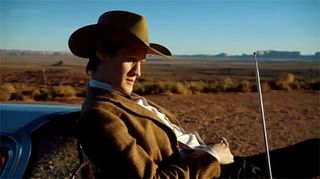
 So the new season of Doctor Who has premiered (in fact, with the release of the third episode this weekend, we're about a quarter of the way through the 13-episode series), and here are a few thoughts:
1) Steven Moffat (the current show-runner and author of five of this season's episodes) continues to impress with his darker, suspense-oriented plots. His new villains–The Silence–are worthy of his old villains, which include the Weeping Angels and the Vashta Nerada (the flesh-eating shadows from Silence in the Library and Forest of the Dead). Moffat is good at delivering creepy villains and compelling horror out of things you wouldn't think could be scary. (An immobile statue of an angel? How can that be scary?)
2) The creep factor on the show has, in general, been really good so far. Not only are The Silence creepy, but the countermeasures used against them and the way they are introduced (e.g., marks on the flesh) are creepy. Many of the creepy elements in Moffat's tenure on the series work a kind of intimate or claustrophobic angle on fear. A statue that can move when you aren't looking at it. You can't let your shadow touch anyone else's or it may get infected with a monster that will consume your flesh. Monsters you forget as soon as you turn away from them. If anyone gets the tiniest knick on their skin, they're doomed to madness and death. This is fear being generated on the small scale, though our own knowledge of how easily we could slip up in such situations. This fear via the intimate and by implication–rather than big explosions, special effects, etc.–is impressive.
3) Moffat has also made time travel far more central to the show than it has ever been before–which is quite a statement since this is a time travel show! Up to now most episodes involved the Doctor landing in a particular time and wrapping up some mystery there before moving on. The time travel was just a way to get us from one setting to another. Moffat has made things vastly richer and multi-layered with the time travel. This emerged very clearly in the 5th season, coming to a head with the mind-bending two-part finale, and it's right here in the 6th season as well, with the two-part opener that portends ominous things about the Doctor's future (and River Song's past).
4) Moffatt's strong character arcs are noteworthy. The complex interplay between the Doctor, Amy, Rory, and River at the different stages of their respective journies is satisfying, and way beyond anything attempted on the show before. Some prior companions have been very memorable (Sarah Jane Smith, Leetah, Rose Tyler, Donna Noble, etc.), and there have been notable character arcs before (Adric, Turlough, Rose, Donna), but nothing like what's going on between the Doctor, Amy, Rory, and River has happened before.
5) Speaking of Rory, it's nice to have him aboard. He's earned his place on the TARDIS. His presence adds a great deal of emotional oomph to the show as he is essentially the everyman, the low character on the exoticness totem pole, and so we understand his reactions on an emotional level that relates more directly to us as audience members.
6) It's still cool, though, to have the mysterious Amy Pond (about whom much yet must be explained) and River Song (who is always a bundle of fun–and provides moments of intense poignancy, as when she realizes that the Doctor's first kiss of her will be the last time she ever kisses him).
7) Matt Smith's portrayal of the comic, frenetic 11th Doctor is pleasing. When I first learned that Matt Smith had been cast as the Doctor I was *profoundly* skeptical–as were many–but as soon as I saw him in action, I realized he was totally fine for the part. At this point, he's delivering one of my more favorite portrayals.
8) Whe the season has all the above going for it, I–of course–do *not* approve of the objectionable moral content that is part of the U.K. fascisto-politically correct regime for children's television (and society at large)–e.g., the final scene between Shepard and Nixon right at the end of Day of the Moon. At least Moffat seems to be less intrusive about this stuff than his predecessor, Russell T. Davies. It's still mighty annoying, even if it is only present in a few throwaway lines.
9) The location shooting in the American Southwest for episodes 1-2 of the season wasn't really payed off in any way. It's pretty scenery, but there isn't much of a reason for it. Perhaps this is more impressive to British viewers, for whom this may have more "wow" factor than for Americans. It would have been better if the scenery had played more of a role in the plot rather than just being window dressing.
10) Also on a down note, the most recent episode–#3, Curse of the Black Spot–had some really huge plot holes. There were multiple parts where I wished I could punch up and fix the script. Some things in it were extremely effective (e.g., don't get cut or you'll die; be careful of everything you touch). Nice close, initimate horror. But there were also massive leaps of logic and plausibility that severely marred the episode. My current thought is that it's the weakest episode since Steven Moffat took over the series.
11) Fortunately, next week's episode is by Neil Gaiman, so it's likely to be really cool!
12) P.S. Stetsons are cool.

While I share your regard for Matt Smith’s DW, I am having difficulty letting go of his predecessor, David Tennant. Tennant was brilliant!
I miss David Tennant. But Moffat is _so_ much better than Davies that I consider the show to be, on balance, still much improved.
Sounds great, but not having the ability to watch, only makes me sad. I only wish there were ways to watch them online somewhere. Keep giving us updates though.
My favorite Doctor has and always will be Tom Baker. Sometimes I slip into the ‘Eldrad must live mode” from time to time. Along with “Message for you sir!”, but that’s a topic for another blog.
Have a great season!
Jimmy – like you, I am thoroughly enjoying season 6. Moffat’s scope for the show is rather expansive, as he’s pulling threads out of Season 5 and even some of the Tennant episodes (for instance, the ending of Day of the Moon hearkens to a Season 4 episode. I have my theory as to who the girl in the astronaut suit is, but I’m keeping it to myself for the time being).
Yeah, Curse of the Black Spot was weak – lots of running fore and aft, which I can understand being that the setting was limiting and claustrophobic to begin with, stuck on a pirate ship. Next week’s episode is intriguing.
And who is the eye-patch woman looking through the disappearing viewing hatch? She’s shown up in episodes 2 and 3 now. Verrrrry creepy.
I’m hanging on thru the season to see how Moffat ties all the strings together.
I could do without the innuendo as well. If Moffat keeps Captain Jack off the show, that will be a huge improvement.
p.s. Bring back the fez!
I agree with you on this season. I’ve only seen a couple of episodes and they were really good. But, you’re right, it’s almost as if they have to push a homosexual agenda. Either that or the writers are homosexuals who fantasize that tough American men are all gay. Less obvious but still annoying are the various other references to sexual immorality–which are there for no other reason than the writers’ personal agendas.
This definitely is not a children’s show, anymore. Still, a few small edits here and there (if I wanted to take the time to do it) and I wouldn’t mind sharing the show with my son.
I started watching Dr. Who in the Tom Baker years and then continued through Peter Davison. Then, I lost track until the 1996 movie. However, watching “The Curse of Fenric” from the Sylvester McCoy years on DVD, I think the moral devolution began with his episodes.
Stetsons are cool!
On a sad note, for those who haven’t heard, Elisabeth Salden, who played Sarah Jane Smith, died on April 19. She was 63 years old. She died of cancer. She was married only oncto and for at least thirty years ( if I recall, correctly). She was the bridge between the early era and the new era. Kids, today will only see the new era, which, if more sophisticated, is also more morally ambiguous. She will be sorely missed. She was a treasure.
The Chicken
Should read:
She was married only once and for at least thirty years ( if I recall, correctly).
In a profession laced with throw-away marriages, this is a good witness.
The Chicken
There was a spin off called “The Sarah Jane Chronicles” that was much more child friendly morally, though still a little scarey and enjoyable for Dr Who fans, too. Salden will be missed.
I think you may mean the Sarah Jane Adventures.
The Sarah Connor Chronicles weren’t quite as kid friendly. 🙂
Could have overlooked the gay “marriage” jab at the US but the more insidious refernce to Amy Pond having an abortion, of the Doctor’s child, is more damaging to the franchise. Especially with the Doctor falshing scans of positive / negative images of Amy that the TARDIS took. Very very disapointing,
I have never watched this show although I am a Sci-Fan fan..I would love to her your thoughts on the season finale of Fringe though! I think I will DVR Dr. Who and see what it is all about!
Great summary, covers most of my thoughts on series 6 too (minus the eye-patch lady, which can I say, is just brilliant! Can’t wait to find out what her role is)
Glad to see another fan out there!
Pochucknorth: I think there may have been a misunderstanding. I didn’t get any implication that Amy had had an abortion or that it was the Doctor’s baby. She was worried that her prior travels in the TARDIS would possibly cause birth defects (two heads, a “time” head) in her and *Rory’s* child.
She was thus relieved to find out (she thought) that she’s not pregnant so she doesn’t have to worry about that. The situation is more complex, however, in that the Doctor’s medical scans alternately show that she is and is not pregnant.
This implies that she *is* pregnant but something strange is happening with the baby, just as she feared.
That’s may be what the eye-patch lady is connected with: Some kind of medical care being given to Amy across time to help her through the difficult pregnancy.
There is also a significant chance that Amy is the mother of the little girl in the space suit and that it was Amy’s travels in the TARDIS that resulted in the child apparently having some form of the timelord ability to regenerate.
There is also a significant chance that Amy is the mother of the little girl in the space suit and that it was Amy’s travels in the TARDIS that resulted in the child apparently having some form of the timelord ability to regenerate.
I’m still holding on to a different theory on the identity of the little girl. Given that Steven Moffat made a crucial decision regarding a past character in one of David Tennant’s episodes from the 4th season leads me to believe that she is…well, I don’t want to ruin it for anybody else, so I’ll just leave it at that! 🙂
W. Ferguson, my Dad has been editing the show in that fashion so we can all watch it together as a family. Except the five-year-old because it’s too scary for her.
Jesus told a parable about someone like this – the Prodigal Son. I trust Jesus. And I trust that when I die, and when God meets me and walks with me through my life, and helps me to see my life through God’s eyes, through the eyes of love; and when my defences are stripped away and I am left without excuses, I trust something will move in me, will cause me to turn to the only one to whom I can turn for healing, and forgiveness and welcome when none of these are deserved nor can be expected.
And I trust that I will be greeted just as the terrorist was on that day so long ago – by a loving Father, who says to his disgruntled older son, “Why are you upset. For this my child was lost and now is found. Was dead, and now is alive.” And God will invite me in to a marvellous feast in my honour. And there – and I don’t know God does this – will be the souls of all those who died that day – including the terrorists – rejoicing and praising God. For there is no hate in heaven. Only love. God’s love.
Okay, first off, Moffat didn’t write the black spot episode.Second. I disagree about Moffats story archs being fantastc. In the first season, the crack in the wall was exellent. But here in the 6th series, we are faced with the mystical woman behind the sliding window. It’s the exact same Idea. Something we don’t know much about popping up randomly during the series.
I do like the Silence. But the Weeping Angels are still the best.
I didn’t like the first episode that much. Well, I liked it, I think Moffat tried to put too much stuff into the first episode, then after that nothing really seemed to get resolved. I felt like I needed to re-watch the first two episodes (And I have a friend who did) several times because there wasn’t a lot of diolauge to explain what was going on. Which is something that T. Davies was good at. David Tennant always had some long rambling speech explaining the timy -wimey stuff he was going to do next.
That said, I am REALLY looking foward to these next few episodes when we find out more about River!!! (whoot whoot!)
Jimmy,
Bow ties are Cool!
Not only you are an impressive theologian and apologist, you are a Doctor Who Fan!!! That just made you my favorite Catholic Answer personality of all time overtaking Patric and Tim by a long mile!
Go Jimmy and God Bless You!!!
Thoughts on the Neil Gaiman-penned episode, Jimmy?
Caleb: Thanks! In addition to fezzes, Stetsons, and bow ties, *bolo*-ties are cool, too! (I have an sizable, collection.)
Deadstop: What a coincidence! I blogged on that just before I saw your comment!